
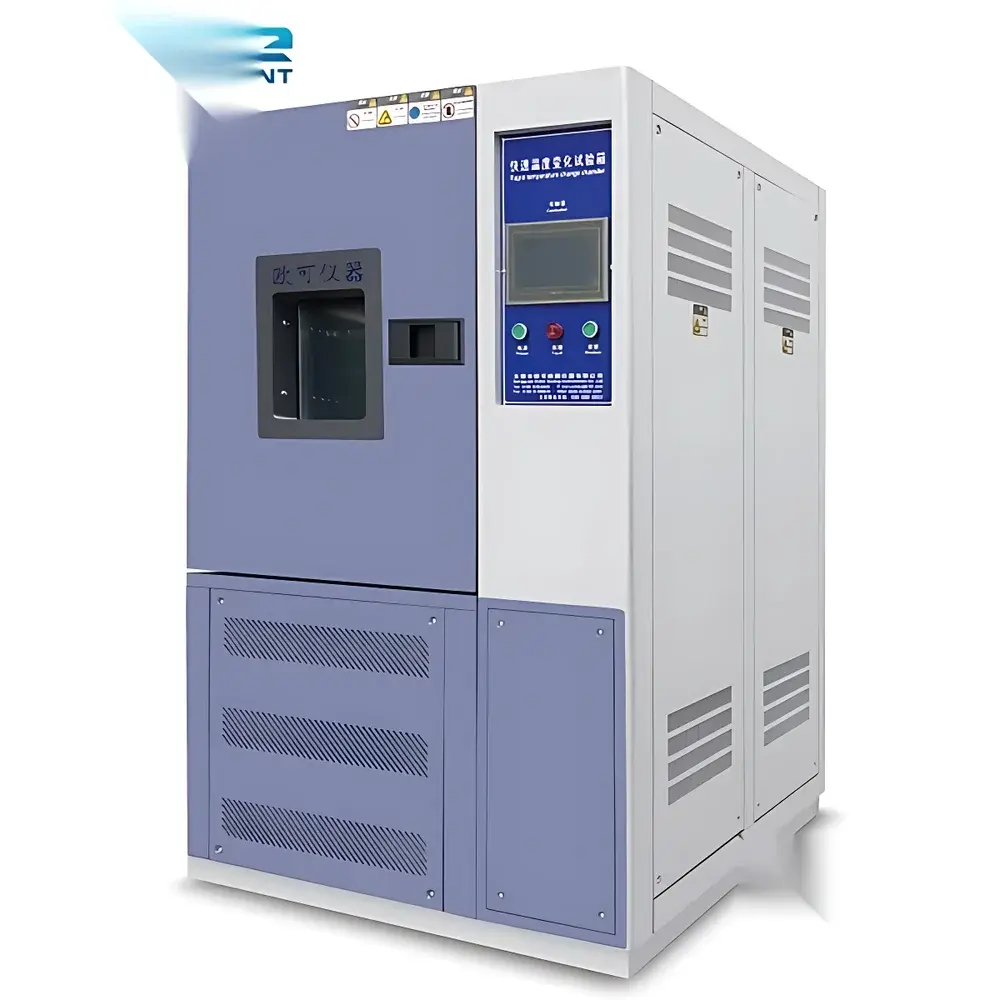
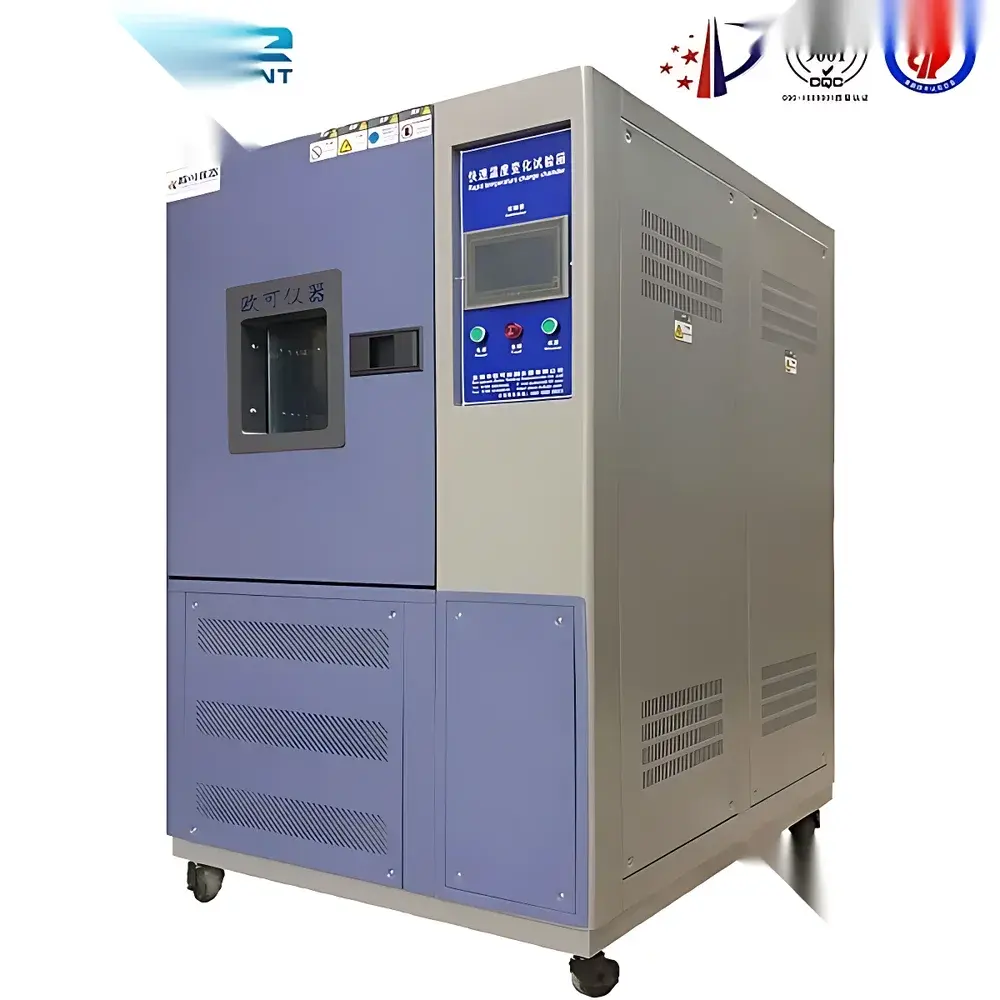
Engine Rapid Temperature Transition Chamber Manufacturer
| Brand | Other Brands |
|---|---|
| Origin | Imported |
| Manufacturer Type | General Distributor |
| Price | USD 5,200 (approx.) |
| Internal Dimensions (W×H×D) | 500×600×500 mm to 1000×1000×1000 mm |
| Temperature Range | −70 °C to +150 °C |
| Humidity Range (optional) | 20–98% RH |
| Rapid Transition Range | −45 °C to +85 °C |
| Transition Rate Options | 5–30 °C/min (linear or non-linear mode selectable) |
| Temperature Uniformity | ±2.0 °C |
| Humidity Uniformity | ±3.0% RH |
| Temperature Control Accuracy | ±0.5 °C |
| Humidity Control Accuracy | ±2.5% RH |
| Temperature Resolution | 0.1 °C |
| Humidity Resolution | 0.1% RH |
| Cooling System | Water-cooled |
| Compressor | Tecumseh (France) or Bitzer (Germany) |
| Power Supply | AC 380 V, 3-phase 5-wire, 50/60 Hz |
| Weight | 950–2300 kg |
| Construction | Inner chamber – SUS304 stainless steel |
| Insulation | High-density polyurethane foam (CFC-free) |
Overview
The Engine Rapid Temperature Transition Chamber is an environmental simulation system engineered for accelerated thermal stress testing of internal combustion engines, engine subassemblies (e.g., cylinder heads, ECU housings, turbochargers), and powertrain components under rigorously controlled, dynamically varying temperature conditions. It operates on a dual-mode thermal control principle—combining high-capacity refrigeration circuits with precision electric heating elements and multi-vane centrifugal air circulation—to achieve repeatable, programmable ramp rates from 5 °C/min up to 30 °C/min across the full operational range (−70 °C to +150 °C). The chamber’s architecture supports both linear and non-linear transition profiles, enabling compliance with automotive reliability standards such as ISO 16750-4 (road vehicles — environmental conditions and testing for electrical and electronic equipment), SAE J2334 (corrosion lab test), and GMW14872 (thermal shock endurance). Its water-cooled condensing system ensures stable performance during extended high-rate cycling, critical for validating thermal fatigue resistance in aluminum die-cast and composite engine parts.
Key Features
- Multi-stage refrigeration circuit with optional dual-loop design (single or two-stage cascade) for extended low-temperature capability down to −70 °C
- High-efficiency centrifugal blower system with multi-wing impeller and balanced air ducting—ensuring ≥90% spatial temperature uniformity (per IEC 60068-3-5) across all chamber volumes
- Intelligent PID + fuzzy logic controller with auto-tuning algorithm, enabling real-time compensation for thermal load shifts and minimizing overshoot during rapid transitions
- Programmable transition rate selection (A–F models: 5, 10, 15, 20, 25, or 30 °C/min), with user-selectable linear or non-linear ramp modes
- Integrated safety architecture: compressor high/low pressure cutouts, phase failure & reverse-phase detection, overtemperature/overhumidity interlocks, leak current protection, and automatic fault-triggered shutdown with event logging
- RS-232 and RS-485 serial interfaces compliant with Modbus RTU protocol—enabling remote program upload, real-time parameter monitoring, and automated start/stop via host PC or SCADA systems
- Optional humidity control module (20–98% RH) with steam humidifier and solid-state dehumidification bypass, designed for combined temperature-humidity stress profiles per MIL-STD-810H Method 502.7
Sample Compatibility & Compliance
The chamber accommodates engine blocks, intake manifolds, exhaust manifolds, fuel injectors, and electronic control units—up to 1000 L internal volume—with standardized mounting fixtures and optional through-wall access ports (glove-compatible or sealed feedthroughs). All standard configurations meet CE marking requirements under the EU Machinery Directive 2006/42/EC and Electromagnetic Compatibility Directive 2014/30/EU. Optional validation packages include IQ/OQ documentation templates aligned with ISO/IEC 17025 and ASTM E2582-22 (standard practice for qualification of environmental chambers). Humidity-equipped variants support calibration traceability to NIST-traceable hygrometers and comply with ISO 17025-accredited laboratory humidity uncertainty budgets (< ±1.5% RH at 23 °C/50% RH).
Software & Data Management
The embedded controller provides on-screen real-time trend graphs for temperature, humidity (if installed), and setpoint tracking—displayed as time-series plots with zoom, pan, and cursor readout functions. Optional PC-based software (Windows 10/11 compatible) enables full test sequence design—including multi-step ramps, dwells, and cyclic profiles—with drag-and-drop logic, conditional branching, and pass/fail limit definition. Data export is supported in CSV and XML formats; audit trails record operator ID, timestamp, parameter changes, and alarm events—meeting FDA 21 CFR Part 11 requirements when paired with electronic signature modules. Historical data storage capacity exceeds 10 million points per test cycle, with automatic rollover and SD card backup (optional).
Applications
- Thermal shock validation of cast aluminum engine blocks per Ford WSS-M99P1111-A2 and VW TL 226
- Accelerated life testing of engine control unit (ECU) enclosures under repeated −40 °C ↔ +125 °C cycles
- Material compatibility screening for gasket compounds, seals, and thermal interface materials (TIMs)
- Pre-certification testing for EV power electronics housings exposed to under-hood thermal transients
- Reliability assessment of turbocharger actuators and variable valve timing (VVT) solenoids
- Development-stage verification of coolant pump housings and oil filter modules
FAQ
What is the maximum allowable test specimen weight for the KS-TH-1000-F model?
The chamber is rated for static loads up to 150 kg distributed evenly on the floor plate; dynamic load limits depend on fixture rigidity and must be validated per ASTM E1828-18.
Can the chamber operate continuously at −70 °C while maintaining 30 °C/min ramp rates?
No—maximum ramp rate is specified within the −45 °C to +85 °C envelope. Full-range ramping (e.g., −70 °C → +150 °C) follows segmented profiles optimized for system longevity and thermal stability.
Is third-party calibration certification included with delivery?
Factory calibration certificates (traceable to national standards) are provided; ISO/IEC 17025-accredited on-site calibration is available as a value-added service.
Does the system support integration with existing MES or PLM platforms?
Yes—via OPC UA or Modbus TCP gateways (optional hardware), enabling bidirectional data exchange with Siemens Opcenter, PTC Windchill, or SAP QM modules.
What maintenance intervals are recommended for the refrigeration system?
Compressor oil and filter dryer replacement every 12 months or 4,000 operating hours; annual leak check and refrigerant charge verification per ASHRAE Standard 15.



