
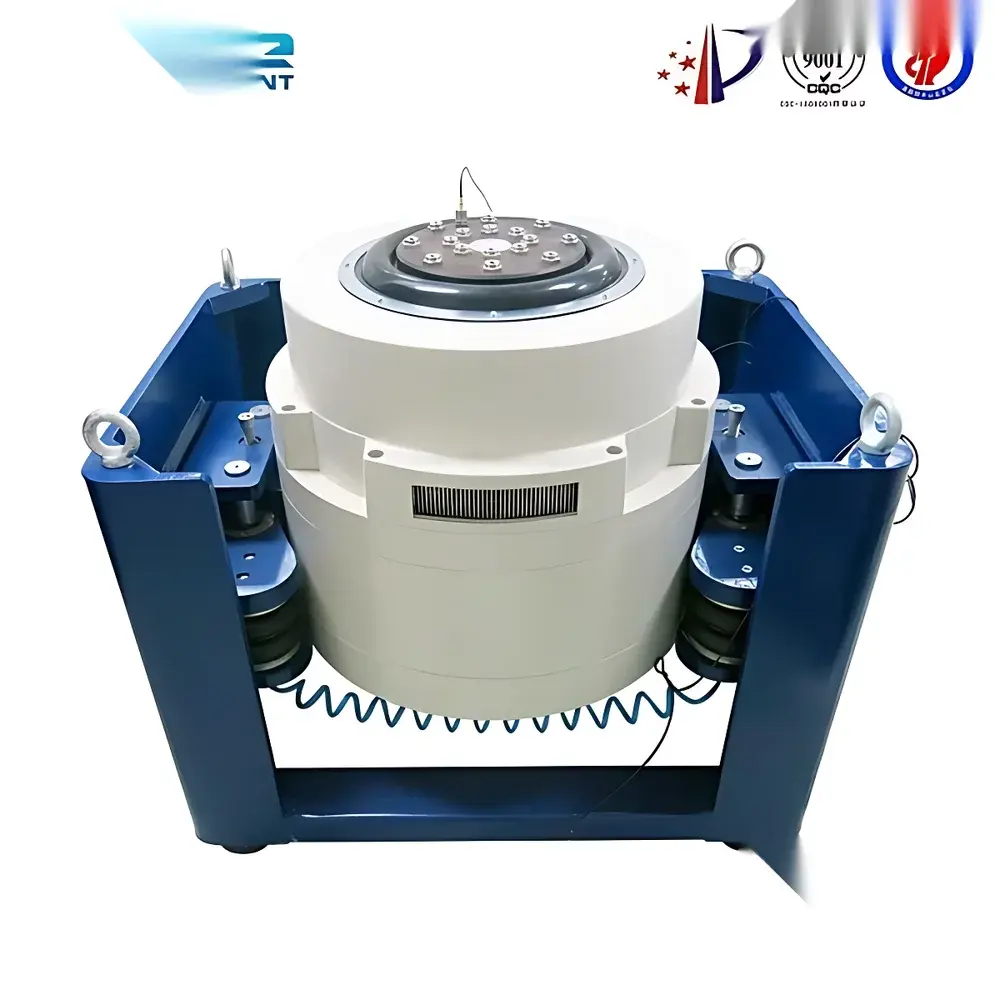
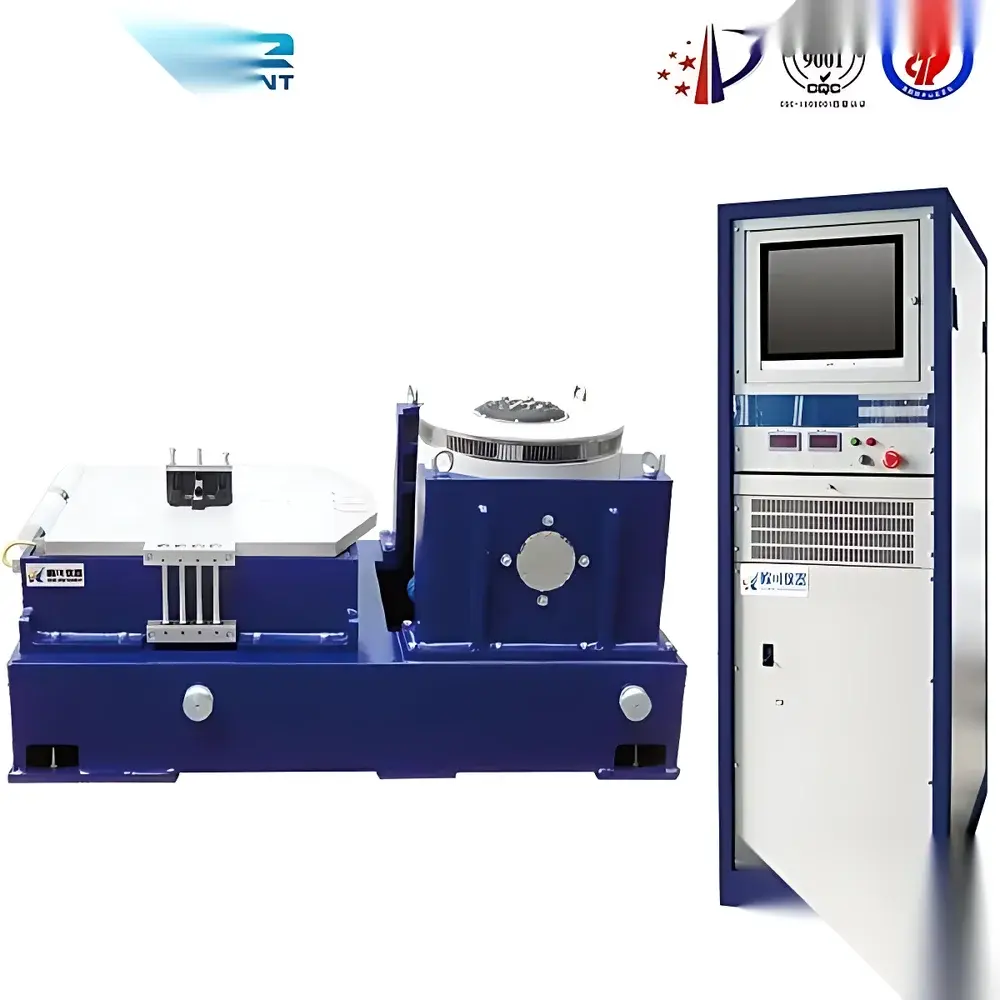
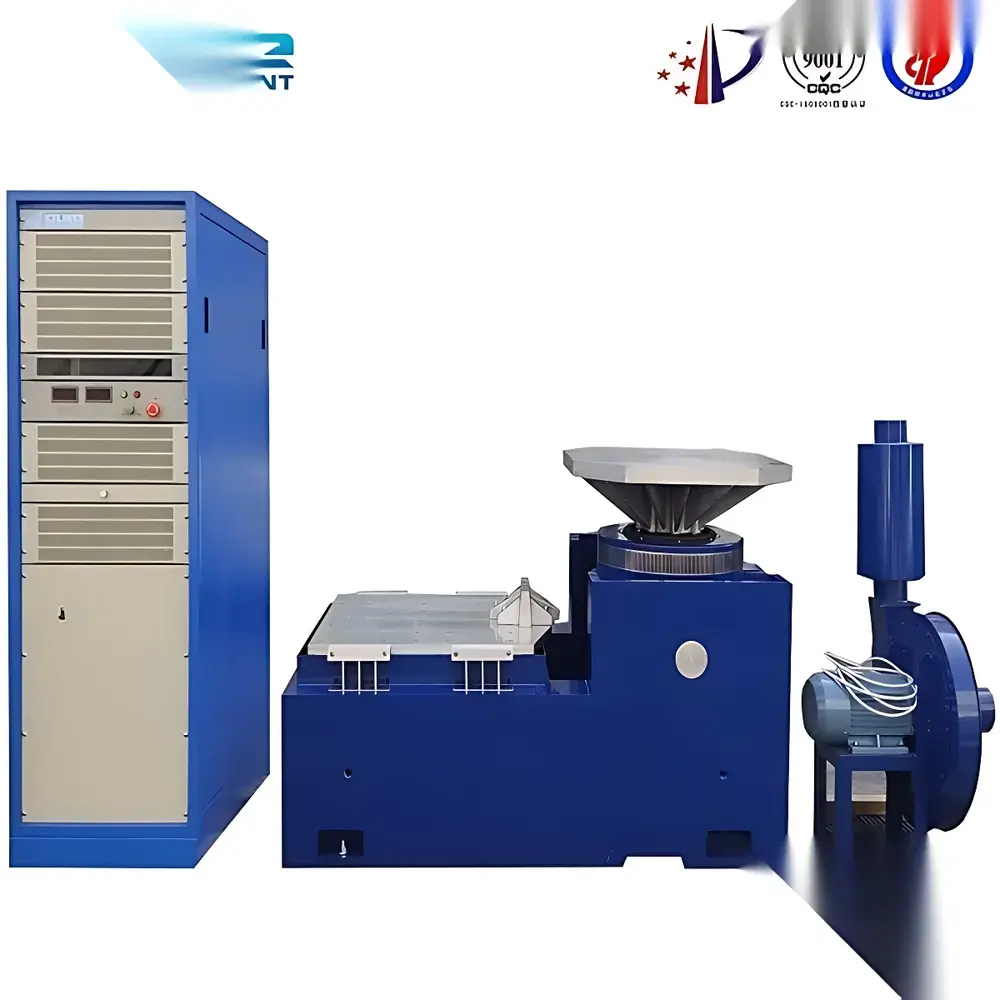
Engine Vibration Test System OK-ES-10 | Electromagnetic Shaker-Based Triaxial Vibration Testing Machine
| Brand | Other Brands |
|---|---|
| Origin | Imported |
| Manufacturer Type | Authorized Distributor |
| Price | USD 21,000 (FOB) |
| Max Acceleration | 20 g (peak) |
| Frequency Range | 5–3000 Hz (dependent on payload & amplitude constraints) |
| Displacement (p-p) | ≤5 mm (at low frequencies), down to 1 mm at 100 Hz |
| Velocity Range | 150–300 rpm equivalent (rotational input reference only |
| Load Capacity | 50 kg |
| Effective Table Area | 1.0 m × 1.0 m |
| Control Interface | Analog + Digital I/O, IEEE-488 (GPIB) compatible |
| Compliance | EN 60068-2-6, EN 60068-2-64, ANSI S2.18, ASTM D999, ISTA 3A/3E/3H, UL 746C, MIL-STD-810H Method 514.8 |
Overview
The OK-ES-10 Engine Vibration Test System is a high-performance electromagnetic shaker-based triaxial vibration testing machine engineered for rigorous mechanical stress evaluation of propulsion systems, powertrain components, and mission-critical assemblies. Unlike rotary or servo-hydraulic exciters, this system employs a dual-magnetic-circuit actuator architecture with self-supporting voice-coil armature and pneumatic suspension—enabling high-fidelity reproduction of sinusoidal, broadband random, classical shock (half-sine, trapezoidal, terminal-peak sawtooth), and Shock Response Spectrum (SRS) profiles per MIL-STD-810H Method 514.8 and ISO 10326-1. Its structural design integrates linear bearings and roller guidance to minimize off-axis motion, while ear-axis isolation decouples base reaction forces—ensuring measurement integrity during high-g, multi-degree-of-freedom excitation. The system is not a rotating engine dynamometer; rather, it simulates real-world vibratory environments encountered by engines during ground testing, airborne operation, or transportation—making it essential for qualification under defense, aerospace, and industrial equipment certification protocols.
Key Features
- Dual magnetic circuit actuator delivering peak acceleration up to 20 g (196 m/s²) with <±1.5% linearity across 5–3000 Hz bandwidth (derated per payload and displacement limits)
- Pneumatic suspension and air-bearing-supported moving mass ensuring minimal parasitic resonance and thermal drift
- Self-generating skeleton-type armature eliminating external coil formers—enhancing dynamic stiffness and thermal dissipation
- Triaxial capability via sequential or synchronized single-axis excitation (X/Y/Z); optional triaxial controller upgrade supports simultaneous 3DOF control per ISO 10816-3
- Programmable test duration from 0 seconds to 99 hours with microsecond-level timestamp resolution for event-triggered logging
- DC speed-controlled 1 HP drive amplifier with analog voltage input (±10 V) and digital command interface (GPIB/RS-232)
- 1.0 m × 1.0 m rigid aluminum table with M10 threaded mounting array (100 mm pitch), optimized for modal mass distribution up to 50 kg
- Real-time amplitude/acceleration interlock logic enforcing ISO 5344 displacement ceiling: Dp-p = 20 / (0.002 × f²) mm (f in Hz), preventing mechanical overstroke
Sample Compatibility & Compliance
The OK-ES-10 accommodates full-scale engine subassemblies—including cylinder heads, turbochargers, ECU housings, fuel injection rails, and aftertreatment modules—provided center-of-gravity alignment remains within ±25 mm of table centroid and moment loading stays below 120 N·m. Mounting fixtures must comply with ISO 10816-3 fixture transmissibility limits (<1.2 above 100 Hz). The system meets electromagnetic compatibility requirements per EN 61326-1 and is pre-validated against environmental stress screening (ESS) protocols defined in GEIA-STD-0004 and NASA-HDBK-7005. It supports full audit trail generation for GLP/GMP-aligned laboratories, including user authentication logs, calibration certificate traceability (NIST-traceable accelerometer verification), and test parameter versioning—fully compliant with FDA 21 CFR Part 11 electronic record requirements when paired with validated control software.
Software & Data Management
Control and analysis are performed via vendor-supplied Vibration Test Executive (VTE) software v4.2, compatible with Windows 10/11 (64-bit). VTE implements closed-loop feedback using IEPE accelerometers and laser Doppler vibrometer inputs, supporting real-time FFT (up to 8192 lines), PSD estimation (per IEEE 1003.1), and SRS synthesis using the ramp-invariant method. All test sequences—including mixed-mode profiles combining sine dwell, random dwell, and transient shocks—are stored as XML-based .vts files with SHA-256 checksums. Raw time-history data is saved in ASAM MDF 4.1 format, enabling interoperability with MATLAB, Python (via asammdf library), and NI DIAdem. Audit logs include operator ID, system configuration hash, sensor calibration expiry, and environmental chamber status (if climate integration option is installed).
Applications
- Qualification of aircraft auxiliary power units (APUs) per DO-160 Section 8 (Vibration)
- Transportation simulation of automotive diesel engines per ISTA 3E (Motor Freight) and ASTM D4169 Cycle C
- Shock survivability validation of missile guidance electronics under MIL-STD-810H Method 516.7
- Resonance search and mode shape identification for ICE intake manifolds using swept-sine excitation
- Combined environment testing (vibration + temperature/humidity) when integrated with an IEC 60068-2-14 compliant climatic chamber
- Production-line screening of EV inverter housings for solder joint fatigue per IPC-9701A
FAQ
What is the maximum allowable payload for full 20 g performance?
At 20 g peak, the rated 50 kg load assumes uniform mass distribution and center-of-gravity offset ≤±15 mm. Derating applies beyond 1000 Hz; consult the system’s dynamic load envelope chart in Section 3.2 of the Installation & Operation Manual.
Does the system support real-time SRS synthesis during random vibration tests?
Yes—VTE v4.2 enables online SRS calculation from live acceleration data using tri-logarithmic frequency spacing (1/12 octave) and shock response filters per MIL-STD-810H Annex G.
Can third-party control software (e.g., Vibration Research VR9500) interface with the OK-ES-10?
The shaker amplifier provides standard analog ±10 V command and feedback channels, plus GPIB SCPI commands for mode selection, start/stop, and limit monitoring—enabling integration with most commercial vibration controllers.
Is climate chamber integration available as a factory option?
Yes—the OK-ES-10 is mechanically and electrically pre-configured for seamless coupling with 1.2 m³ reach-in chambers meeting IEC 60068-3-5, including feedthroughs for signal, power, and cooling lines.
How often does the system require metrological recalibration?
Annual accelerometer sensitivity verification and force transducer linearity check are recommended; full system calibration (including table impedance mapping) is required every 24 months or after any major mechanical service event.



