
English Product Name
| Brand | OK |
|---|---|
| Model | OK-HQ-100 / OK-HQ-150 / OK-HQ-225 / OK-HQ-500 / OK-HQ-800 |
| Temperature Range | RT+10°C to 200°C or 300°C |
| Temperature Uniformity | ±2°C |
| Temperature Fluctuation | ±0.5°C |
| Air Exchange Rate | 2–100 cycles/hour |
| Adjustable Air Exchange Interval | 1 min – 99 h |
| Internal Chamber Dimensions (W×D×H, mm) | 450×450×500 to 800×1000×1000 |
| External Dimensions (W×D×H, mm) | 1100×830×1600 to 1450×1400×2100 |
| Power Rating | 4.0–9.0 kW |
| Turntable Diameter | Φ250–Φ700 mm |
| Controller | LED digital PID microcomputer controller with timer (1–9999 min) |
| Compliance | ASTM D5423-09 (Type II), ASTM D5374-93(2005), UL 1581, GB, VDE, JIS, IEC |
Overview
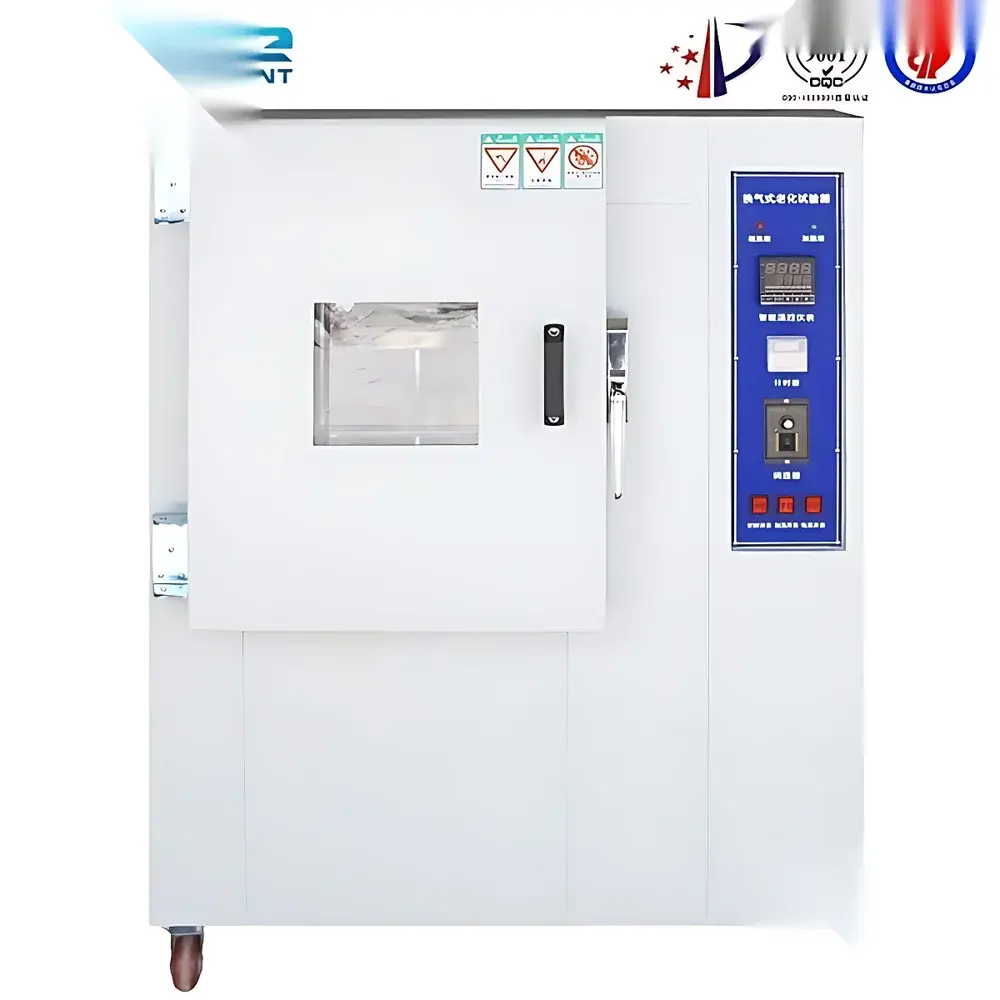
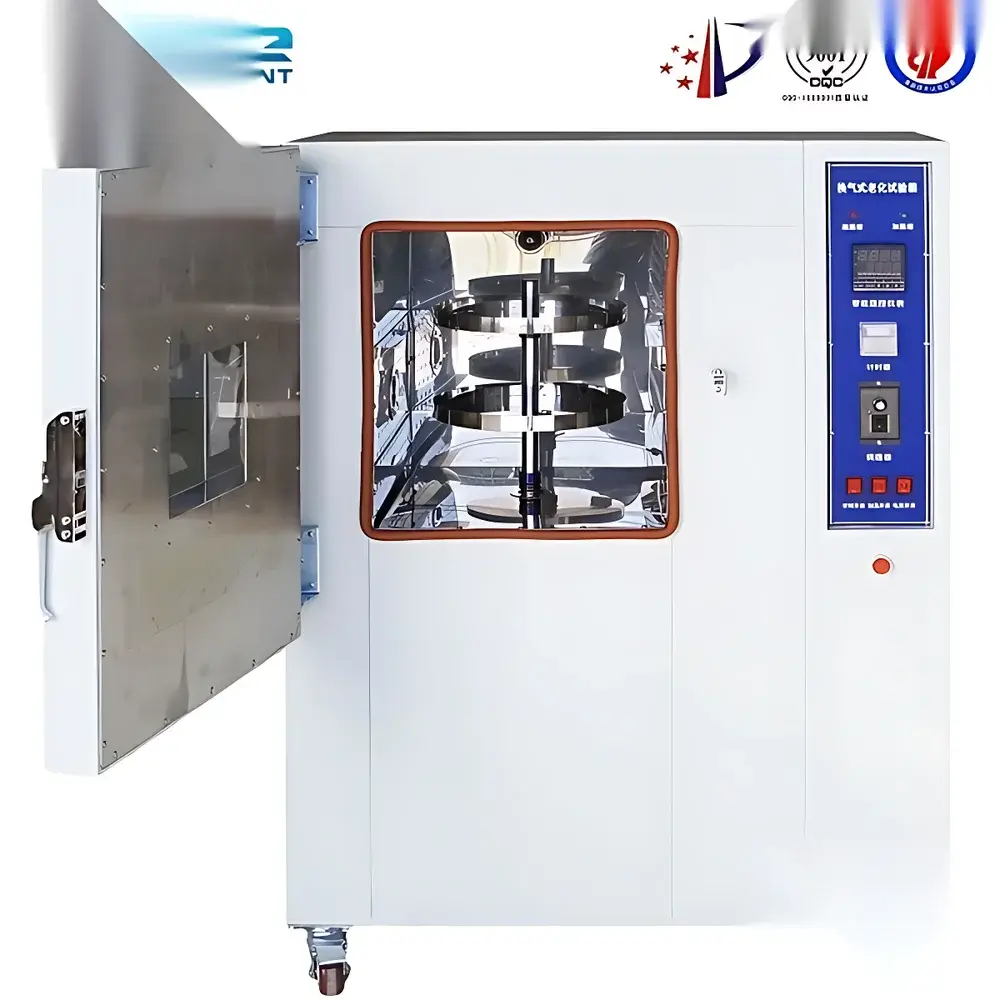
The OK-HQ Series Forced-Air High-Temperature Aging Test Chamber is an engineered environmental test system designed for accelerated thermal aging evaluation of polymeric and elastomeric materials under controlled air exchange conditions. Based on the principle of forced convection and regulated ventilation, it replicates long-term thermal degradation effects in a compressed timeframe by maintaining precise temperature stability while enabling programmable air renewal—critical for simulating real-world oxidative aging in wire insulation, rubber compounds, textile laminates, and plastic components. Unlike static oven environments, this chamber integrates a calibrated volumetric air exchange mechanism that complies with ASTM D5423-09 (Type II) requirements for laboratory forced-ventilation ovens used in electrical insulation testing. Its architecture supports both steady-state thermal exposure and dynamic aging protocols where oxygen replenishment rate directly influences oxidation kinetics—making it indispensable for R&D labs and quality assurance departments validating material lifetime predictions per ISO 2578, IEC 60216, and UL 1581 Clause 1060.
Key Features
- Precision-engineered air exchange regulation system with digital control over exchange frequency (2–100 cycles/hour) and interval timing (1 minute to 99 hours), enabling reproducible oxidative stress profiles.
- High-stability temperature control via PID-regulated microcomputer controller with ±0.5°C fluctuation and ±2°C uniformity across the working chamber—validated per IEC 60068-3-5.
- Horizontal forced-air circulation architecture with dual-side airflow baffles and high-temp-rated centrifugal blower ensures uniform thermal distribution without hot/cold zones.
- Chamber construction: Interior lined with polished SUS304 stainless steel (electropolished finish); exterior fabricated from A3 steel with electrostatic powder coating for corrosion resistance and cleanroom-compatible surface integrity.
- Integrated turntable (Φ250–Φ700 mm, model-dependent) for rotational sample exposure—minimizing positional bias during extended aging cycles.
- Energy-efficient thermal insulation using high-density ultra-fine glass fiber cotton (≥100 mm thickness), reducing standby heat loss and improving thermal inertia.
- Dual-access observation window with tempered glass and built-in LED lighting enables continuous visual monitoring without compromising chamber integrity.
- Standard 50 mm diameter test port on left side wall for external power/signal line feedthrough, compatible with data loggers and real-time sensor integration.
Sample Compatibility & Compliance
The OK-HQ series accommodates flat, cylindrical, and flexible specimens—including insulated wires, cable jackets, vulcanized rubber strips, synthetic leather panels, and nonwoven fabric layers—without requiring custom fixtures. Its internal geometry supports vertical hanging, horizontal placement, or rotation-mounted configurations. All models meet the structural, thermal, and airflow performance criteria specified in ASTM D5423-09 (Type II), ASTM D5374-93(2005), UL 1581 Section 1060, and national standards GB/T 2423.22, GB/T 11026, VDE 0472-811, JIS C 6471, and IEC 60811-2-1. The chamber’s air exchange calibration methodology aligns with GLP-compliant validation practices and supports audit-ready documentation for ISO/IEC 17025-accredited laboratories.
Software & Data Management
While the base configuration employs a standalone LED-PID controller with manual setpoint input, optional RS485/Modbus RTU interface enables integration into centralized lab management systems (LIMS) or SCADA platforms. Time-stamped temperature logs, cycle completion alerts, and alarm event records (e.g., overtemperature, fan failure, door open) are retained onboard for ≥30 days. When deployed in regulated environments, the system supports 21 CFR Part 11-compliant electronic record generation when paired with validated third-party data acquisition software—ensuring traceability, user authentication, and audit trail integrity required for FDA, CE, and TÜV assessments.
Applications
- Accelerated aging of PVC, PE, XLPE, and EPR insulation in automotive wiring harnesses and aerospace cables.
- Oxidative stability assessment of silicone rubber gaskets, EPDM seals, and nitrile elastomers per ASTM D573.
- Thermal endurance classification of textile composites and flame-retardant fabrics per IEC 60695-1-10.
- Pre-qualification screening of adhesives, encapsulants, and conformal coatings prior to HALT/HASS testing.
- Material selection support for high-reliability applications in energy storage systems, photovoltaic junction boxes, and EV battery modules.
FAQ
What standards does the OK-HQ chamber specifically comply with?
It meets ASTM D5423-09 (Type II forced-ventilation oven), ASTM D5374-93(2005), UL 1581 Clause 1060, GB/T 2423.22, VDE 0472-811, JIS C 6471, and IEC 60811-2-1 for thermal aging of insulating materials.
Can the air exchange rate be verified and recalibrated?
Yes—the chamber includes provisions for volumetric airflow measurement using calibrated anemometers or thermal mass flow sensors at the inlet/outlet ducts; calibration certificates are available upon request.
Is the turntable speed adjustable?
No—the turntable operates at fixed low RPM (≤6 rpm) optimized for uniform exposure without mechanical stress; speed is not user-variable but is consistent across all models.
Does the chamber support remote monitoring via Ethernet or Wi-Fi?
Not natively—but optional RS485-to-Ethernet gateways enable networked supervision when integrated with existing facility SCADA infrastructure.
What safety protections are built into the system?
Comprehensive safeguards include overtemperature cutoff (dual independent sensors), motor overheat protection, leakage current detection, short-circuit interruption, and phase-loss monitoring—fully documented in the CE-conformity declaration.



