
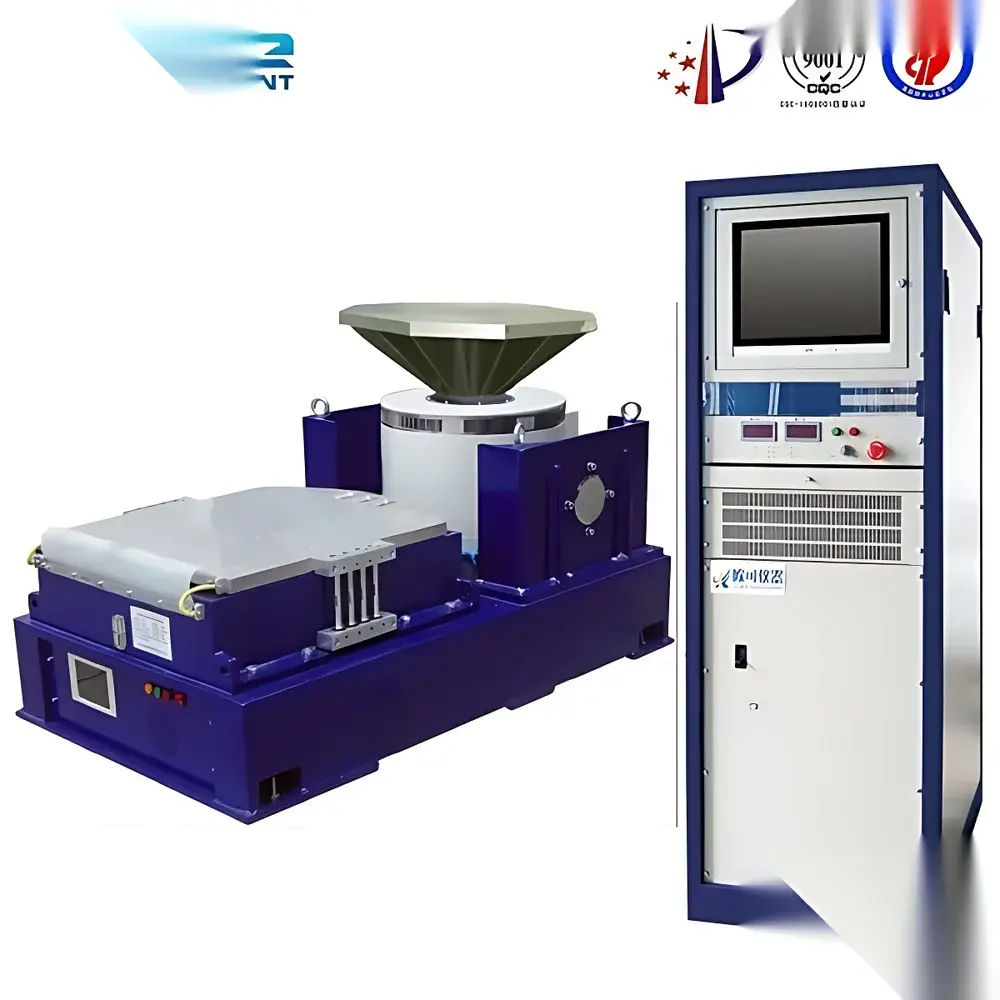
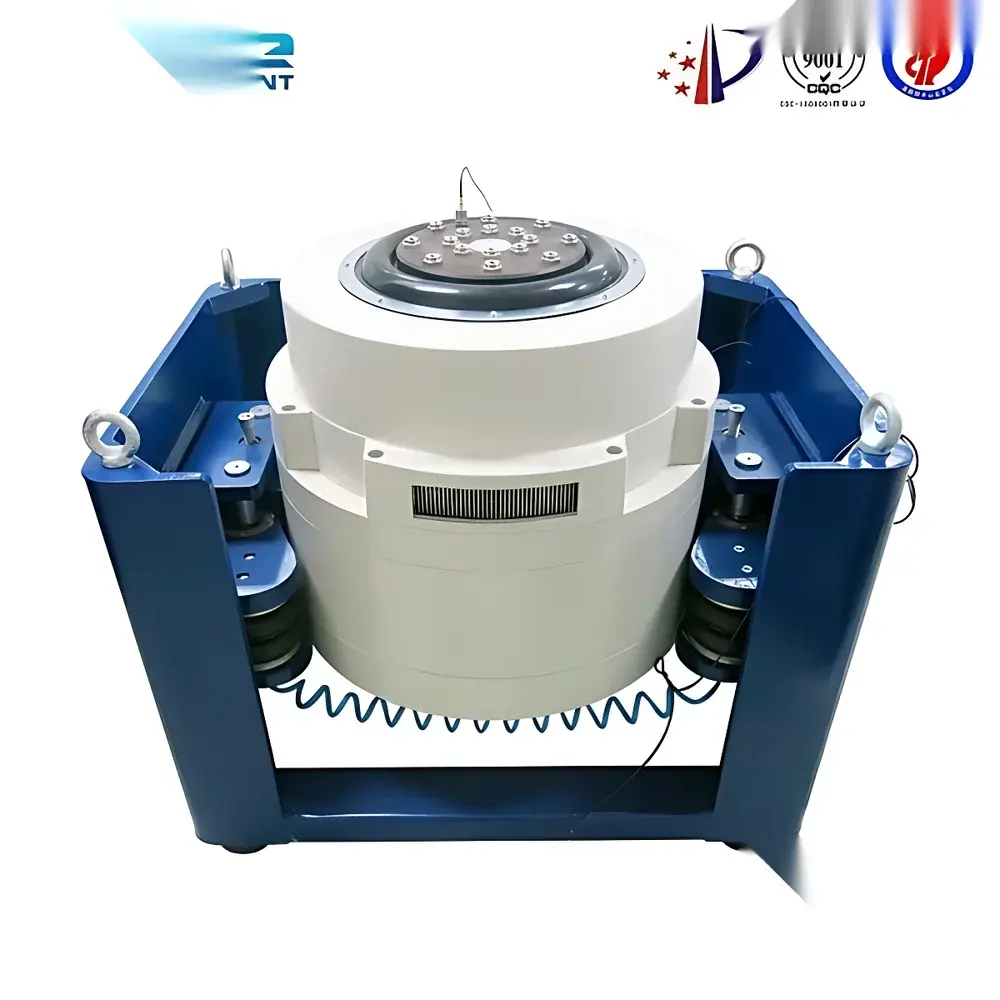
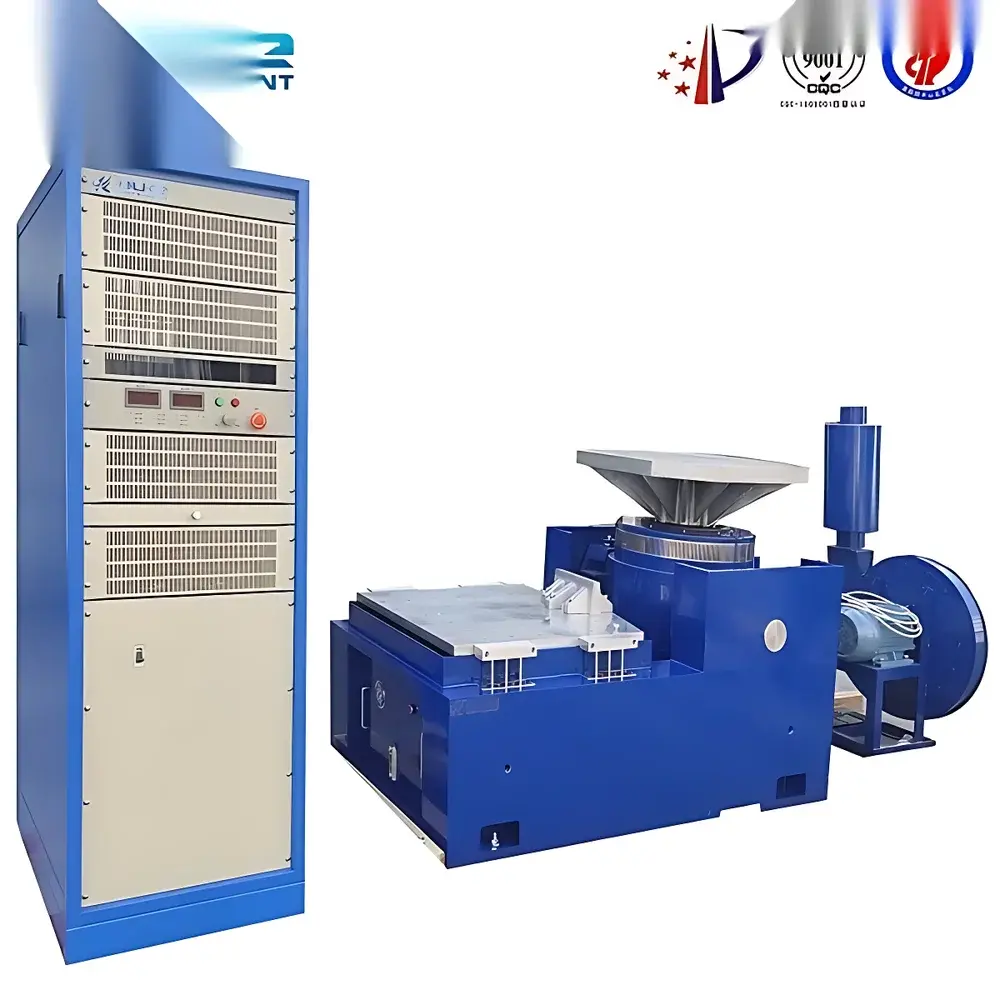
English Product Name
| Max. Load Capacity | 60 kg |
|---|---|
| Frequency Range (Manual/Scan) | 1–200 Hz |
| Table Surface Dimensions | 550 × 550 × 46 mm |
| Table Body Dimensions | 550 × 550 × 350 mm |
| Displacement Amplitude (Empty Load) | 0–5 mm |
| Vibration Direction | Vertical |
| Waveform | Sinusoidal |
| Power Supply | 220 V / 50 Hz ±2% |
| Rated Power Consumption | 1.7 kVA |
| Timer Range | 0.01 s – 99.99 h |
| Control Interface | Digital LCD with Real-Time Parameter Display |
| Sweep Programs | Up to 30 Segments |
| Compliance Standard | GB/T 2423.10 |
| Vibration Mode | Fixed-Frequency & Linear Sweep |
| Base Construction | Heavy-Duty Steel Frame with Vibration-Damping Rubber Mounts |
| Drive Mechanism | Electromagnetic Shaker with Four-Point Synchronous Excitation |
Overview
The ES-Series Unidirectional Electromagnetic Vibration Shaker System is a precision-engineered testing platform designed for sinusoidal vibration testing in laboratory and production environments. Based on electromagnetic excitation principles, it generates controlled vertical oscillatory motion to simulate real-world mechanical stress conditions—such as those encountered during transportation, operational use, or environmental exposure. Unlike hydraulic or electrodynamic shakers requiring complex infrastructure, this system delivers high reproducibility and stability within a compact footprint, making it suitable for R&D labs, QC departments, and small-to-midsize manufacturing facilities conducting early-failure detection, solder joint integrity verification (e.g., cold solder joints, voids), structural resonance analysis, and qualification-level environmental stress screening per IEC 60068-2-6 and GB/T 2423.10. Its unidirectional (Z-axis) configuration ensures focused energy transfer without cross-axis coupling, minimizing measurement uncertainty and enabling repeatable acceleration profiles across test specimens.
Key Features
- Digital PID-controlled frequency regulation with real-time synchronization of setpoint and actual values—enabling stable operation across the full 1–200 Hz range
- Four-point synchronous electromagnetic excitation architecture ensuring uniform amplitude distribution across the entire 550 × 550 mm test surface
- Stepless amplitude adjustment (0–5 mm peak-to-peak displacement under no-load conditions), supporting both fixed-frequency endurance tests and linear sweep profiles
- Integrated amplitude prediction algorithm and intuitive front-panel LCD interface for immediate parameter feedback—no external PC required for basic operation
- Heavy-gauge steel base frame with integrated anti-vibration rubber mounts; eliminates need for anchor bolts or reinforced concrete foundations
- EMI-hardened control circuitry with dedicated shielding and filtering to maintain signal integrity in electrically noisy industrial settings (e.g., near welding stations or motor drives)
- Support for up to 30 programmable sweep segments—including start/stop frequencies, dwell times, and rate-of-change specifications—for multi-stage fatigue simulation
Sample Compatibility & Compliance
The shaker accommodates payloads up to 60 kg, with compatibility extending to assembled electronic modules (PCBAs, enclosures, connectors), automotive components (sensors, actuators, infotainment units), consumer appliances (compressors, motors, housings), and aerospace subassemblies. Its mechanical design conforms to GB/T 2423.10 (equivalent to IEC 60068-2-6) for sinusoidal vibration testing. While not certified to ISO/IEC 17025 for accredited calibration, the system supports traceable verification via external laser vibrometer or accelerometer-based validation protocols. All firmware and control logic are designed to meet basic electromagnetic compatibility (EMC) requirements per CISPR 11 Group 1, Class B, ensuring safe co-location with sensitive instrumentation.
Software & Data Management
The embedded controller provides local data logging of time-stamped frequency, amplitude, and elapsed test duration. For advanced analysis, optional USB or RS-232 connectivity enables export of raw waveform data (ASCII format) to third-party platforms such as MATLAB, LabVIEW, or Python-based post-processing scripts. The system supports audit-ready operation under GLP-aligned workflows: all parameter changes are timestamped and stored in non-volatile memory, and user access levels can be configured via password-protected menus. Though not FDA 21 CFR Part 11 compliant out-of-the-box, the architecture permits integration into validated environments through documented IQ/OQ protocols and external electronic signature solutions.
Applications
- Early-life failure screening of printed circuit board assemblies (PCBAs) to detect latent defects including micro-cracks, solder bridging, and intermetallic compound instability
- Structural durability assessment of plastic enclosures, metal brackets, and mounting hardware subjected to resonant amplification
- Vibration-induced loosening evaluation of fasteners, connectors, and cable harnesses in automotive ECU modules
- Qualification testing of telecom base station components per Telcordia GR-63-CORE shock/vibration profiles
- Process validation of reflow soldering parameters by correlating thermal cycling with subsequent vibrational stress response
- Educational use in mechanical engineering laboratories for modal analysis fundamentals and resonance characterization
FAQ
What is the maximum payload capacity for reliable performance?
The system is rated for continuous operation at up to 60 kg on its 550 × 550 mm table surface. Load distribution must remain centered within ±15% of the geometric center to maintain amplitude uniformity and avoid mechanical overloading.
Can this shaker perform random vibration testing?
No—this model is optimized exclusively for sinusoidal waveforms (fixed frequency and linear sweep). Random vibration capability requires a separate electrodynamic shaker with broadband power amplifier and dedicated controller.
Is calibration documentation included with shipment?
A factory calibration report verifying frequency accuracy (±0.1 Hz), amplitude linearity (±3% FS), and timer resolution (0.01 s) is provided. Full ISO/IEC 17025 traceable calibration services are available upon request.
How is the vibration direction oriented relative to the table surface?
Vibration is strictly unidirectional along the vertical (Z) axis, perpendicular to the table plane. Lateral or rotational modes are mechanically suppressed by the four-point symmetric drive arrangement.
Does the system support remote monitoring or network integration?
Standard configuration includes local display only. Optional Ethernet or Modbus TCP add-on modules enable SCADA-level integration, subject to firmware version 2.3 or higher.



