
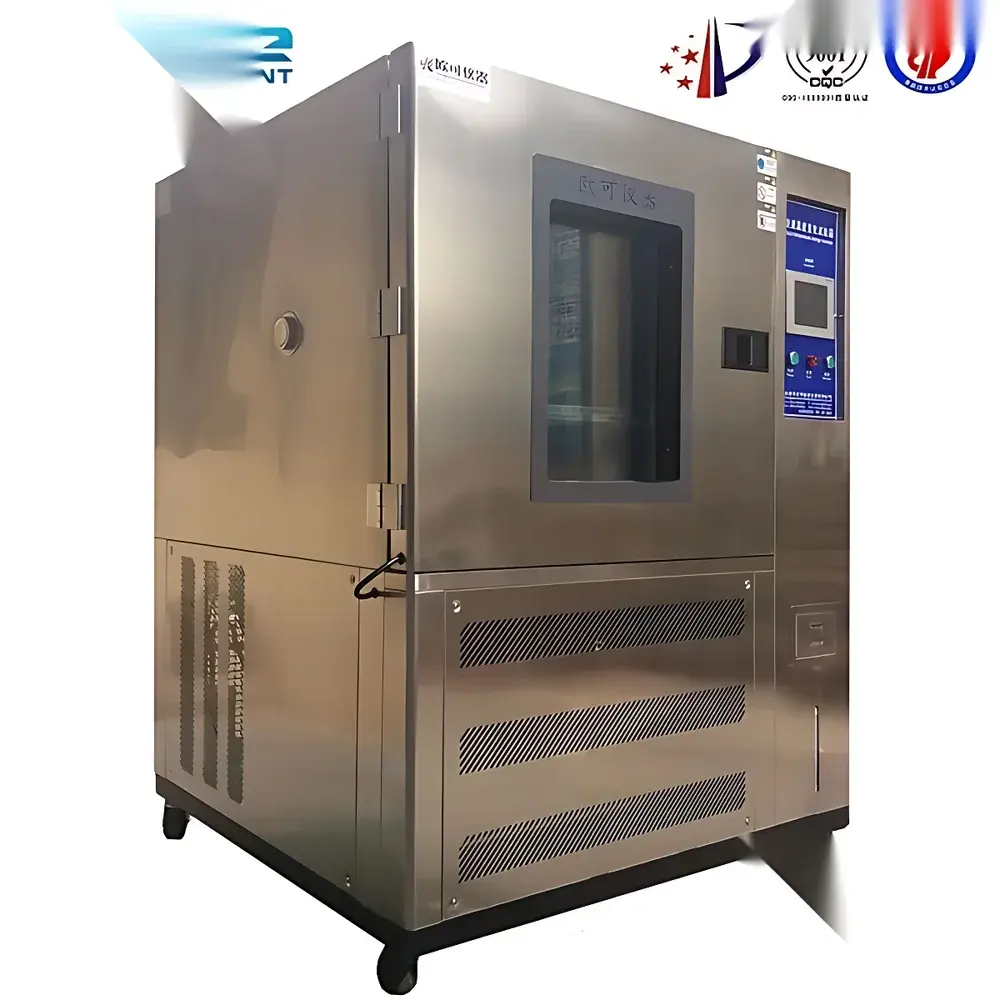
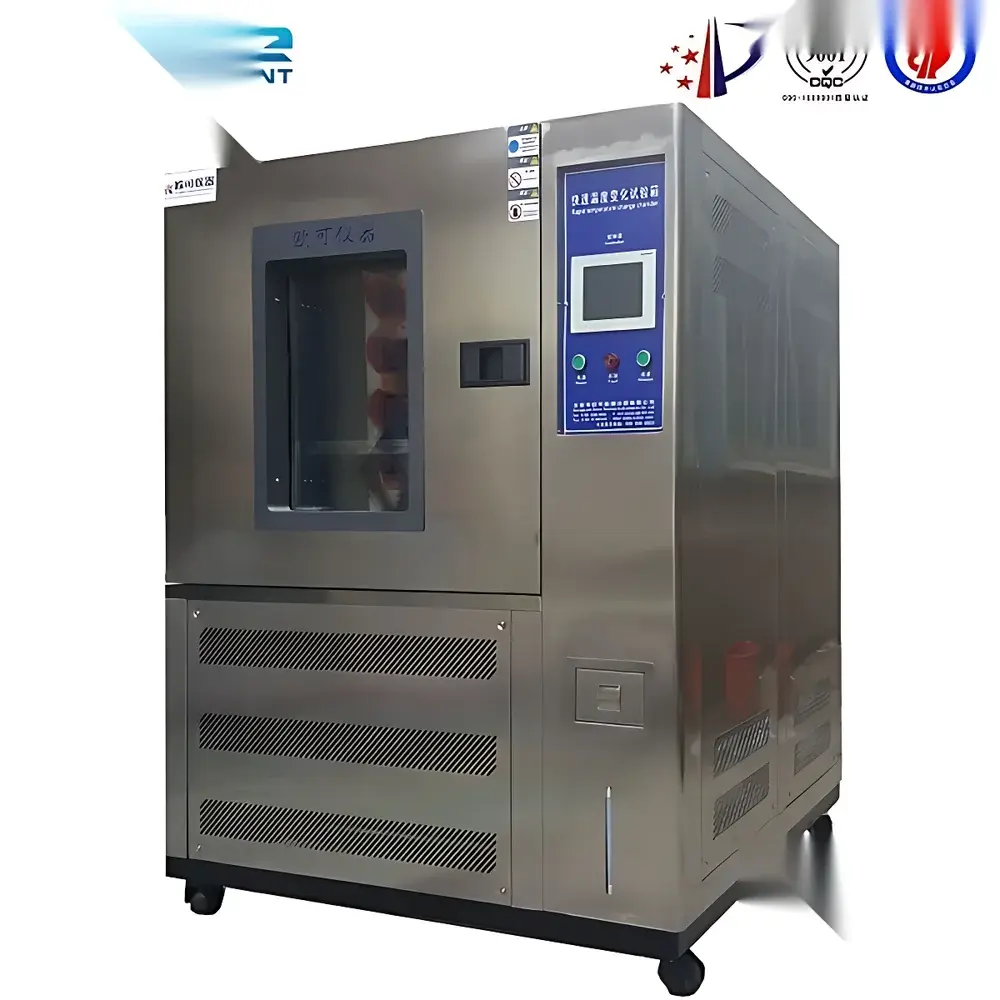
English Product Name
| Brand | OKEO |
|---|---|
| Origin | Imported |
| Manufacturer Type | Authorized Distributor |
| Temperature Range | -70°C to +180°C (configurable) |
| Internal Dimensions | 600 mm (W) × 500 mm (H) × 500 mm (D) |
| External Dimensions | 1500 mm (W) × 2100 mm (H) × 2250 mm (D) |
| Temperature Control Accuracy | ±0.1°C (setpoint & indication) |
| Sensor | PT100 Class A Platinum Resistance Thermometer |
| Heating System | Independent Ni-Cr Alloy Heaters |
| Refrigeration | Twin-Stage or Single-Stage Hermetic Compressor (Tecumseh/Tecumseh-derived, air-cooled) |
| Air Circulation | Low-noise AC Motor with Multi-blade Centrifugal Impeller |
| Insulation | High-density Glass Wool + Polyurethane Foam (≥120 mm thickness) |
| Door Seal | High-tensile Packing Rated for -200°C to +400°C |
| Conversion Mechanism | Pneumatic Actuated Dual-Zone Isolation Valves |
| Compliance | Designed per IEC 60068-2-14, ISO 16750-4, and ASTM D3418 |
Overview
The OKEO Linear Rapid Temperature Cycling Chamber is an engineered environmental test system designed for high-fidelity thermal stress evaluation of electronic components, automotive modules, aerospace subsystems, and advanced packaging materials. It operates on a dual-zone architecture—comprising independent high-temperature and low-temperature chambers—and employs precise pneumatic isolation valves to enable rapid, linear temperature transitions across the full operational range (–70°C to +180°C). Unlike single-chamber ramp-based systems, this design decouples thermal mass management from test specimen positioning, ensuring minimal thermal lag and reproducible ramp rates up to 15°C/min (dependent on load and setpoint delta). The chamber’s control architecture integrates Siemens S7-series PLC logic with a color TFT touchscreen HMI, enabling deterministic sequencing, real-time deviation monitoring, and traceable parameter logging—critical for qualification testing under MIL-STD-810H, JEDEC JESD22-A104, and AEC-Q200 protocols.
Key Features
- Dual-zone physical separation with pneumatically actuated stainless-steel isolation gates, reducing temperature transition time to ≤10 seconds between extreme zones
- Linear ramp rate control with programmable slope profiles (e.g., constant ΔT/Δt, step-and-hold, or custom ramp segments)
- High-stability temperature regulation via Class A PT100 sensors (IEC 60751), calibrated traceable to NIST standards
- Redundant safety architecture: independent over-temperature cut-off, refrigerant pressure monitoring, and door interlock with forced-air purge
- Structural integrity ensured by SUS304 stainless steel interior and exterior panels, fully welded and passivated for corrosion resistance in humid or saline environments
- Thermal insulation comprising ≥120 mm composite layer—high-density glass wool (λ ≤ 0.036 W/m·K) and closed-cell PU foam (density ≥ 40 kg/m³)—minimizing heat leakage and condensation risk
Sample Compatibility & Compliance
The chamber accommodates static and dynamic test configurations: in two-zone mode, specimens are physically transferred between chambers; in single-zone (static) mode, airflow routing is dynamically redirected via motorized dampers to expose stationary samples to alternating thermal streams—ideal for in-situ electrical characterization or optical inspection during cycling. Internal volume (150 L) supports standard JEDEC trays, PCB assemblies up to 450 mm × 450 mm, and automotive ECUs with integrated harnesses. All hardware and firmware comply with CE marking requirements (EMC Directive 2014/30/EU, Machinery Directive 2006/42/EC), and software architecture supports audit-ready data integrity per FDA 21 CFR Part 11 when paired with optional validation packages.
Software & Data Management
The embedded Siemens WinCC-based control interface supports multi-segment test programming, real-time trend visualization (temperature, ramp rate, valve status), and CSV/Excel export of timestamped sensor data at user-defined intervals (100 ms to 5 min resolution). Optional Ethernet/IP or Modbus TCP connectivity enables integration into centralized MES or LIMS platforms. For regulated environments, the system can be configured with electronic signatures, role-based access control, and immutable audit trails—including operator ID, parameter changes, alarm events, and calibration history—meeting GLP and GMP documentation expectations.
Applications
- Thermal shock qualification of solder joints, MEMS devices, and ceramic capacitors per IPC-9701 and J-STD-020
- Reliability screening of battery cells and BMS modules under accelerated thermal cycling (e.g., 500–2000 cycles, –40°C ↔ +85°C)
- Material coefficient-of-thermal-expansion (CTE) mismatch analysis in heterogeneous packaging stacks
- Environmental stress screening (ESS) for defense electronics per MIL-STD-2164A
- Validation of thermal interface materials (TIMs) under dynamic load conditions
FAQ
What is the maximum achievable linear ramp rate, and under what conditions?
Up to 15°C/min is attainable for empty chamber operation between –40°C and +85°C; loaded rates depend on sample thermal mass and fixture emissivity—typical derating is 20–40% for 5 kg aluminum loads.
Does the system support automated calibration verification?
Yes—integrated dry-well-compatible reference ports allow periodic field verification using external metrology-grade thermometers; calibration certificates are provided with initial commissioning.
Can the chamber operate unattended for extended cycles (e.g., 72+ hours)?
Fully supported—hardware watchdog timers, redundant refrigerant monitoring, and auto-recovery logic ensure safe continuous operation; remote SMS/email alerts available via optional IoT gateway.
Is third-party IQ/OQ/PQ documentation available?
Standard IQ/OQ templates compliant with ISO/IEC 17025 are included; PQ execution requires site-specific load mapping and is performed by OKEO-certified field engineers.
What maintenance intervals are recommended for compressor and control system?
Compressor oil and filter replacement every 12 months or 4,000 operating hours; PLC firmware updates and HMI touchscreen calibration annually; full preventive maintenance (including sensor recalibration) biannually.



