
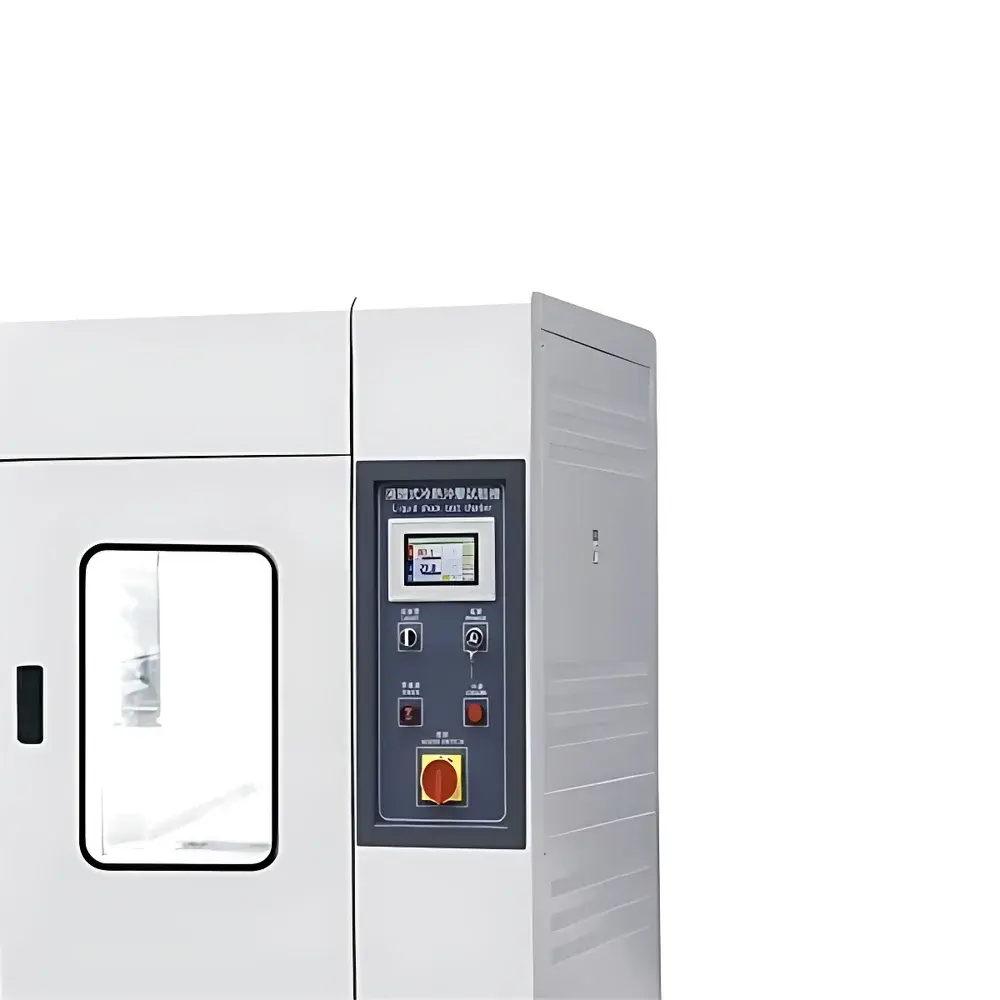
English Product Name
| Brand | Other Brands |
|---|---|
| Origin | Imported |
| Manufacturer Type | Authorized Distributor |
| Price | USD 12,500 (FOB) |
| Internal Dimensions (W×H×D) | 40×35×30 cm to 70×60×60 cm |
| External Dimensions (W×H×D) | 145×180×140 cm to 190×170×270 cm |
| Hot Zone Temperature Range | RT to +200 °C |
| Cold Zone Temperature Range | RT to −70 °C |
| Test Zone Temperature Range | +60 °C to +150 °C (hot shock) |
| Transfer Time (Door Switch) | < 5 s |
| Temperature Recovery Time | ≤ 5 min |
| Temperature Uniformity | ±2.0 °C |
| Temperature Control Accuracy | ±0.5 °C |
| Refrigeration System | Dual-stage cascade refrigeration with imported semi-hermetic compressors (R404A/R23) |
| Cooling Water Requirement | 10 m³/h external cooling tower (user-supplied) |
| Construction | Interior – mirror-finish SUS304 stainless steel |
| Power Supply | AC 380 V ±5%, 50 Hz ±0.5 Hz, 3-phase 5-wire |
Overview
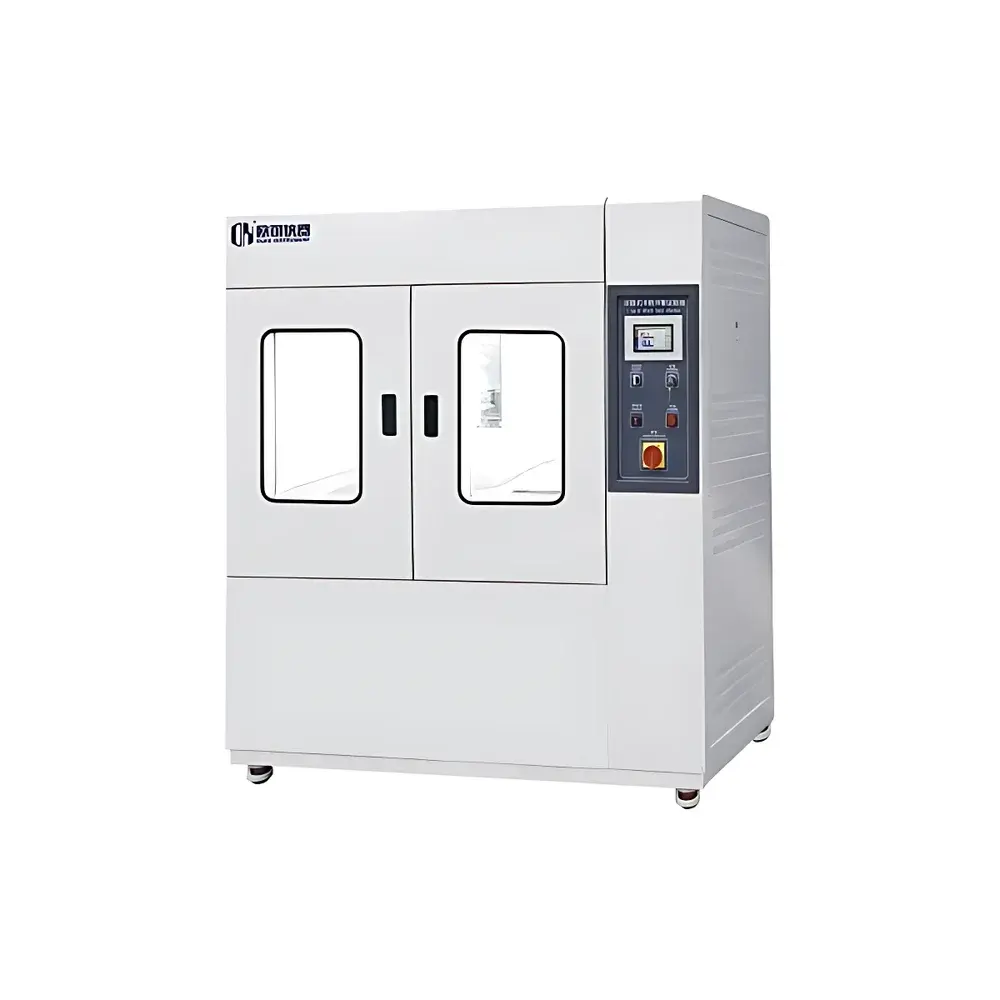
The Liquid-Medium Thermal Shock Test Chamber is an engineered environmental test system designed to evaluate the reliability and structural integrity of materials, electronic components, automotive parts, and aerospace assemblies under rapid, repeated transitions between extreme high and low temperatures. Unlike air-based thermal shock chambers, this system employs a liquid-medium heat transfer architecture—integrated hot and cold reservoirs filled with thermally stable, non-corrosive heat-transfer fluids—to achieve high-speed thermal energy exchange and superior temperature stability during transition phases. The chamber operates on the principle of controlled thermal inertia: specimens remain stationary in the test zone while pneumatic isolation doors rapidly route conditioned fluid streams from pre-conditioned hot and cold reservoirs, minimizing mechanical stress induced by specimen movement and ensuring repeatable, ISO-compliant thermal transients. This design supports precise execution of temperature shock profiles defined in IEC 60068-2-14 (Test N), MIL-STD-810H Method 503.5, and ASTM D5229/D5229M, with full traceability for GLP/GMP-regulated validation protocols.
Key Features
- Dual-zone cascade refrigeration system featuring imported semi-hermetic compressors (EU/US-sourced), enabling stable operation down to −70 °C in the cold reservoir and up to +200 °C in the hot reservoir
- Pneumatically actuated, leak-tight isolation valves with <5 second switching time between thermal zones, eliminating mechanical basket motion and reducing positional uncertainty
- High-efficiency evaporative condenser coupling between high- and low-stage refrigeration circuits, optimized for energy modulation across varying load conditions
- Mirror-finish SUS304 stainless steel interior chamber with seamless welds and electro-polished surfaces—resistant to thermal cycling-induced microcracking and corrosion
- Fire-retardant, closed-cell polyurethane (PU) insulation (≥150 mm thickness) meeting UL 94 V-0 flame rating requirements for laboratory safety compliance
- Integrated 50 mm diameter cable port with silicone gasket and two-tier SUS304 adjustable shelving for flexible sample mounting configurations
- Real-time monitoring of chamber pressure differential, refrigerant subcooling, and compressor discharge temperature to support predictive maintenance scheduling
Sample Compatibility & Compliance
This chamber accommodates rigid and semi-rigid samples up to 70 × 60 × 60 cm (OK-YT-225 model), including PCB assemblies, molded plastic housings, battery modules, optical sensors, and sealed enclosures. Its stationary-test-zone configuration ensures compatibility with vibration-sensitive or weight-unbalanced specimens unsuitable for basket-type systems. The chamber meets or exceeds requirements of GB/T 2423.22–2002 (Temperature Change), IEC 60068-2-14 (Test N), MIL-STD-1540D (Environmental Stress Screening), EIA-364-32 (Connector Thermal Shock), and QC/T 17–1992 (Automotive Component Environmental Testing). All thermal profiles are fully programmable and auditable per FDA 21 CFR Part 11 requirements when paired with optional compliant software.
Software & Data Management
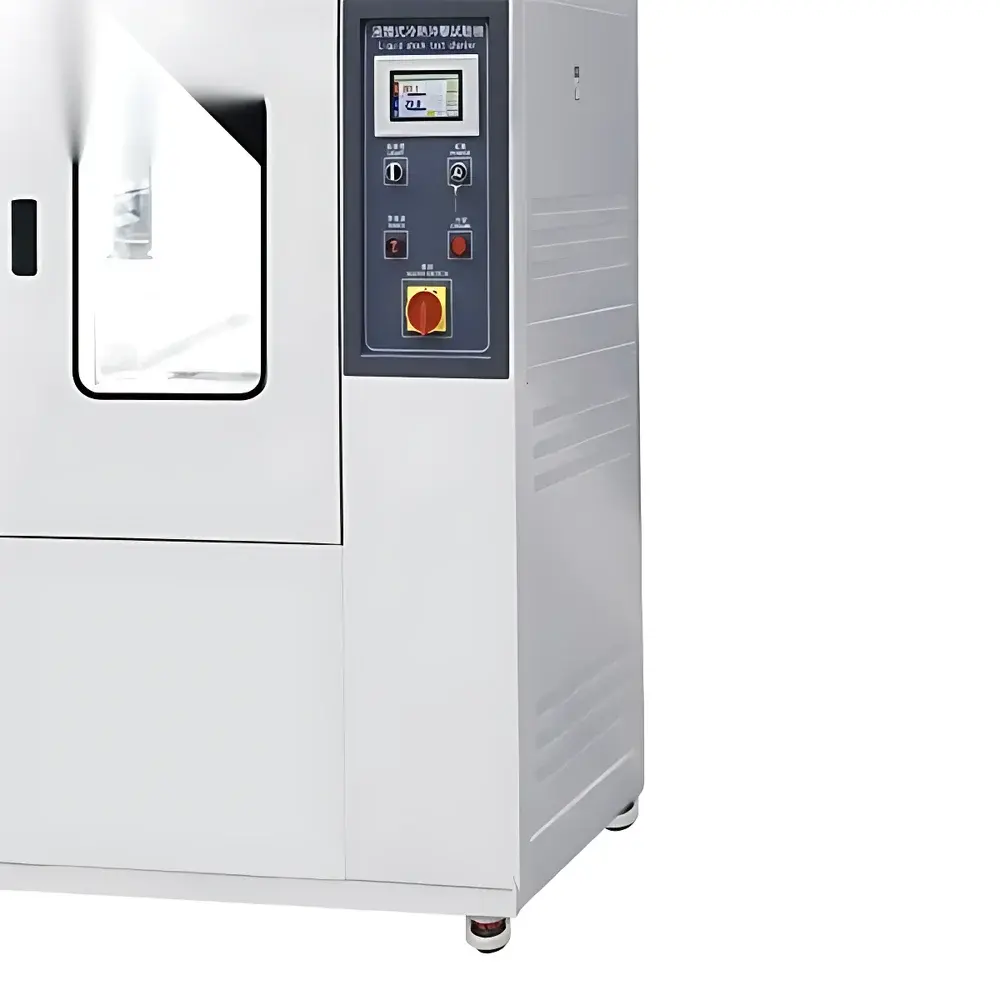
The embedded controller supports multi-segment ramp-soak-shock profiles with user-defined dwell times, transition rates, and cycle counts. Optional PC-based software provides full data logging at 1 Hz resolution—including chamber air temperature, reservoir fluid temperature, door position status, and compressor operational parameters—with automatic export to CSV or PDF formats. Audit trails record operator ID, timestamp, parameter changes, and alarm events. Data encryption, electronic signatures, and role-based access control align with GLP and GMP documentation standards. Calibration certificates (NIST-traceable) are provided for all integrated PT100 sensors and reference thermocouples.
Applications
- Qualification testing of solder joints, conformal coatings, and die-attach adhesives in electronics packaging
- Validation of thermal interface material (TIM) performance under cyclic thermal loading
- Reliability screening of lithium-ion battery cells and module housings prior to field deployment
- Material fatigue assessment of polymer composites used in avionics enclosures and automotive lighting systems
- Process validation for reflow soldering, potting, and encapsulation manufacturing lines
- Accelerated aging studies per JEDEC JESD22-A106 (Thermal Shock) and IPC-9701 (Performance Requirements)
FAQ
What distinguishes liquid-medium thermal shock from air-blast or basket-type systems?
Liquid-medium systems eliminate mechanical motion of test specimens, reduce thermal lag via higher heat capacity fluids, and deliver tighter temperature uniformity (<±2.0 °C) and faster recovery (<5 min), critical for high-reliability qualification.
Is external cooling water infrastructure mandatory?
Yes. A dedicated 10 m³/h closed-loop cooling tower must be installed outdoors to reject heat from the dual-stage refrigeration condensers. Chilled water or glycol loops are not supported.
Can the chamber operate continuously for extended HALT/HASS cycles?
It is rated for continuous duty at nominal load (≤70% chamber volume occupied); however, extended operation (>1000 cycles) requires scheduled maintenance of refrigerant charge, oil separators, and valve actuators per OEM service manual.
Does the system comply with EU RoHS and REACH regulations?
All structural materials, insulation, and refrigerants (R404A/R23) meet RoHS Directive 2011/65/EU Annex II substance restrictions and REACH SVHC candidate list thresholds as verified by third-party SGS testing reports.
What calibration and verification documentation is included?
Each unit ships with a factory calibration certificate (traceable to NIST or PTB), IQ/OQ protocol templates, and a 12-month warranty covering refrigeration system integrity and temperature control accuracy.



