
English Product Name
| Platform Dimensions | 500 × 500 mm |
|---|---|
| Shaker Body Dimensions | 500 × 450 × 500 mm |
| Mounting Pattern | 25 × M10 threaded holes on platform surface |
| Vibration Axes | Independent or simultaneous excitation along X (horizontal, left–right), Y (vertical, up–down), and Z (horizontal, front–back) |
| Frequency Range | 1–5000 Hz (display resolution: 0.01 Hz) |
| Peak-to-Peak Displacement | 0–4 mm adjustable |
| Maximum Load Capacity | 75 kg |
| Peak Sinusoidal Force | 1125 kgf (≈11.03 kN) |
| Maximum Acceleration | ≤15 g (peak) |
| Waveform Options | Sinusoidal (full- or half-wave), programmable random, road-profile-simulated vibration, multi-axis coupled motion (4-DOF synchronized), mixed-mode (e.g., half-wave on Y + full-wave on X) |
| Test Duration Setting | 0–999,999 s (user-defined) |
| Power Consumption | 3.8 kW |
| Input Current | ≤15 A |
| Supply Voltage | 380 V ±20%, 3-phase, 50/60 Hz |
| Acceleration–Amplitude–Frequency Relationship | aₚₑₐₖ (g) = 0.002 × f² (Hz²) × D (mm, p–p) |
Overview
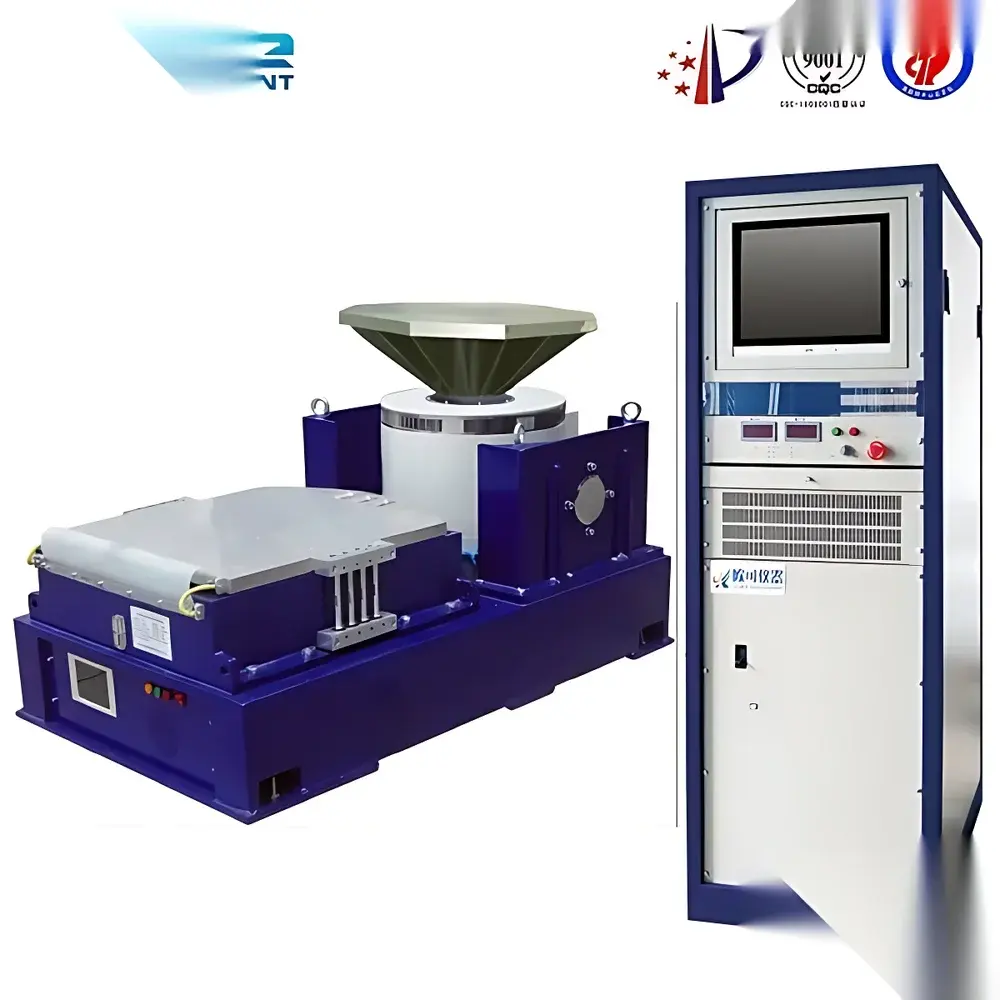
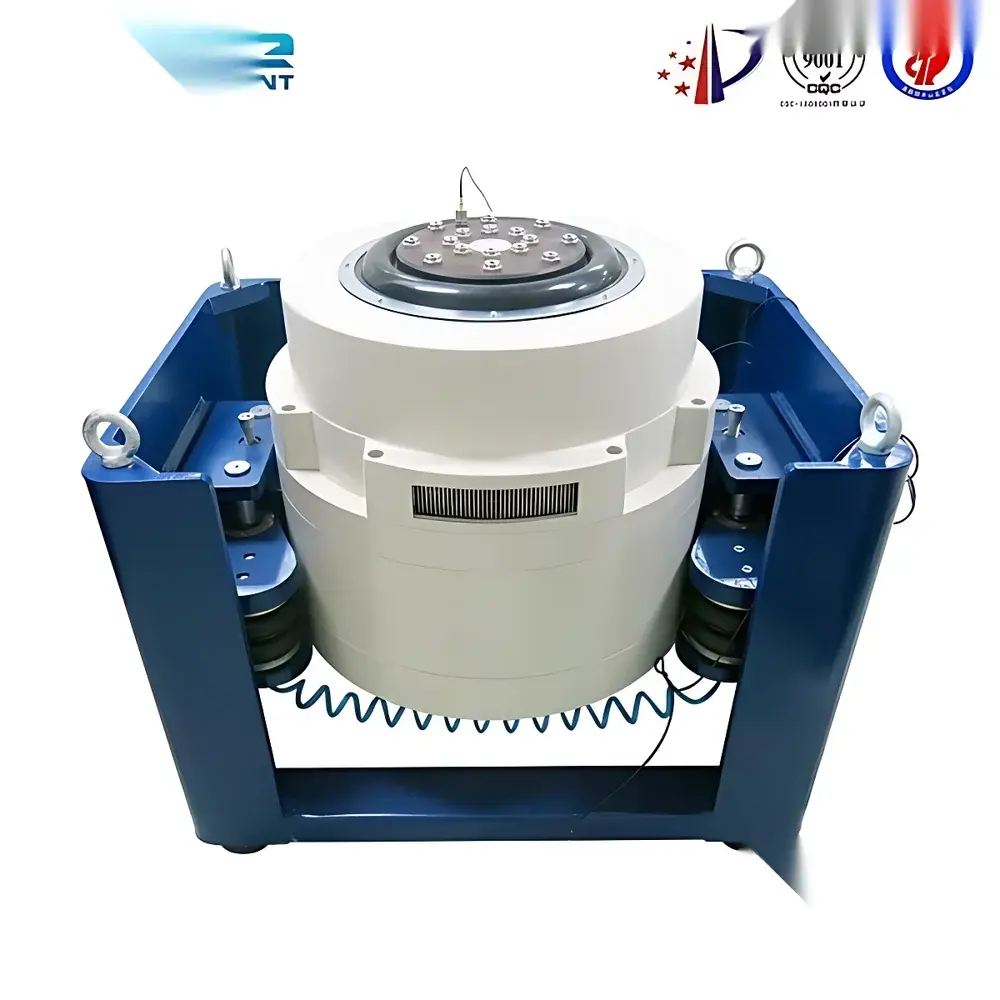
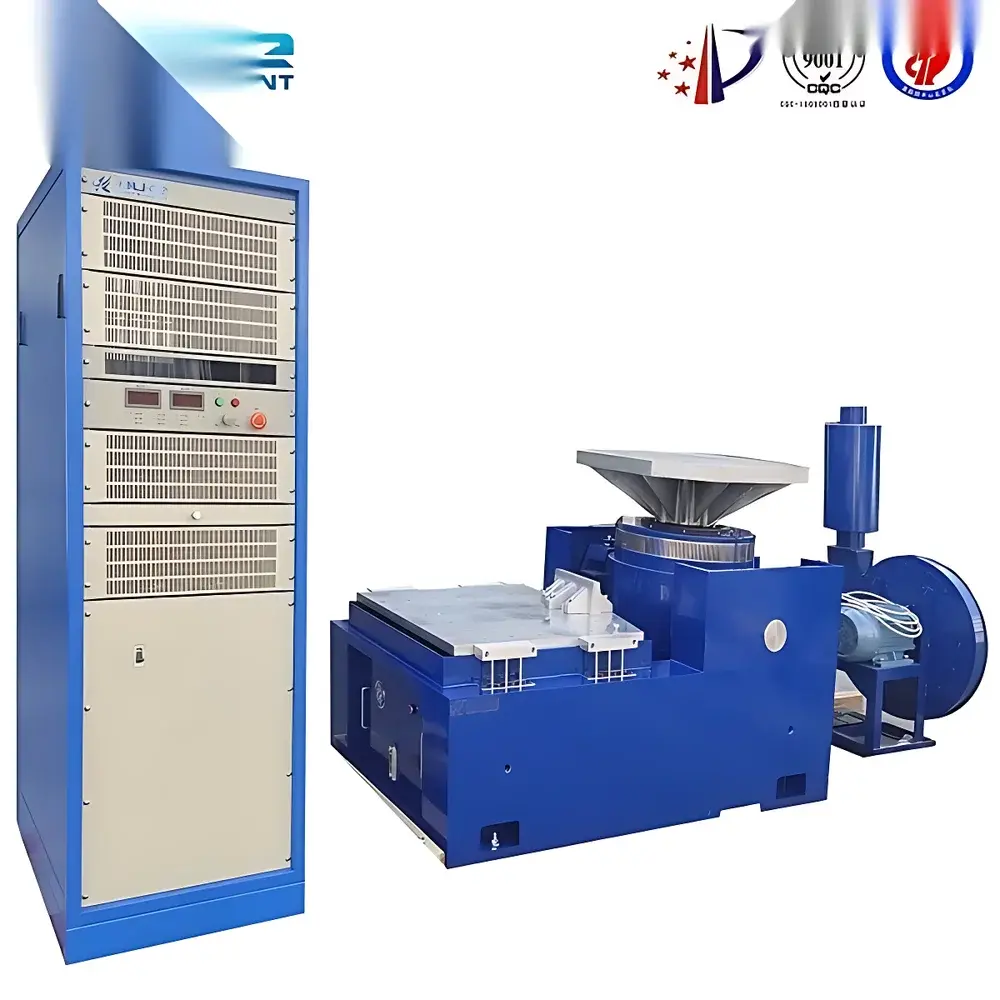
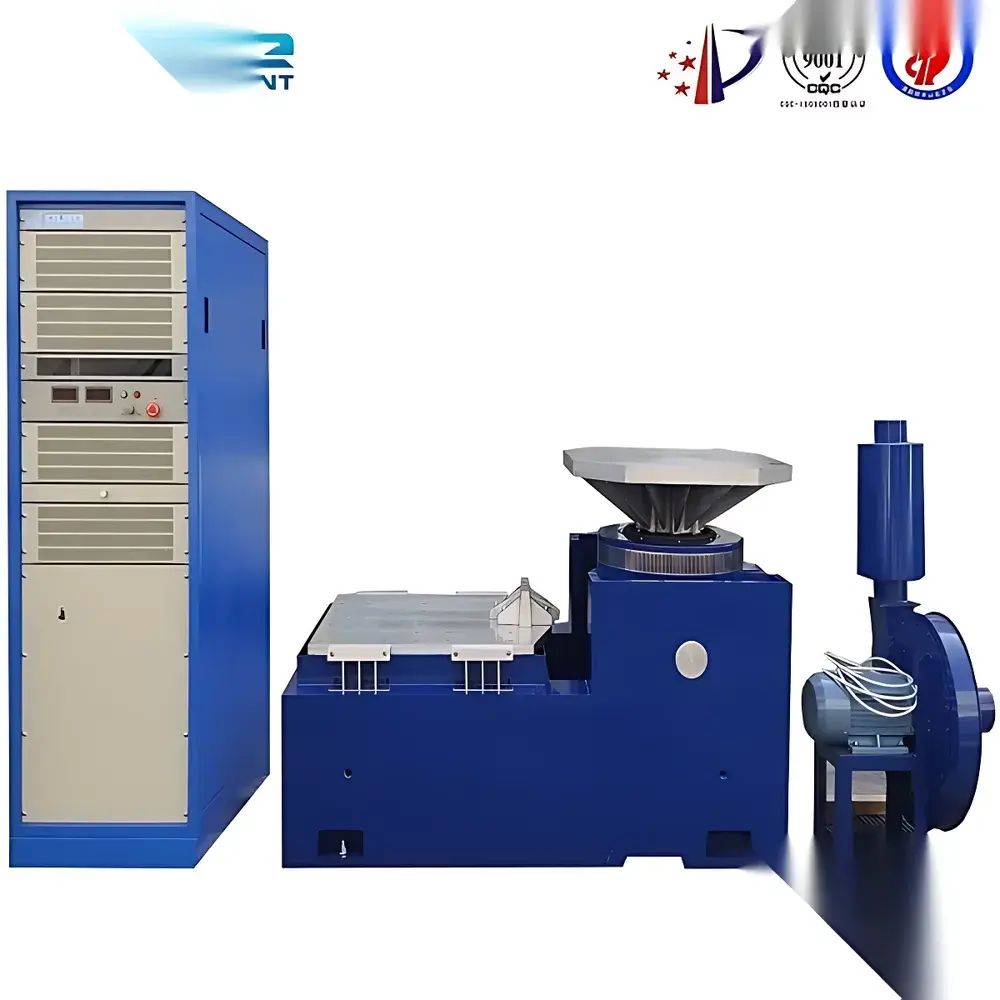
The Triaxial Electromagnetic Vibration Shaker System is an engineered test platform designed for rigorous mechanical durability assessment under controlled dynamic loading conditions. Based on electromagnetic actuation principles, it generates precisely regulated inertial forces across three orthogonal axes (X, Y, Z), enabling true multi-degree-of-freedom (multi-DOF) vibration simulation. Unlike single-axis shakers, this system supports independent or phase-synchronized excitation—critical for replicating real-world transport-induced stresses such as those encountered during rail, truck, or air cargo shipment. Its core architecture complies with fundamental vibration testing theory defined in ISO 10816, ASTM D999, and IEC 60068-2-64, supporting both deterministic (sine, swept-sine, programmed) and stochastic (road-spectrum, random) test profiles. The system is calibrated for traceable force and acceleration output, and its structural rigidity ensures minimal modal coupling below 500 Hz—essential for high-fidelity response measurement of mounted DUTs (Devices Under Test).
Key Features
- Triaxial electromagnetic actuation with independent drive control per axis, enabling decoupled or coordinated motion—including simultaneous 4-DOF (X+Y+Z+rotational coupling via platform constraint) vibration patterns
- High-force density design: 1125 kgf peak thrust at low frequencies, sustaining ≤15 g acceleration up to 5000 Hz with <±1.5% amplitude linearity across the operational bandwidth
- Programmable waveform engine supporting sine (full/half-wave), swept-sine (logarithmic/linear), step-sine, resonance dwell, and user-defined time-history profiles
- Integrated digital controller with real-time frequency resolution of 0.01 Hz and sub-millisecond timing accuracy for duration-based test termination
- Rigid aluminum alloy platform (500 × 500 mm) featuring 25 × M10 threaded mounting points and four reinforced L-slot hook interfaces (70 mm length) for secure fixture attachment and load distribution
- Thermally stabilized voice coil assembly with forced-air cooling, validated for continuous operation over 2,160 hours (3 months) without performance drift
Sample Compatibility & Compliance
The shaker accommodates test specimens up to 75 kg mass with center-of-gravity height ≤200 mm above the platform surface. Fixture design must maintain CG alignment within ±15 mm of the platform’s geometric center to minimize overturning moments. Compatible with standard DIN/ISO mounting adapters, seismic mass plates, and custom rigid fixtures meeting ISO 5344 mechanical interface specifications. All vibration profiles adhere to internationally recognized test standards including: ISO 13373-2 (machine condition monitoring), MIL-STD-810H Method 514.8 (vibration), ISTA 3A/3E (transport simulation), and GB/T 2423.10 (Chinese national equivalent of IEC 60068-2-6). The system supports GLP-compliant test documentation when integrated with audit-trail-enabled software (see Software & Data Management).
Software & Data Management
The system operates natively with embedded firmware supporting local keypad-driven test setup and real-time parameter monitoring. Optional PC-based control software provides full IEEE 1588-2019 time-synchronized data acquisition at up to 100 kHz sampling rate per channel. Software modules include: waveform editor with FFT-based spectrum shaping, automated resonance search and dwell, profile sequencing with conditional branching, and export of raw time-series data in ASAM MDF4 or HDF5 format. All test logs include timestamped metadata (operator ID, calibration certificate ID, environmental conditions), satisfying FDA 21 CFR Part 11 requirements for electronic records and signatures when deployed in regulated QC/QA environments. Remote diagnostics and firmware updates are supported via encrypted TLS 1.2 communication.
Applications
This shaker serves critical validation functions across multiple industries: automotive component suppliers use it for ECU, sensor, and infotainment module qualification per LV-124 and GMW14872; electronics manufacturers apply it to PCB-level shock/vibration screening aligned with JEDEC JESD22-B103; aerospace subcontractors perform avionics box certification against RTCA DO-160 Section 8; and packaging engineers replicate multimodal logistics stress using synthesized road, rail, and air transport spectra. It is also employed in academic research on fatigue life prediction, damping material characterization, and structural dynamic modeling—particularly where phase-coherent multi-axis input is required to excite coupled bending-torsional modes.
FAQ
What standards does this shaker support for regulatory compliance?
It meets core requirements of ISO 10816-3 (machinery vibration), ASTM D999 (shipping container testing), IEC 60068-2-64 (random vibration), and MIL-STD-810H Method 514.8. Full traceability requires optional software with audit trail and electronic signature modules.
Can the system perform random vibration testing with user-defined PSD profiles?
Yes—the optional software includes a PSD editor supporting import of industry-standard spectra (e.g., NATO AEP-55, Bell Helicopter BHT-2100) and real-time closed-loop control with convergence tolerance ≤0.5 dB across 100–2000 Hz.
Is thermal management sufficient for extended high-g testing?
The forced-air cooling system maintains coil temperature below 120°C during sustained 10 g @ 200 Hz operation for ≥4 hours, verified per IEC 60034-12 thermal class H insulation rating.
How is mechanical coupling between axes minimized?
Cross-axis transmissibility is limited to <−45 dB (≤0.56% energy transfer) below 1 kHz through optimized suspension geometry, orthogonal magnetic circuit isolation, and active cross-talk compensation in the controller firmware.
What calibration documentation is provided?
Each unit ships with NIST-traceable factory calibration report covering force, acceleration, displacement, and frequency response (5–5000 Hz), valid for 12 months under normal operating conditions.



