
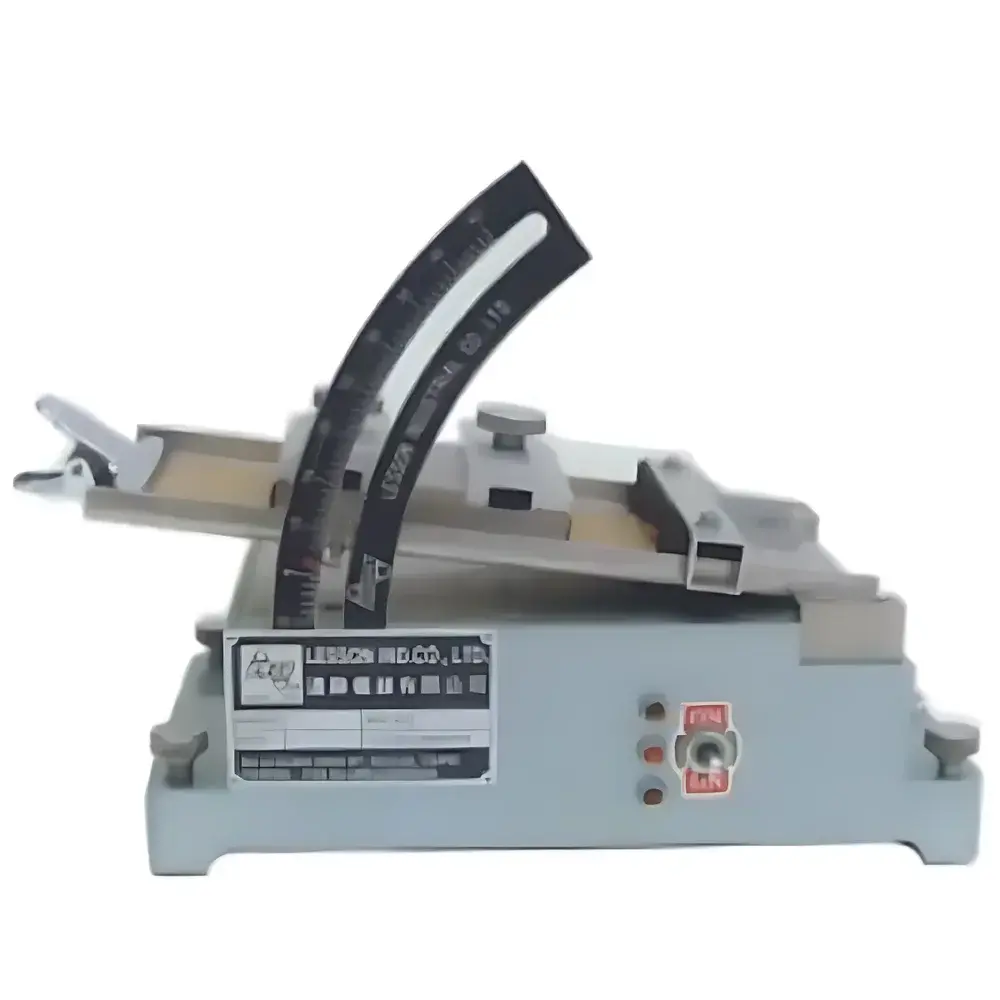
English Product Name
| Brand | LienSheng |
|---|---|
| Origin | Taiwan |
| Model | LS-905 |
| Instrument Type | Static Coefficient of Friction Tester |
| Max Inclination Angle | 45° |
| Tilt Rate | 1.5 ± 0.5 °/s |
| Test Block Dimensions | 100 mm (L) × 50 mm (W) × 750 g |
| Sample Platform Size | 125 mm (W) × 280 mm (L) |
| Motor | 110 V, 5 W |
| Overall Dimensions | 400 mm (L) × 350 mm (W) × 350 mm (H) |
| Weight | 2.5 kg |
| Compliant Standards | CNS 13119, TAPPI T815 om-85 |
Overview
The LienSheng LS-905 Inclined-Plane Static Coefficient of Friction Tester is an engineered precision instrument designed to quantify the static coefficient of friction (COF) between two contacting surfaces—primarily paper, kraft paper, corrugated fiberboard, and solid fiberboard—using the standardized inclined-plane method. It operates on the fundamental tribological principle that static COF (μs) equals the tangent of the critical angle (θ) at which relative motion initiates under controlled normal load and surface geometry: μs = tan(θ). The device applies a consistent nominal contact pressure of 1.5 ± 0.7 kPa via a calibrated 750 g metal test block, ensuring repeatable interfacial stress conditions across samples. Its mechanical architecture features a motor-driven, continuously adjustable incline platform with real-time angular feedback and automatic stop-triggering upon slip detection—enabling direct, analog readout of the onset angle on a high-contrast, linearly scaled protractor. This methodology delivers traceable, operator-independent results essential for packaging integrity validation in logistics and distribution environments.
Key Features
- Motorized, programmable tilt mechanism delivering precise angular ramping at 1.5 ± 0.5 °/s—fully compliant with TAPPI T815 om-85 and CNS 13119 timing requirements
- Integrated slip-detection system: A micro-switch-actuated sensor bar triggers immediate motor halt and mechanical pointer lock upon first motion, eliminating parallax error and temporal drift
- Dual-axis leveling base with four independent adjustment screws and built-in bubble level—ensuring gravitational alignment prior to each test cycle
- Modular sample clamping design: Separate fixtures for both the stationary platform (125 mm × 280 mm) and sliding block (100 mm × 50 mm), accommodating CD/MD grain orientation documentation per ASTM D1894 guidance
- Robust aluminum alloy frame and low-inertia drive train—minimizing vibration transmission and supporting long-term dimensional stability under laboratory conditions
- No software dependency: Fully mechanical operation ensures compliance with GLP environments where electronic data capture is restricted or requires full 21 CFR Part 11 validation
Sample Compatibility & Compliance
The LS-905 is validated for testing planar, non-porous, and semi-rigid sheet materials up to 0.8 mm thickness—including linerboard, testliner, kraft wrapping paper, SBS board, and double-wall corrugated medium. Sample preparation follows strict dimensional protocols: 115 mm × 210 mm specimens are mounted with defined fiber orientation (machine direction MD or cross direction CD) and surface-side identification (wire side vs. felt side). The instrument’s fixed 750 g test mass and 50 mm contact width yield a nominal pressure range suitable for ISO 8295 and ASTM D1894–22 equivalent evaluation. All operational procedures, calibration checks, and maintenance routines are documented in accordance with ISO/IEC 17025:2017 clause 6.4 (Equipment) and support audit readiness for GMP-aligned packaging QC laboratories.
Software & Data Management
The LS-905 operates as a standalone mechanical tester with no embedded firmware or digital interface. All measurements are recorded manually into laboratory notebooks or LIMS-compatible spreadsheets. Users may integrate the instrument into electronic quality management systems by logging angle readings alongside metadata—such as lot number, humidity/temperature (per ISO 187), operator ID, and test date—using externally validated templates. For labs requiring electronic audit trails, manual entries must adhere to ALCOA+ principles (Attributable, Legible, Contemporaneous, Original, Accurate, Complete, Consistent, Enduring, Available) and be subject to second-person verification per FDA guidance on paper-based records.
Applications
This tester serves critical roles in packaging R&D and production QA workflows: evaluating pallet-stacking stability of export-grade corrugated containers; validating anti-slip performance of multi-layer kraft sacks used in bulk agricultural transport; benchmarking surface treatments (e.g., silicone coatings or corona discharge) applied to linerboard; and supporting root-cause analysis of in-transit damage claims. It further supports supplier qualification programs aligned with ISTA 3A and ASTM D4169 distribution simulation protocols—where static COF thresholds directly correlate with unit-load retention metrics. Routine use enables correlation studies between friction angle and dynamic compression strength (ECT), aiding predictive modeling of vertical load transfer in stacked configurations.
FAQ
What standards does the LS-905 comply with?
It meets the procedural and dimensional requirements of TAPPI T815 om-85, CNS 13119, and is functionally aligned with ASTM D1894–22 and ISO 8295 for static COF determination.
Can the instrument measure kinetic (dynamic) COF?
No—it is purpose-built for static COF only, as defined by the initial slip threshold. Kinetic COF requires continuous velocity-controlled shear measurement, which falls outside its mechanical design scope.
Is calibration traceable to national metrology institutes?
Yes—angular scale linearity is verified using NIST-traceable optical inclinometers; mass calibration follows ISO/IEC 17025-accredited weight sets certified to ±0.1 g uncertainty.
How often should leveling be performed?
Leveling must be confirmed before every test session and after any relocation—even minor bench vibrations can induce angular bias exceeding ±0.3°.
Does ambient humidity affect results?
Yes—paper hygroscopicity significantly influences surface adhesion. Testing must occur in conditioned rooms at 23 ± 1 °C and 50 ± 2 % RH per ISO 187, with samples equilibrated ≥24 h prior to measurement.



