
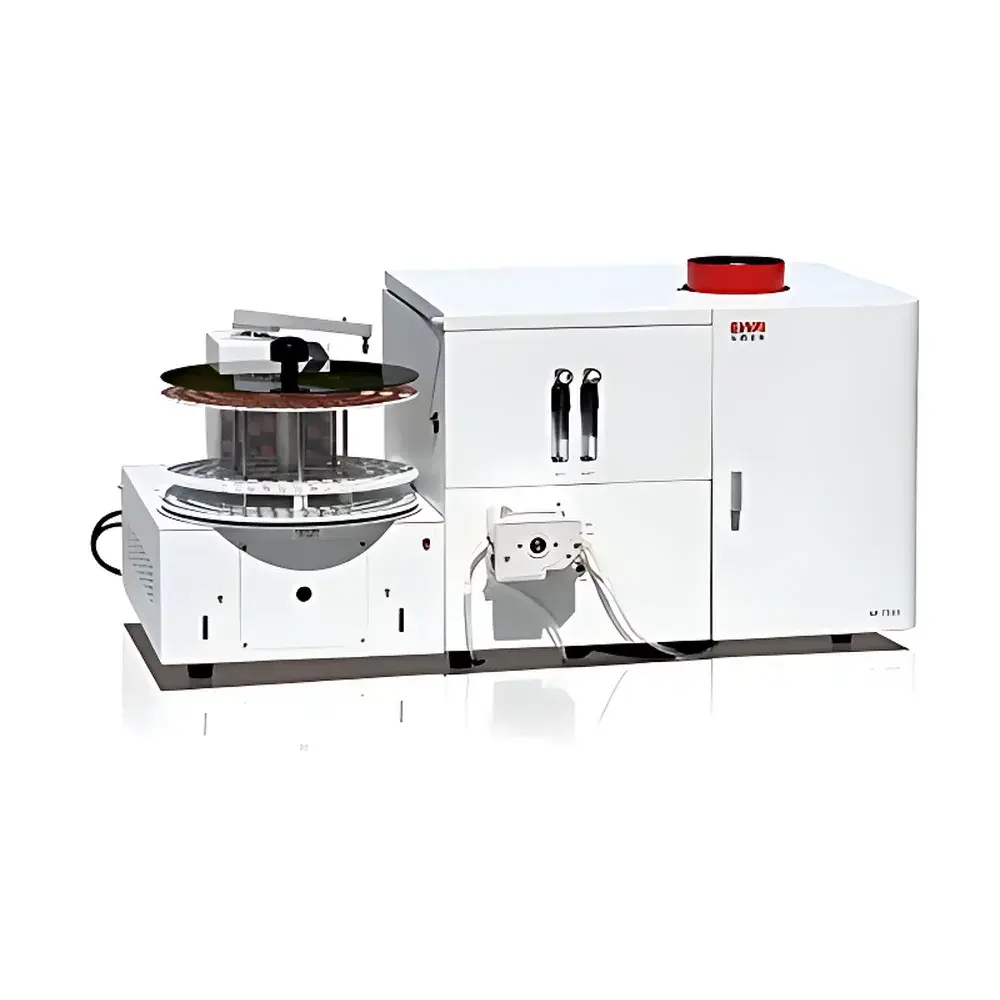
English Product Name
| Brand | Dongxi Analysis |
|---|---|
| Origin | Beijing, China |
| Manufacturer Type | Direct Manufacturer |
| Instrument Type | Multi-Channel Atomic Fluorescence Spectrometer |
| Sample Introduction | Peristaltic Pump |
| Detectable Elements | As, Sb, Bi, Se, Sn, Pb, Ge, Te, Zn, Cd, Hg |
| Relative Standard Deviation (RSD) | <1.0% |
| Linear Dynamic Range | >3 orders of magnitude |
| Detection Limits | As, Sb, Se, Pb, Sn, Bi, Te < 0.01 ng |
Overview
The Dongxi Analysis AF-7500 Multi-Channel Atomic Fluorescence Spectrometer is a high-performance, laboratory-grade instrument engineered for trace and ultra-trace elemental analysis via hydride generation atomic fluorescence spectrometry (HG-AFS). It operates on the principle of atomization in a low-temperature argon-hydrogen flame, followed by excitation using high-intensity hollow cathode lamps and detection of element-specific atomic fluorescence emissions at characteristic wavelengths. Designed for routine and regulatory-compliant analysis in demanding environments, the AF-7500 delivers exceptional sensitivity, stability, and multi-element capability—particularly for Group V and VI elements that form volatile hydrides. Its architecture integrates modern optoelectronic design, embedded microcontroller-based gas and fluid control, and robust thermal management to ensure reproducible signal generation across extended analytical campaigns.
Key Features
- Multi-channel dual-element simultaneous analysis capability with independent optical paths and detector channels—enabling concurrent quantification of two elements (e.g., As and Sb) without spectral interference or cross-contamination.
- Patented continuous-flow/discrete-injection hybrid sample introduction system (Patent No. ZL200620012910.2), combining an 8-port injection valve with precision peristaltic pumping to enable alternating analysis cycles: while one channel performs sample aspiration and pre-reduction, the other executes atomization and detection—effectively doubling throughput without compromising accuracy.
- Infrared-controlled, membrane-based gas–liquid separator (Patent No. 200720104068.X) eliminates mechanical pump-driven waste removal, ensures complete phase separation, suppresses background noise, and enables stable, colorless flame operation—contributing directly to sub-picomolar detection limits and extended linear dynamic range.
- Low-temperature Ar–H₂ flame ignition system with automatic thermal sequencing minimizes memory effects and enhances analyte atomization efficiency—particularly critical for mercury (Hg) and selenium (Se) analysis where volatilization losses are common.
- Universal power supply compatible with both standard and specialty hollow cathode lamps—including high-intensity variants—allowing rapid lamp exchange without hardware modification or recalibration.
- Far-infrared heated quartz tube atomizer offering rapid thermal ramping (2,000 analyses under standard conditions).
- Fully automated pneumatic control circuitry with real-time pressure monitoring, leak detection, and fail-safe shutdown protocols—ensuring compliance with ISO/IEC 17025 safety requirements for unattended operation.
- Compact footprint (reduced by 50% vs. conventional AFS platforms), making it suitable for space-constrained laboratories including mobile labs, research vessels, and field-deployable environmental monitoring stations.
Sample Compatibility & Compliance
The AF-7500 is validated for aqueous liquid matrices requiring hydride-forming element determination—including acid-digested biological tissues, filtered environmental water, food extracts, pharmaceutical leachates, and geological digests. It supports direct analysis of samples meeting EPA Method 1631E (for Hg), ASTM D5762 (for As in coal), and GB/T 223.76–2008 (Chinese national standard for As/Sb in food). The system’s reagent consumption (NaBH₄, HCl, carrier gas) is optimized to meet ISO 17025 cost-efficiency benchmarks, and its fluidic pathways employ PFA, PTFE, and quartz components rated for long-term exposure to concentrated mineral acids (up to 6 M HCl). All operational logs—including lamp usage, gas pressure events, calibration history, and sample sequence metadata—are timestamped and stored locally to support GLP/GMP audit readiness and FDA 21 CFR Part 11–compliant data integrity frameworks when paired with validated software configurations.
Software & Data Management
The AF-7500 is controlled via the proprietary AF-7500 Windows Application—a 64-bit, multi-threaded platform supporting dual-channel synchronized acquisition, real-time spectral visualization, peak integration with baseline correction algorithms, and automated calibration curve generation (linear, quadratic, or weighted least-squares). The software enforces user-level access control (administrator/operator modes), maintains full electronic audit trails (including parameter changes and result overrides), and exports results in CSV, PDF, and XML formats compatible with LIMS integration. Batch processing supports up to 130 samples via the optional autosampler, with customizable pause/resume functionality and auto-diagnostic alerts for flow interruption, lamp intensity decay (>15% deviation), or gas pressure anomaly. All raw data files include embedded metadata compliant with ASTM E1382–22 for digital record retention.
Applications
The AF-7500 serves as a primary analytical tool in accredited testing laboratories performing regulatory monitoring under national and international frameworks. Key application domains include: (i) Food safety surveillance—quantifying arsenic in rice, mercury in seafood, and cadmium in infant formula; (ii) Environmental compliance—measuring antimony in drinking water per WHO guidelines, selenium in wastewater effluents, and lead in soil leachates; (iii) Clinical toxicology—determining urinary arsenic speciation post-exposure assessment; (iv) Geochemical exploration—screening sediment cores for bismuth and tellurium anomalies during mineral prospecting; (v) Pharmaceutical quality control—verifying elemental impurities in active pharmaceutical ingredients (APIs) per ICH Q3D thresholds. Its demonstrated RSD <1.0% and detection limits below 0.01 ng for seven key elements align with USP , EP 2.4.20, and CNAS-CL01:2018 performance validation criteria.
FAQ
What hydride-forming elements can the AF-7500 quantify?
The instrument is validated for As, Sb, Bi, Se, Sn, Pb, Ge, Te, Zn, Cd, and Hg—covering all elements specified in ISO 11930, EPA 1631E, and GB 5009 series standards.
Is the AF-7500 compatible with third-party LIMS systems?
Yes—via ODBC-compliant database export and configurable ASCII/PDF report templates supporting HL7 and ASTM E1382–22 structured data exchange.
Does the system require external cooling or exhaust ventilation?
No dedicated chiller is required; ambient air convection suffices. A standard chemical fume hood is recommended only during method development or high-acid digestion workflows.
Can the AF-7500 perform speciation analysis?
Not natively—speciation requires coupling with HPLC or CE separation modules. However, the AF-7500 serves as the ideal fluorescence detection module in such hyphenated configurations.
What maintenance intervals are recommended for routine operation?
Peristaltic pump tubing: every 500 runs; quartz atomizer tube: every 2,000 analyses; hollow cathode lamps: lamp energy verification every 200 hours; gas filter replacement: quarterly or after 500 hours of operation.
Related Products






