
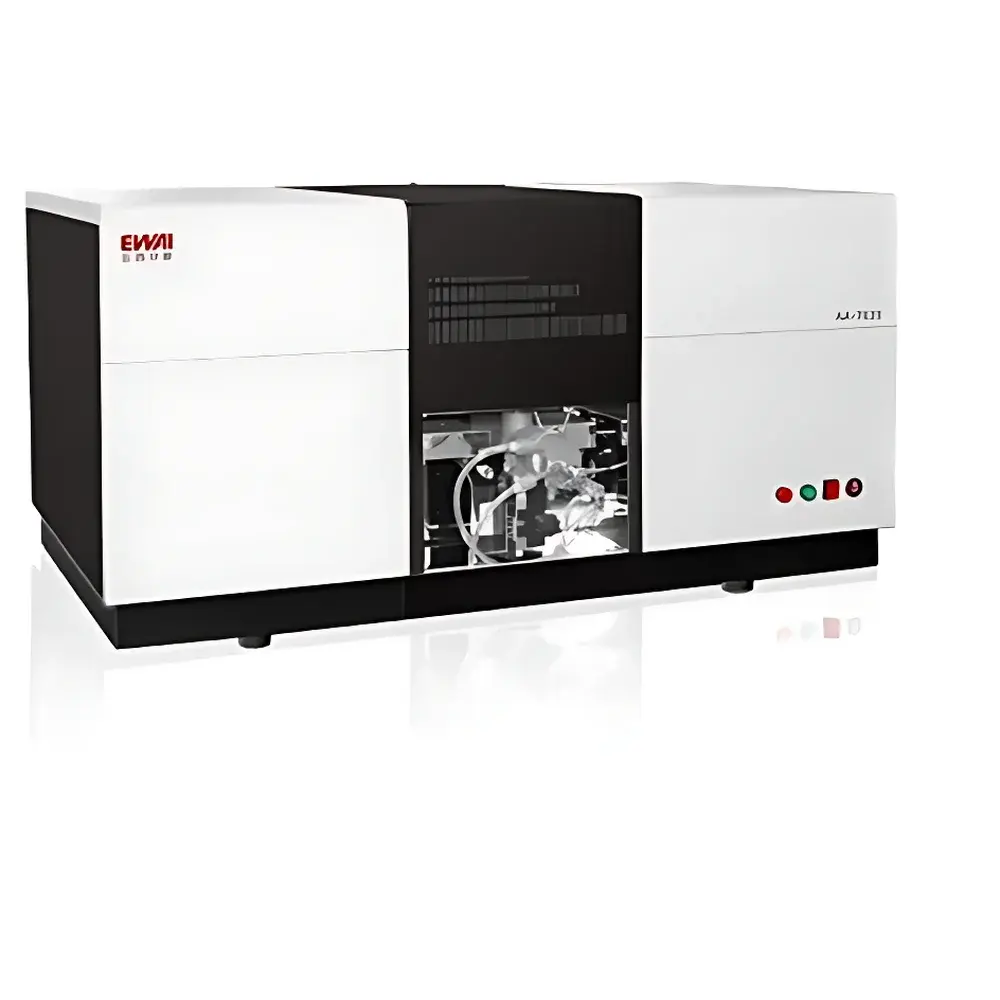
English Product Name
| Brand | Dongxi Analytical |
|---|---|
| Origin | Beijing, China |
| Manufacturer Type | Direct Manufacturer |
| Instrument Type | Flame and Graphite Furnace AAS |
| Monochromator | Concave Grating (1800 lines/mm) |
| Optical System | Double-Beam |
| Detector | Photomultiplier Tube (PMT) |
| Background Correction | D₂ Lamp + Self-Absorption Method |
| Resolution | <0.2 nm |
| Sensitivity | Cu 0.015 µg/mL (Flame), Cd 0.5 pg (Graphite Furnace) |
| Repeatability (RSD) | Flame RSD ≤0.6% (Cu), Graphite Furnace RSD ≤2% (Cd) |
| Detection Limit | Flame: 0.002–0.005 mg/L (e.g., Cu) |
| Graphite Furnace | 0.1–5 pg (e.g., Cd, Pb, As) |
Overview
The Dongxi Analytical AA-7020 is a dual-atomization atomic absorption spectrophotometer engineered for high-precision elemental quantification across environmental, clinical, food safety, pharmaceutical, and geological laboratories. It operates on the fundamental principle of atomic absorption spectroscopy (AAS), where ground-state free atoms in a flame or graphite furnace absorb characteristic radiation emitted by a hollow cathode lamp. The instrument integrates flame atomization for routine ppm-level analysis and electrothermal graphite furnace atomization for sub-pg trace metal determination—enabling seamless transition between microgram and picogram detection regimes without mechanical reconfiguration. Its optical architecture employs a double-beam design with a suspended Czerny-Turner monochromator featuring an 1800-line/mm concave grating, ensuring superior spectral resolution (<0.2 nm), reduced stray light, and enhanced signal-to-noise ratio. The system conforms to ISO/IEC 17025 analytical validation requirements and supports GLP-compliant workflows through audit-trail-capable software.
Key Features
- Dual-Atomizer Platform with Sub-Second Switching: Flame and graphite furnace atomizers are co-mounted on a patented precision-machined platform (Patent No. ZL 2006 2 0023297.4), enabling full optical and gas-path alignment. Atomizer switching is completed in ≤2 seconds—eliminating manual disassembly, reducing misalignment risk, and minimizing downtime.
- Advanced Graphite Furnace Design: Features a square-section furnace body to prevent coolant leakage, modular replaceable graphite cones for stable electrode contact, and longitudinal heating technology capable of precise temperature control up to 3000 °C—validated for high-boiling-point elements including Al, Ni, Pd, and Sr.
- Optimized Gas Management: Dual-gas flow control delivers argon with 5–10% O₂ during low-temperature ashing (≤500 °C) to oxidize organic matrix, followed by pure argon purge above 500 °C to suppress graphite oxidation and extend tube lifetime.
- Enhanced Safety Architecture: Integrated flame safety logic links water-seal float level to electromagnetic valve actuation, preventing acetylene release under low-water conditions. Real-time monitoring of fuel gas pressure, air supply, flame status, cooling water flow, and argon pressure triggers audible/visual alarms and automatic power/gas cutoff.
- Full Automation Suite: Auto-wavelength scanning, slit width selection, lamp current optimization, PMT gain balancing, and background correction mode activation are executed within 40 seconds. Flame height is dynamically adjusted via motorized burner head positioning.
- Robust Optical Stability: The entire optical train—including monochromator, mirrors, and detector—is mounted on a thermally insulated, vibration-damped base (Patent No. ZL 2006 2 0023296.X), ensuring long-term wavelength stability even in non-climate-controlled or mechanically noisy lab environments.
Sample Compatibility & Compliance
The AA-7020 accommodates liquid samples ranging from ultrapure standards to complex high-salt matrices such as seawater, biological digests, food extracts (e.g., soy sauce, infant formula), and wastewater. Its dual background correction—simultaneous deuterium lamp and self-absorption methods—enables accurate quantification in samples with elevated molecular absorption or scattering interference. The all-titanium burner head and nebulizer chamber resist corrosion from HNO₃, HCl, and HF-based digestion solutions, supporting compliance with EPA Method 200.7, ISO 11885, and ASTM D1688 for metals in water. Optional N₂O-C₂H₂ flame configuration extends measurable element range to refractory species (e.g., V, Mo, Ti), satisfying USP heavy metals testing requirements.
Software & Data Management
Control and data acquisition are managed via Dongxi’s proprietary AAWin software, compliant with FDA 21 CFR Part 11 for electronic records and signatures. The platform supports multi-point calibration curves with forced zero intercept, QC check standards at user-defined intervals (e.g., every 5th sample), and automatic recalibration prompts based on slope drift thresholds. Audit trails log all parameter changes, measurement events, and instrument status transitions with timestamped operator ID. Export formats include CSV, XML, and PDF reports compatible with LIMS integration. Optional QC module implements statistical process control (SPC) charts and Westgard rules for ongoing method performance verification.
Applications
- Environmental monitoring: Quantification of Pb, Cd, As, Hg, and Cr(VI) in drinking water per WHO guidelines and EU Directive 2020/2184.
- Clinical toxicology: Trace metal profiling (Zn, Cu, Se, Mn) in serum and whole blood using graphite furnace mode with Zeeman background correction.
- Food and agriculture: Multi-element screening in cereals, dairy, and seafood for regulatory compliance (e.g., China GB 5009.12–2023, EU Commission Regulation (EU) No 836/2011).
- Pharmaceutical quality control: Residual catalyst metals (Pd, Pt, Rh) in active pharmaceutical ingredients (APIs) per ICH Q2(R2) validation criteria.
- Geological prospecting: Rapid determination of Au, Ag, and rare earth elements in acid-digested rock samples with hydride generation accessory compatibility.
FAQ
What atomization modes does the AA-7020 support?
It supports flame atomization (air-acetylene and optional nitrous oxide-acetylene) and electrothermal graphite furnace atomization—both accessible via automated hardware switching.
Is the instrument compliant with international regulatory standards?
Yes. Its optical design, background correction accuracy, and software architecture align with ISO/IEC 17025, ASTM E1995, and FDA 21 CFR Part 11 requirements for validated analytical instrumentation.
Can the AA-7020 perform hydride generation analysis?
Yes. With optional hydride generation accessory installation, it enables cold vapor and hydride-forming element analysis (As, Se, Sb, Bi, Te, Pb, Sn, Ge) in under 60 seconds.
What maintenance intervals are recommended for the graphite furnace?
Under typical usage (500–800 firings/year), graphite tubes require replacement every 200–300 firings; graphite cones every 1,000–1,500 firings. Full preventive maintenance is advised every 6 months or 1,000 operating hours.
Does the system support remote diagnostics or service access?
Yes. Optional Ethernet-enabled remote support allows authorized Dongxi service engineers to perform firmware updates, diagnostic logging, and calibration verification without on-site visits.
Related Products






