
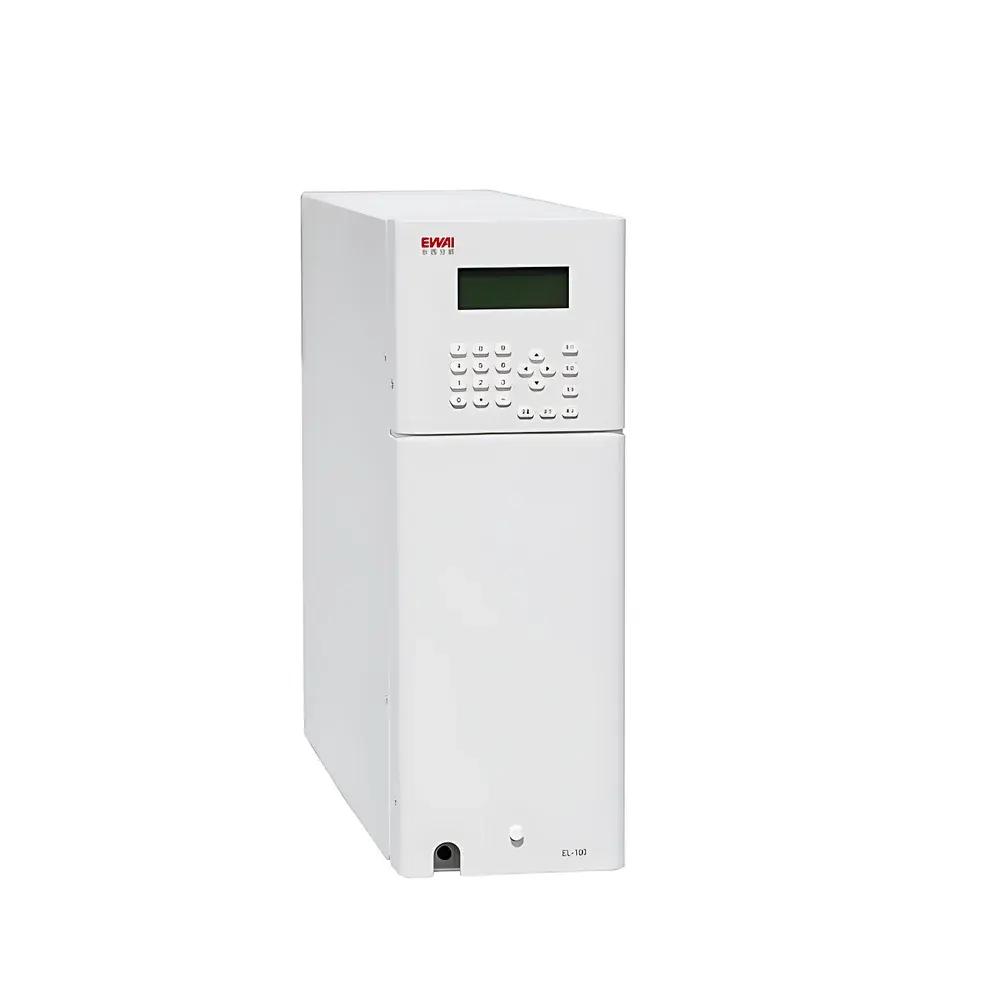
English Product Name
| Brand | Dongxi Analysis |
|---|---|
| Origin | Beijing, China |
| Manufacturer Type | Manufacturer |
| Country of Origin | Domestic (China) |
| Model | EL-100 |
| Instrument Type | Evaporative Light Scattering Detector (ELSD) |
| Wavelength | 450 nm (blue LED) |
| Detection Method | Photomultiplier Tube (PMT) |
| Light Source | High-Stability Blue LED |
| Evaporation Zone Temperature Range | Ambient to 100 °C |
| Temperature Control Accuracy | ±1 °C |
| Solvent Flow Rate Compatibility | 10 µL/min – 3 mL/min |
| Nebulizing Gas Flow Rate | 300 mL/min – 1.5 L/min |
| Nebulizing Gas Pressure | 0.2–0.5 MPa |
| Detection Limit | <1 ng (glucose, direct injection) |
| Baseline Noise | <0.1 mV (at 1 mL/min mobile phase flow) |
| Dimensions (W×D×H) | 165 × 470 × 580 mm |
Overview
The Dongxi Analysis EL-100 Evaporative Light Scattering Detector (ELSD) is a universal, mass-sensitive detection system engineered for integration with any high-performance liquid chromatography (HPLC) platform. Operating on the principle of nebulization, solvent evaporation, and light scattering detection, the EL-100 enables quantitative analysis of non-volatile and semi-volatile analytes that lack chromophores or fluorophores — including carbohydrates, lipids, polymers, surfactants, and underivatized amino acids. Unlike UV-Vis or fluorescence detectors, the EL-100 does not require analyte-specific optical properties; instead, it responds proportionally to the mass of non-volatile residue remaining after controlled evaporation of the mobile phase. This makes it especially valuable in method development for complex matrices where reference standards are unavailable or structural information is incomplete. The detector’s robust architecture supports gradient elution across a wide range of solvents — from volatile acetonitrile/water mixtures to high-boiling-point chlorinated or ethereal solvents — without generating solvent front artifacts or baseline drift induced by temperature fluctuations.
Key Features
- Dual-orifice quartz nebulizer: Engineered for stable aerosol generation without self-aspiration; relies on high-pressure HPLC pump delivery for consistent flow-driven雾化. Integrated impact bead enhances droplet breakup efficiency, while a precision-engineered small-diameter carrier gas outlet reduces nitrogen consumption by up to 30% and minimizes clogging risk.
- Optimized drift tube design: Heated zone directly bonded to the outer wall of the stainless-steel drift tube ensures rapid thermal equilibration and uniform temperature distribution. Paired with a calibrated platinum resistance thermometer (PT100) and redundant overtemperature cutoff circuitry, the system maintains ±1 °C stability across the full 0–100 °C operating range.
- Stabilized blue LED light source: Driven by constant-current circuitry, the 450 nm LED delivers low-noise, long-lifetime illumination with negligible intensity drift over time — critical for reducing baseline noise (<0.1 mV at 1 mL/min) and improving signal reproducibility across multi-day sequences.
- Side-window photomultiplier tube (PMT) detection cell: Equipped with collimating lens and precision aperture to suppress stray light, enabling high signal-to-noise ratio detection of scattered photons from dried analyte particles. The PMT gain is software-adjustable to accommodate diverse concentration ranges without hardware modification.
- Front-panel LCD interface and dual-control architecture: Real-time status monitoring (temperature, gas pressure, lamp status, error codes) via intuitive graphical display. Full operational control available either through tactile keypad navigation or via PC-based chromatography data system (CDS) software.
Sample Compatibility & Compliance
The EL-100 is compatible with all common reversed-phase, normal-phase, and HILIC mobile phases, including gradients containing methanol, acetonitrile, THF, chloroform, and isopropanol. It accommodates post-column addition of volatile modifiers such as ammonium acetate, acetic acid, trifluoroacetic acid (TFA), and triethylamine to improve peak shape and response for polar or ionizable compounds. The detector meets essential regulatory requirements for QC/QA laboratories: its firmware and workstation software support audit trail functionality, user access levels, electronic signatures, and data integrity controls aligned with FDA 21 CFR Part 11 and EU Annex 11 expectations. All hardware components comply with IEC 61010-1 safety standards for laboratory electrical equipment.
Software & Data Management
The EL-100 integrates seamlessly with Dongxi’s proprietary ChromaLink CDS software — validated for GMP environments and designed to meet ALCOA+ (Attributable, Legible, Contemporaneous, Original, Accurate, Complete, Consistent, Enduring, Available) data governance principles. Raw detector signals are acquired at ≥10 Hz sampling rate and stored in vendor-neutral .CDF format (compatible with OpenLab CDS, Chromeleon, and Empower). Software features include real-time baseline correction algorithms, automatic gain optimization, customizable event markers for fraction collection triggers, and export-ready report templates compliant with ISO/IEC 17025 documentation requirements.
Applications
The EL-100 is routinely deployed in pharmaceutical quality control (e.g., assay of excipients, residual solvents, and degradation products), natural product isolation (e.g., saponins, flavonoid glycosides, polysaccharides), food and nutraceutical analysis (e.g., triglycerides, phospholipids, prebiotic oligosaccharides), polymer characterization (e.g., molecular weight distribution of PEGs and PLGA), and environmental screening (e.g., non-ionic surfactants in wastewater). Its mass-proportional response facilitates relative quantitation of unknowns when certified standards are absent — a capability particularly advantageous during early-stage R&D and impurity profiling.
FAQ
Can the EL-100 be used with UHPLC systems?
Yes — the detector supports flow rates down to 10 µL/min and is compatible with low-volume microbore and capillary columns when paired with appropriate restrictor tubing and optimized gas flow settings.
What carrier gases are recommended?
Dry, oil-free nitrogen is preferred for lowest background noise; compressed, desiccated air may be substituted if nitrogen supply is constrained, provided particulate and hydrocarbon filters are installed upstream.
Is method transfer possible between different ELSD models?
Method parameters (evaporation temperature, gas flow, gain) are instrument-specific due to variations in drift tube geometry and PMT sensitivity; however, the EL-100’s standardized analog/digital output interface simplifies revalidation protocols per ICH Q2(R2).
Does the EL-100 support GLP-compliant data archiving?
Yes — ChromaLink CDS provides secure, time-stamped audit trails, role-based permissions, and encrypted raw data storage compliant with OECD GLP Principles and FDA guidance on electronic records.
How often does the nebulizer require maintenance?
Under typical use (≤2 mL/min aqueous/organic gradients), the quartz nebulizer requires cleaning every 2–3 weeks using ultrasonic bath immersion in 50% methanol/water; replacement interval exceeds 12 months with proper mobile phase filtration (≤0.22 µm).





