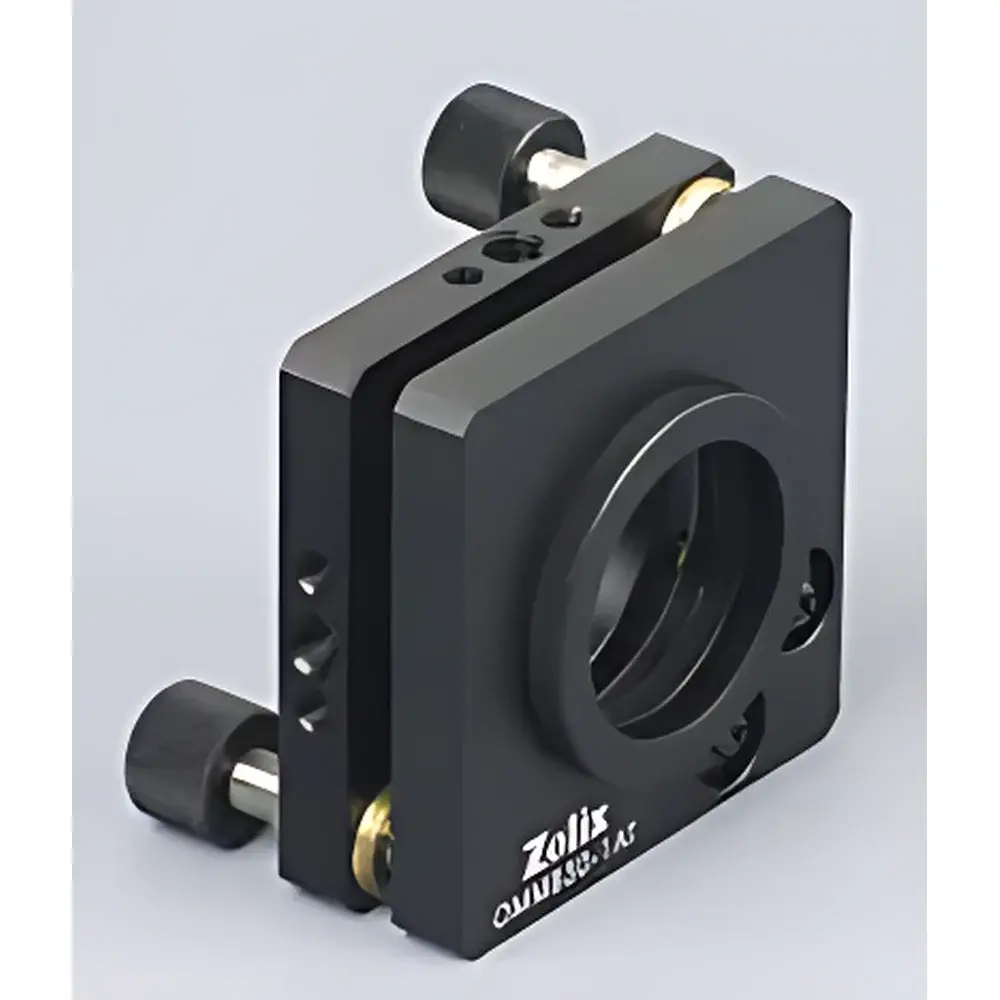
English Product Name
| Origin | Beijing, China |
|---|---|
| Manufacturer Type | Distributor |
| Origin Category | Domestic (China-made) |
| Model | OMMB15-1AT, OMMB20-1AT, OMMB25-1AT, OMMB25.4-1AT, OMMB30-1AT, OMMB50-1AT |
| Aperture Diameter (A) | 15 mm, 20 mm, 25 mm, 25.4 mm, 30 mm, 50 mm |
| Base Width (B) | 13 mm, 18 mm, 23 mm, 23 mm, 28 mm, 47 mm |
| Mass | 0.10 kg – 0.18 kg |
| Mounting Mechanism | Enclosed ring-clamp with threaded insert and disc-spring return |
Overview
The Zolix OMMB Series Reflective Beam Splitter Mounts are precision-engineered optical mounts designed for stable, repeatable positioning of reflective beam splitters—including dielectric, metallic, and broadband coated variants—in free-space optical setups. These mounts operate on a kinematic, three-point contact principle with integrated angular adjustment capability, enabling fine-tuning of incidence angle (±3° typical range) while maintaining high mechanical stability under thermal drift and vibration. Unlike open-frame or post-mounted alternatives, the OMMB series employs a fully enclosed housing architecture that shields internal adjustment mechanisms from dust, particulate contamination, and accidental torque-induced misalignment—critical for long-duration interferometric, spectroscopic, or laser cavity alignment applications. Each unit is machined from high-grade anodized aluminum alloy (6061-T6), ensuring dimensional stability across ambient laboratory conditions (15–30 °C) and compatibility with vacuum-compatible variants upon request. The mount interfaces seamlessly with standard Ø12.7 mm and Ø25.4 mm optical posts via M4 and M6 tapped holes, supporting modular integration into larger optical breadboard or cage system configurations.
Key Features
- Enclosed structural design prevents debris ingress and preserves adjustment integrity over extended operational cycles.
- Ring-clamp retention mechanism applies uniform radial pressure to beam splitter substrates (thickness range: 1–6 mm), minimizing edge stress and avoiding birefringence-induced wavefront distortion.
- Threaded brass inserts in all adjustment screws ensure wear resistance and consistent torque response across >10,000 adjustment cycles.
- Disc-spring–based return system provides deterministic, hysteresis-free repositioning after angular reset—essential for multi-position experimental protocols requiring traceable repeatability.
- Low-mass construction (0.10–0.18 kg) reduces inertial loading on motion stages and minimizes resonance coupling in active stabilization environments.
- Standardized mounting foot geometry enables direct compatibility with PHSP-series support rods and industry-standard optical rails (e.g., Thorlabs TR series, Newport U-channel).
Sample Compatibility & Compliance
The OMMB mounts accommodate reflective beam splitters with clear apertures ranging from 15 mm to 50 mm and substrate thicknesses between 1.0 mm and 6.0 mm. Compatible optics include fused silica, BK7, CaF₂, and UV-grade quartz substrates with metallic (Al/MgF₂, Ag) or dielectric coatings (R/T ratios from 50:50 to 90:10 across 250–1100 nm). All units conform to ISO 10110-7 surface form tolerances (λ/10 @ 633 nm) for mounting surfaces and meet RoHS 2011/65/EU material compliance requirements. While not certified to ISO 9001 at the component level, the manufacturing process adheres to documented quality control checkpoints aligned with GLP-aligned optical assembly practices.
Software & Data Management
As a passive mechanical mount, the OMMB series requires no firmware, drivers, or software integration. However, its dimensional consistency and angular reproducibility support traceable calibration workflows when used in conjunction with motorized rotation stages (e.g., Zolix RSA series) and position-sensing systems. Angular offset data may be logged externally via encoder feedback or interferometric alignment tools, enabling full audit trails compliant with ISO/IEC 17025 documentation standards for metrology-lab environments.
Applications
- Laser cavity output coupling and intracavity beam sampling in CW and pulsed solid-state laser systems.
- Interferometer arm balancing in Michelson, Mach–Zehnder, and Sagnac configurations.
- Beam routing and polarization management in ellipsometry and Mueller matrix polarimetry platforms.
- Multi-channel spectral splitting in FTIR and Raman spectrometer optical benches.
- Alignment reference fixtures in optical coherence tomography (OCT) source and detection arms.
- Education and training labs requiring robust, student-safe beam manipulation hardware with minimal setup complexity.
FAQ
Can the OMMB mount accommodate wedged or tilted beam splitters?
Yes—the enclosed clamp design allows secure fixation of substrates with wedge angles up to 3° without compromising clamping force distribution or introducing astigmatic error.
Is thermal expansion compensated in the mount design?
No active compensation is implemented; however, the matched CTE (23.6 × 10⁻⁶ /K) between the aluminum housing and standard BK7 substrates limits relative drift to <0.5 arcsec/°C over the 20–25 °C range.
What is the maximum recommended torque for the adjustment screws?
0.25 N·m maximum—exceeding this value risks brass insert deformation and loss of angular repeatability.
Are vacuum-compatible versions available?
Standard units are air-only rated; vacuum variants (10⁻⁶ mbar) with stainless steel fasteners and dry-lubricated threads can be ordered as custom configurations.
Does the mount include alignment fiducials or reference marks?
Each unit features laser-etched centerline indicators on the base plate and top housing surface, aligned to the optical axis within ±10 µm tolerance.