
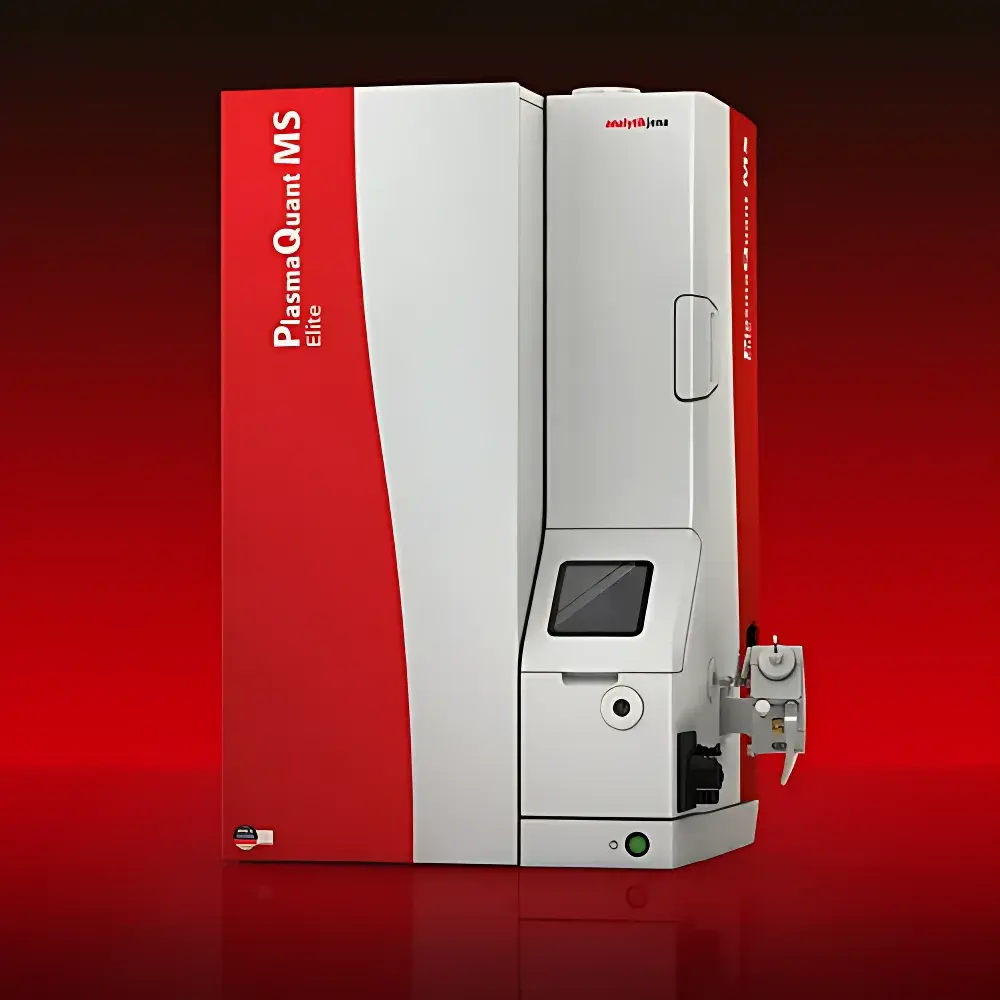
English Product Name
| Brand | Analytik Jena |
|---|---|
| Origin | Germany |
| Manufacturer Type | Original Equipment Manufacturer (OEM) |
| Origin Category | Imported |
| Model | PQMS Elite |
| Instrument Type | Quadrupole ICP-MS |
| Sensitivity (7Li) | >90 Mcps/mg·L⁻¹ |
| Sensitivity (115In) | >1500 Mcps/mg·L⁻¹ |
| Sensitivity (232Th) | >1000 Mcps/mg·L⁻¹ |
| Vacuum System | Dual 300 L/s Turbo Molecular Pumps + High-Capacity Rotary Vane Pump |
| Typical Analysis Cycle Time to Operational Vacuum | <5 min |
| Base Pressure | 1×10⁻⁸–1×10⁻⁹ mbar |
Overview
The Analytik Jena PQMS Elite is a high-performance quadrupole-based inductively coupled plasma mass spectrometer (ICP-MS) engineered for ultra-trace elemental analysis in environmental, clinical, geochemical, and nuclear applications. It operates on the fundamental principle of ionization in a high-temperature argon plasma (~7000 K), followed by mass separation via a radiofrequency-driven quadrupole mass filter and detection using a fully digital pulse-counting/analog-switching detector. Designed and manufactured in Jena, Germany, the PQMS Elite integrates proprietary innovations—including the industry’s first 90° ion mirror, cone-mounted collision/reaction cell (CRC), and fully digital detector architecture—to deliver exceptional sensitivity, long-term stability, and operational robustness under routine laboratory conditions.
Key Features
- Energy-Efficient Plasma Operation: Consumes approximately 50% less argon than conventional ICP-MS systems—reducing annual gas costs by ~USD 10,000 and lowering total cost of ownership over instrument lifetime without compromising analytical performance.
- Patented 90° Ion Mirror (introduced 2003): Reflects ions while rejecting neutral species, photons, and solvent-based background—significantly reducing cone and interface contamination, extending maintenance intervals, and improving signal-to-noise ratio (S/N) across the mass range.
- Cone-Mounted Collision/Reaction Cell: Positioned at the skimmer cone rather than within the high-vacuum region; enables rapid, safe introduction of H₂ or He for polyatomic interference removal (e.g., ⁴⁰Ar³⁵Cl⁺ on ⁷⁵As⁺, ⁴⁰Ar⁴⁰Ar⁺ on ⁸⁰Se⁺). Hydrogen is supplied via an integrated electrolytic H₂ generator—eliminating high-pressure cylinder handling and associated safety risks.
- Full-Digital Detector Architecture: Eliminates mode-switching between pulse-counting and analog detection; provides linear dynamic range exceeding 10⁸, consistent gain calibration, and extended detector lifetime—even during high-signal analyses.
- High-Integrity Vacuum System: Features two 300 L/s turbomolecular pumps backed by a high-capacity rotary vane pump; achieves operational vacuum (<1×10⁻⁷ mbar) in under 5 minutes and sustains base pressure of 1×10⁻⁸–1×10⁻⁹ mbar—critical for minimizing background noise and maximizing sensitivity and mass stability.
Sample Compatibility & Compliance
The PQMS Elite supports direct aqueous sample introduction (via concentric nebulizer and spray chamber), as well as laser ablation (LA-ICP-MS) and hydride generation (HG-ICP-MS) interfaces—enabling solid, liquid, and gaseous sample analysis. Its hardware and firmware architecture comply with ISO/IEC 17025 requirements for testing laboratories and supports audit-ready data integrity features aligned with FDA 21 CFR Part 11 and EU Annex 11 expectations—including electronic signatures, user access control, and immutable audit trails for method parameters and raw data files. Routine operation meets ASTM D5673 (trace metals in water), ISO 17294-2 (water quality), and USP / (elemental impurities in pharmaceuticals).
Software & Data Management
Controlled via the proprietary Qtegra Intelligent Scientific Data Solution™ software, the PQMS Elite offers intuitive method setup, real-time spectral visualization, automated tuning (including mass calibration, sensitivity optimization, and CRC gas flow adjustment), and customizable reporting templates. All raw data are stored in vendor-neutral .raw format compliant with ASTM E1947 and accessible via third-party chemometrics platforms. The software includes built-in QC monitoring (e.g., internal standard drift, oxide ratio, doubly charged ion ratio) and supports GLP/GMP workflows with full electronic record retention, version-controlled methods, and configurable review/approval workflows.
Applications
The PQMS Elite is routinely deployed for sub-pg/g quantification of isotopes in diverse matrices: ultrapure semiconductor chemicals (ASTM F1879), geological reference materials (NIST SRM 610), human serum (clinical trace element panels), nuclear fuel cycle samples (²³⁶U/²³⁸U ratio determination), and environmental waters (EPA Method 6020B). Its high sensitivity and interference mitigation capabilities make it particularly suited for low-abundance isotopes (e.g., ¹⁸⁰Ta, ²⁰⁵Tl) and challenging multi-element analyses where matrix suppression or polyatomic overlap would compromise accuracy in conventional instruments.
FAQ
What is the typical detection limit for common elements such as Cd, Pb, and U?
Detection limits are matrix- and condition-dependent; under optimized conditions with standard sample introduction, typical instrumental detection limits (IDLs) range from 0.01–0.05 pg/L for Cd, Pb, and U isotopes.
Does the PQMS Elite support hyphenated techniques such as LC-ICP-MS?
Yes—the system is compatible with external chromatographic interfaces via its universal sample introduction port and time-resolved acquisition mode, supporting speciation analysis per EPA Method 1638.
Is remote diagnostics and service support available?
Analytik Jena provides secure remote connectivity for proactive diagnostics, firmware updates, and technical assistance through its global service network—subject to customer-configured firewall policies and IT governance protocols.
Can the instrument be upgraded to accommodate future regulatory requirements?
Hardware modules—including the CRC, detector, and vacuum system—are designed for field-upgradability; software updates are delivered quarterly to ensure alignment with evolving ISO, ASTM, and pharmacopeial standards.
Related Products





