
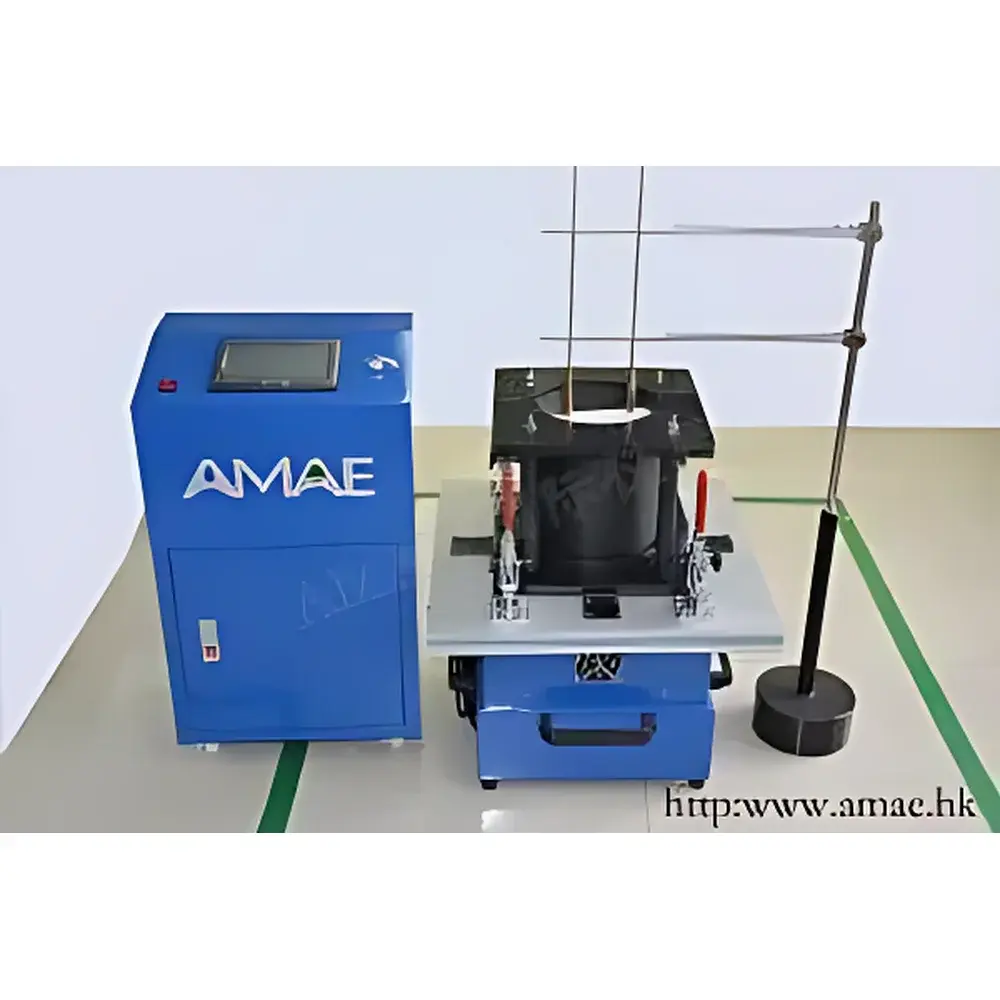
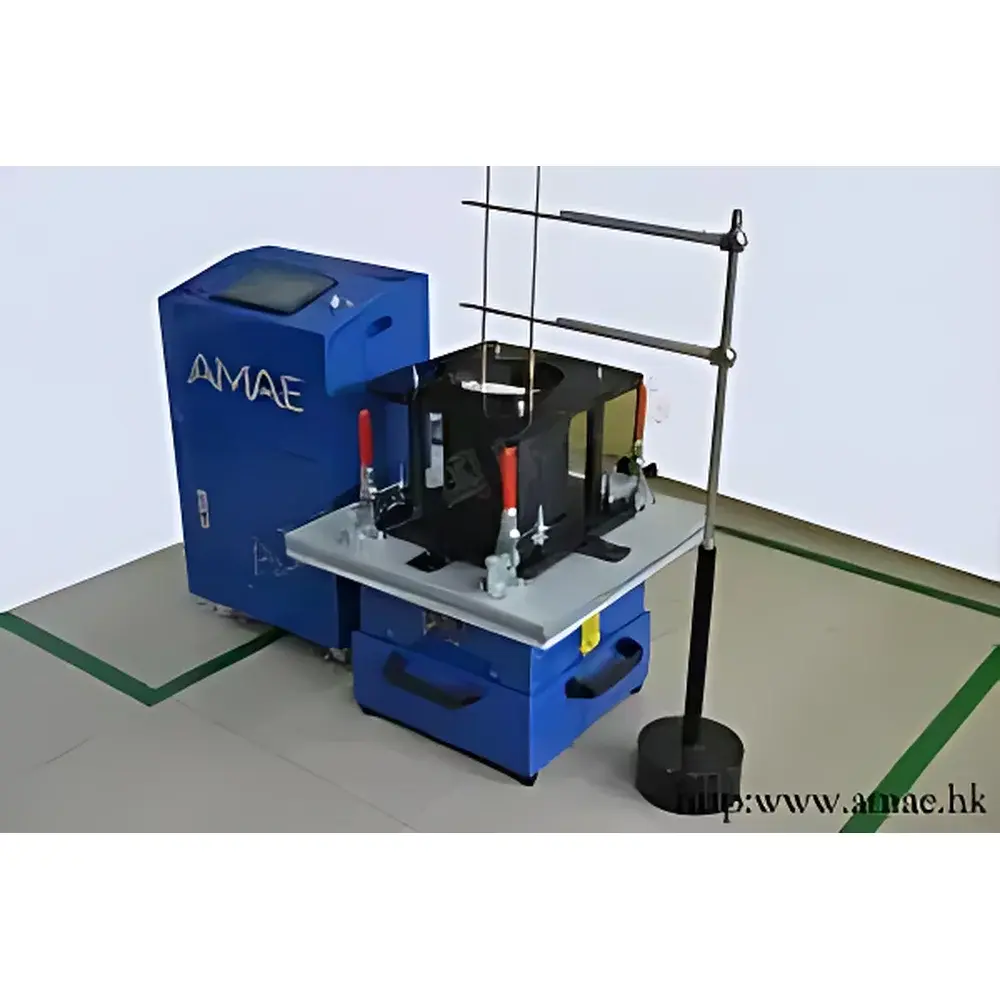
English Product Name
| Brand | AMAE |
|---|---|
| Model | MI-1000A |
| Origin | Guangdong, China |
| Dimensions (L×H×W) | 500 × 200 × 500 mm |
| Vibration Direction | Vertical |
| Max Load Capacity | 100 kg |
| Adjustable Peak-to-Peak Amplitude | 0–5 mm |
| Vibration Waveform | Sine |
| Frequency | 50 Hz |
| Insertion Rod Masses | 88 g and 177 g |
| Power Supply | 220 V ±10%, 5 A max |
| Environmental Requirement | Temperature- and humidity-controlled, draft-free |
| Sample Container Options | Small cylinder (1.7 L, for particles ≤10 mm) |
| Compliance | IMSBC Code Annex 1, Section 3.1.2 |
Overview
The AMAE MI-1000A Flow Moisture Point (FMP) and Transportable Moisture Limit (TML) Tester is a precision-engineered laboratory instrument designed to determine the critical moisture thresholds of solid bulk cargoes prone to liquefaction during maritime transport. It operates on the principle of controlled vertical sinusoidal vibration applied to a confined sample within standardized cylindrical containers, inducing progressive pore water pressure buildup until surface liquefaction—marked by the penetration depth of a calibrated copper rod—is observed. This empirical method directly implements the test protocol specified in the International Maritime Solid Bulk Cargoes (IMSBC) Code, Annex 1, Section 3.1.2, and supports compliance with IMO Resolution MSC.354(92) and associated classification society requirements. The instrument is not a generic vibrator but a purpose-built metrological system where amplitude, frequency, timing, and rod mass are rigorously defined and repeatable—ensuring inter-laboratory comparability essential for cargo declaration, port state control, and pre-shipment certification.
Key Features
- Vertical vibration platform delivering stable 50 Hz sine-wave excitation with peak-to-peak amplitude continuously adjustable from 0 to 5 mm—enabling precise replication of the IMSBC-specified dynamic loading profile.
- Dual-mass insertion rods (88 g and 177 g), fabricated from non-magnetic, non-porous, high-stiffness copper, minimizing thermal expansion effects and ensuring consistent penetration force across repeated trials.
- Two standardized sample cylinders: a 1.7 L small cylinder compliant with IMSBC requirements for materials with maximum particle size ≤10 mm; and a 4.7 L large cylinder for materials with maximum particle size ≤25 mm—both manufactured to dimensional tolerances per IMSBC Annex 1 Figure 3.1.
- Programmable digital timer with second-level resolution, allowing user-defined vibration duration up to 999 seconds—critical for capturing the onset of flow behavior at varying moisture contents.
- Robust mechanical architecture supporting up to 100 kg total mass (including cylinder, sample, and fixtures), ensuring minimal resonance interference and high reproducibility under full-load conditions.
- Integrated safety circuitry including over-current protection (5 A max), voltage regulation (±10% tolerance), and thermal cutoff—meeting IEC 61000-6-2 electromagnetic compatibility and IEC 61000-6-3 emission standards.
Sample Compatibility & Compliance
The MI-1000A accommodates granular or powdered solid bulk cargoes—including iron ore fines, nickel ore, bauxite, coal slurry, and mineral concentrates—provided particle size distribution conforms to IMSBC-defined limits. Sample preparation follows ISO 17892-1 (Geotechnical investigation and testing — Laboratory testing of soil — Part 1: Determination of water content) and ASTM D4318 (Standard Test Methods for Liquid Limit, Plastic Limit, and Plasticity Index of Soils), adapted for coarse-grained systems. All test procedures align with IMSBC Code mandatory testing methodology, and results are admissible for submission to flag state authorities, port state control officers, and classification societies (e.g., LR, DNV, ABS, ClassNK). The system supports GLP-aligned documentation practices, including operator ID logging, date/time stamping, and manual entry of sample identification and moisture content values—facilitating audit readiness under IMO regulatory frameworks.
Software & Data Management
The MI-1000A operates as a hardware-controlled analog-digital hybrid system without embedded firmware or proprietary software. All operational parameters—vibration duration, rod mass used, cylinder type, ambient temperature/humidity (recorded manually), and observed penetration depth—are documented in accordance with IMSBC-prescribed reporting format (Annex 1, Table 3.1). Laboratories integrate the instrument into validated LIMS or ELN platforms via standardized PDF report templates or Excel-based data capture sheets aligned with ISO/IEC 17025:2017 Clause 7.5 (Technical records). While no real-time data export interface is included, the design prioritizes traceability: each test cycle requires explicit operator sign-off, and physical test logs—including cylinder calibration certificates and rod mass verification records—are retained for minimum 5 years per IMO guidance on cargo declaration validity.
Applications
- Determination of Flow Moisture Point (FMP) for solid bulk cargoes prior to ocean shipment, fulfilling SOLAS Chapter VI/Regulation 5 and IMSBC Code Chapter 1.1 obligations.
- Derivation of Transportable Moisture Limit (TML) as 90% of the FMP value, required for cargo declaration forms (e.g., IMO Form FMC-1) and vessel loading plans.
- Pre-shipment quality assurance in mining and commodity trading laboratories, supporting contractual moisture specifications and dispute resolution.
- Research and development of moisture stabilization additives or dewatering protocols for high-risk ores.
- Training and proficiency testing for port laboratory personnel accredited under IMO Model Course 1.39 (Safe Handling of Solid Bulk Cargoes).
FAQ
Does the MI-1000A comply with the latest IMSBC Code amendments?
Yes—the mechanical configuration, cylinder dimensions, rod masses, and vibration parameters conform strictly to IMSBC Code 2023 Edition, Annex 1, Section 3.1.2.
Can the instrument be used for materials with particles larger than 25 mm?
No—per IMSBC requirements, the large cylinder is validated only for particles ≤25 mm. Samples exceeding this limit must undergo size reduction or alternative testing per IMO Circular MSC.1/Circ.1623.
Is calibration traceable to national standards?
Rod masses are certified to ISO/IEC 17025-accredited mass calibration services (e.g., NIM, NIST-traceable reference weights). Cylinder volumes are verified using gravimetric water-fill methods per ISO 4787.
What environmental conditions are mandatory during testing?
Testing must occur in a climate-controlled room (20 ±2 °C, 50 ±5% RH) with no air drafts—verified prior to each test batch per IMSBC Section 3.1.2.3.
Is operator training included with purchase?
AMAE provides a comprehensive IMSBC-aligned test procedure manual and video-based SOPs; third-party IMO-certified training is recommended for initial operator qualification.



