
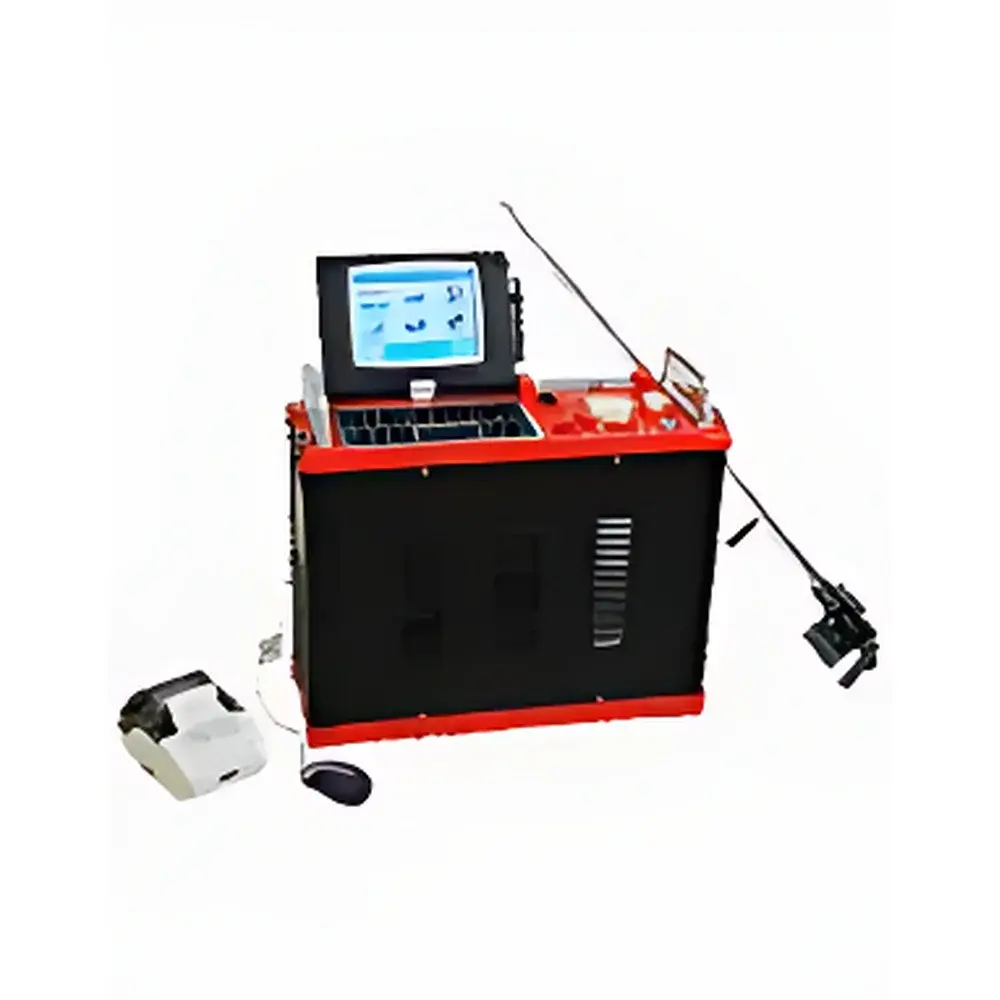
English Product Name
| Origin | Qingdao, Shandong, China |
|---|---|
| Manufacturer Type | Authorized Distributor |
| Origin Category | Domestic (China) |
| Model | 3012H |
| Pricing | Available Upon Request |
| Sampling Principle | Isokinetic Sampling via Pitot Tube + Gravimetric Collection |
| Gas Detection Method | Potentiostatic Electrolysis |
| Operating Power | AC 220 V ±10%, 50 Hz or DC 12 V |
| Dimensions | 450 × 168 × 410 mm |
| Weight | ~10.0 kg |
| Noise Level | <65 dB(A) |
| Power Consumption | <180 W |
| Data Storage Capacity | >100,000 measurement records |
Overview
The Qingdao 3012H Automatic Flue Gas and Particulate Emission Analyzer is an integrated field-deployable instrument engineered for regulatory-compliant stack emission monitoring in industrial combustion sources. It implements isokinetic sampling—guided by real-time Pitot tube differential pressure measurements—to ensure representative particulate capture in accordance with ISO 9096, EPA Method 5, and GB/T 16157–1996. Simultaneously, it quantifies key gaseous pollutants—including O₂, SO₂, NO, NO₂, CO, H₂S, and CO₂—using certified potentiostatic electrolytic sensors calibrated per IEC 60779 and EN 50104. Designed for continuous operation under variable flue conditions (e.g., temperature up to 500 °C, expandable to 800 °C; static pressure range −30 to +30 kPa), the system delivers traceable, audit-ready data essential for environmental compliance reporting, desulfurization/dedusting efficiency evaluation, and periodic stack testing required by local ecological authorities and ISO 14001-certified facilities.
Key Features
- Embedded high-speed industrial microcomputer running Windows CE OS with full Chinese/English UI support and touchscreen navigation (with optional external mouse compatibility)
- 6.5-inch industrial-grade TFT color display (high-brightness, wide viewing angle) for real-time visualization of flue parameters, gas concentrations, and isokinetic tracking status
- Automatic isokinetic flow control with ≤4 s dynamic response time and stability maintained at ±2% across input voltage fluctuations (180–250 V AC) and backpressure variations (3–6 kPa)
- Dual-mode power supply: AC 220 V ±10% / 50 Hz or DC 12 V, enabling uninterrupted operation during grid instability or mobile deployment
- Integrated thermoelectric (Peltier) cooling module for active moisture removal—critical for accurate gravimetric particulate analysis and sensor protection in high-humidity flue streams
- Self-diagnostic gas-tightness verification, dust-backflow prevention, and intelligent fault detection with audible/visual alerts and automatic pump shutdown on overpressure or filter clogging
- High-efficiency multi-stage particulate filtration upstream of electrochemical sensors to extend service life (typical 2-year operational lifespan in ambient air)
- USB interface and U-disk bidirectional data transfer capability, supporting offline report generation and database synchronization
Sample Compatibility & Compliance
The 3012H supports sampling from ducts and stacks with diameters ≥100 mm and flue gas velocities between 5 (2) and 45 m/s. Its modular sensor configuration accommodates optional gas modules for O₂ (0–25% or 0–30%), SO₂ (0–5700 mg/m³ standard range, up to 14,000 mg/m³ overload), NO (0–1300 mg/m³), NO₂ (0–200 mg/m³), CO (0–5000 mg/m³), H₂S (0–300 mg/m³), and CO₂ (0–5%). All gas measurements meet repeatability ≤2.0%, response time ≤90 s, and stability ≤5.0% drift over 1 hour. The system complies with Chinese national standards GB/T 5468–2011 (particulate measurement), GB/T 16157–1996 (isokinetic sampling), and HJ/T 48–1999 (smoke monitor performance). While not pre-certified to EU MCERTS or US EPA PS-11, its architecture and calibration traceability support third-party validation for international regulatory acceptance.
Software & Data Management
The analyzer includes PC-based database management software compatible with Windows 7/10/11, enabling secure import/export of raw field data (CSV, Excel), automated calculation of emission rates (mg/m³, kg/h), removal efficiency (%), and flue gas dry/wet basis conversion. Data logs include timestamps, GPS-tagged location metadata (when paired with optional GNSS module), operator ID, and full audit trail of parameter changes. Software supports configurable reporting templates aligned with provincial environmental monitoring forms and integrates with LIMS environments via ODBC. All stored records (>100,000 entries) retain full sensor calibration history, zero/span verification logs, and error flags—ensuring full traceability for GLP-aligned QA/QC workflows and regulatory audits.
Applications
- Regulatory stack testing for coal-fired boilers, waste incinerators, cement kilns, and steel reheating furnaces
- Performance evaluation of wet/dry scrubbers, electrostatic precipitators (ESP), and fabric filters
- Commissioning and periodic verification of continuous emission monitoring systems (CEMS)
- Environmental impact assessment (EIA) field surveys and baseline emission profiling
- Research-grade flue gas characterization in combustion optimization studies
- Training and certification programs for environmental inspectors and plant-level QA personnel
FAQ
Does the 3012H comply with ISO or ASTM standards for particulate sampling?
Yes—it implements isokinetic sampling principles aligned with ISO 9096 and ASTM D6331, though final method validation must be performed per site-specific protocol and local regulatory requirements.
Can the instrument operate continuously for extended field campaigns?
Yes—the dual-power architecture, robust thermal management, and >100,000-record internal storage enable unattended 8–12 hour shifts; battery backup (DC 12 V) extends operation during AC outages.
How is sensor calibration maintained in the field?
The system supports on-site zero/span calibration using certified gas standards; all calibrations are timestamped, user-logged, and retained in the audit trail for regulatory review.
Is remote data transmission supported?
Standard USB/U-disk export is provided; optional 4G LTE telemetry module (sold separately) enables encrypted cloud upload and real-time dashboard integration.
What maintenance intervals are recommended?
Filter elements require replacement after every 50 hours of cumulative sampling; electrochemical sensors should be verified quarterly and replaced every 24 months under typical operating conditions.







