
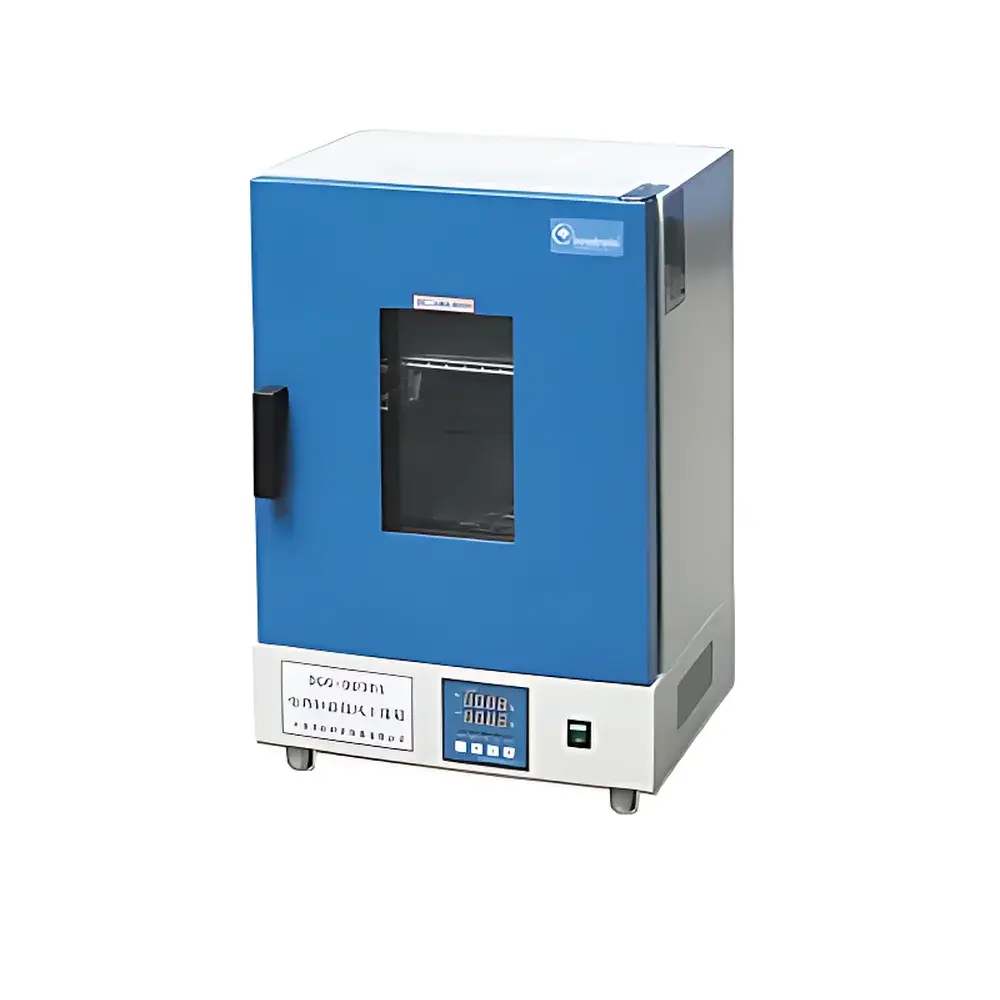
English Product Name
| Brand | Jihepu |
|---|---|
| Origin | Shandong, China |
| Model | DGG-9626A |
| Temperature Range | RT+10 °C to 300 °C |
| Temperature Uniformity | ±1 °C |
| Interior Dimensions (W×D×H) | 800 mm × 600 mm × 1300 mm |
| Exterior Dimensions (W×D×H) | 980 mm × 800 mm × 1800 mm |
| Interior Material | Mirror-finish stainless steel or galvanized steel |
| Heating Method | Forced convection with axial fan |
| Power Supply | 380 V, 50 Hz |
| Rated Power | 6000 W |
| Timer Range | 1–9999 minutes |
| Temperature Resolution | 0.1 °C |
| Standard Shelving | 4 adjustable stainless steel trays |
Overview
The Jihepu DGG-9626A is a vertical forced-air constant-temperature drying oven engineered for precision thermal processing in industrial laboratories, quality control environments, and research institutions. It operates on the principle of horizontal air circulation—driven by a high-efficiency imported axial fan—to ensure uniform heat distribution across the entire working chamber. Unlike natural convection ovens, this model employs vertical airflow architecture with rear-mounted heating elements and front-to-back air ducting, minimizing thermal stratification and achieving ≤±1 °C temperature stability under no-load conditions (tested at 20 °C ambient, 50% RH). Designed for continuous operation in regulated settings, it supports critical non-destructive thermal treatments including moisture removal, polymer curing, powder conditioning, wax melting, and low-temperature sterilization (up to 300 °C), without vacuum capability—distinguishing it from vacuum drying systems.
Key Features
- Microprocessor-based digital controller with 0.1 °C resolution and programmable timer (1–9999 minutes), supporting both single-setpoint and multi-segment ramp-soak profiles (optional D-series intelligent LCD controller available).
- Mirror-finish stainless steel interior chamber—welded via TIG (tungsten inert gas) process—resists corrosion, facilitates cleaning, and complies with basic hygienic design principles for repeated use in analytical and pharmaceutical sample preparation.
- Robust exterior housing constructed from cold-rolled steel with electrostatic powder coating, providing mechanical durability and resistance to incidental abrasion in shared lab environments.
- Independent over-temperature protection circuit—mechanically isolated from the main controller—that triggers automatic power cutoff if chamber temperature exceeds user-defined safety limits, fulfilling essential IEC 61010-1 functional safety requirements for laboratory equipment.
- Four adjustable, load-rated stainless steel shelving trays included as standard; tray spacing optimized for unrestricted airflow and compatibility with standard ISO/IEC 17025-compliant sample containers (e.g., Petri dishes, weighing boats, aluminum pans).
Sample Compatibility & Compliance
The DGG-9626A accommodates a wide range of solid and semi-solid samples, including but not limited to granular powders (e.g., catalysts, excipients), polymer pellets, biological tissue sections (post-fixation), filter papers, ceramic green bodies, and metal oxide precursors. Its 800 × 600 × 1300 mm usable volume enables batch processing of up to 20 L of loosely packed material. While not certified to UL or CE for standalone safety compliance, its construction and control architecture align with foundational expectations for Class II laboratory ovens per ANSI/NCSL Z540 and ISO/IEC 17025 clause 5.5.2 (equipment suitability). For GxP-regulated workflows, optional RS485 interface (with Modbus RTU protocol support) and audit-trail-capable software enable integration into validated data acquisition systems compliant with FDA 21 CFR Part 11 when paired with appropriate electronic record controls.
Software & Data Management
The base configuration includes a stand-alone microcontroller with LED display and tactile keypad navigation. Optional upgrades include the D-series intelligent LCD controller—supporting up to 30 programmable temperature segments with slope rate definition—and RS485 communication module with bundled Windows-compatible configuration software. This software allows remote parameter setting, real-time temperature logging (CSV export), and event-triggered data capture (e.g., door open/close, alarm activation). When deployed in GLP or GMP environments, users must implement supplementary procedural controls—including defined calibration intervals (recommended annually per ISO/IEC 17025), documented sensor verification (using NIST-traceable reference thermometers), and version-controlled software installation protocols—to satisfy regulatory data integrity expectations.
Applications
- Moisture content determination per ASTM D2297, ISO 758, and USP <731> using gravimetric loss-on-drying methodology.
- Pre-conditioning of test specimens prior to tensile, impact, or hardness testing (ASTM D618, ISO 291).
- Thermal stabilization of reference standards and calibration weights in metrology labs.
- Drying of chromatographic stationary phases, TLC plates, and GC vials before solvent exposure.
- Low-temperature depyrogenation of glassware and stainless-steel components where steam autoclaving is unsuitable.
FAQ
Is the DGG-9626A suitable for sterilization applications?
It supports dry-heat sterilization protocols (e.g., 160 °C for 120 minutes) for heat-stable instruments and glassware, but does not replace steam autoclaves for microbiological sterility assurance per ISO 17665.
Can this oven be calibrated internally?
No internal calibration routine is provided; external verification using traceable PT100 probes or calibrated thermocouples is required per ISO/IEC 17025 Section 6.5.
What is the maximum recommended load weight per shelf?
Each stainless steel shelf is rated for 15 kg uniformly distributed load; total chamber load should not exceed 60 kg to maintain airflow integrity and thermal uniformity.
Does the unit meet electromagnetic compatibility (EMC) standards for laboratory use?
While not formally tested to EN 61326-1, its industrial-grade power supply and shielded control board minimize radiated emissions in typical 50 Hz mains environments.
Is validation documentation available for IQ/OQ/PQ protocols?
Factory-supplied test reports (temperature mapping, stability, and controller accuracy) are provided; full qualification documentation requires site-specific execution per Annex 15 of EU GMP Guidelines.



