
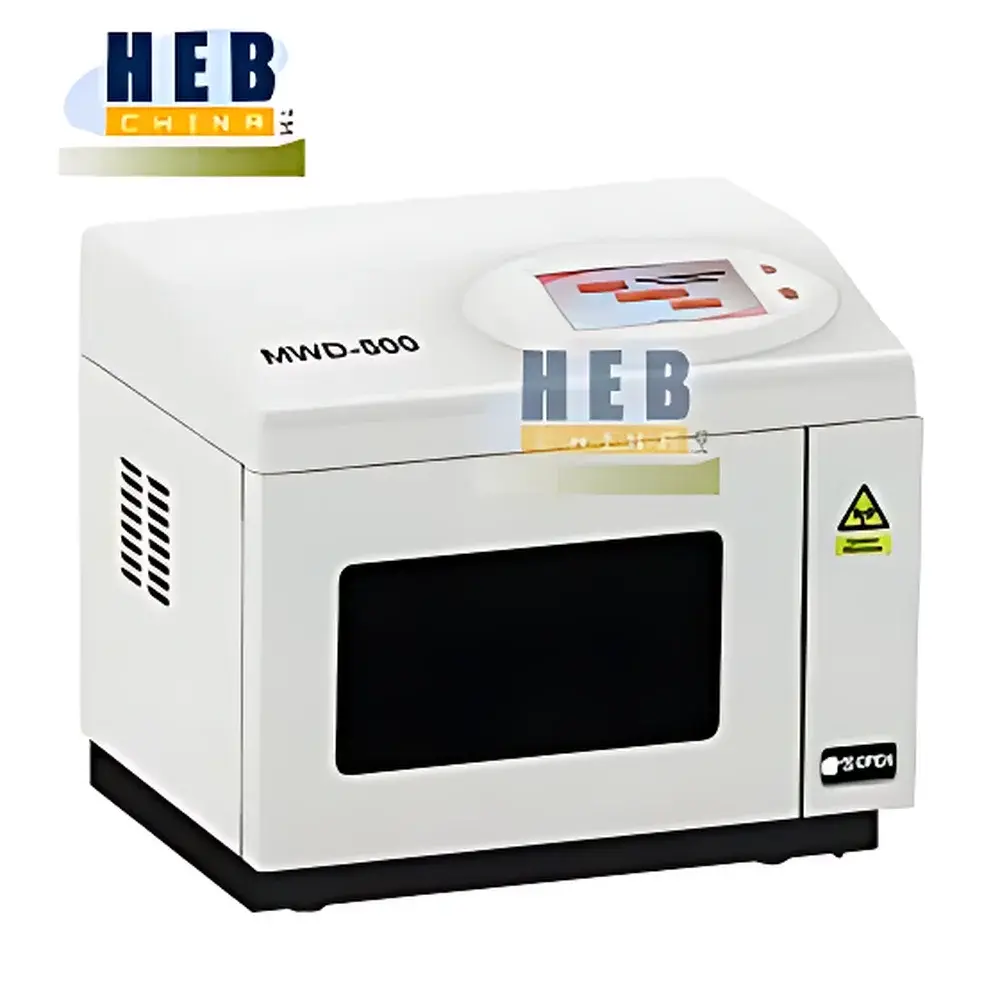
English Product Name
| Brand | HePu (Jihepu) |
|---|---|
| Origin | Shandong, China |
| Model | MWD-500 |
| Sample Capacity | 1–6 vessels |
| Microwave Source | Single Magnetron |
| Max Temperature | 250 °C |
| Max Pressure | 5 MPa |
| Cavity Volume | 65 L |
| Vessel Material | TFM-lined inner vessel |
| Pressure Control | Multi-fiber optical non-contact scanning pressure monitoring |
| Temperature Monitoring | Mid-infrared in-vessel temperature sensing |
| Power Range | 0–1000 W (2450 MHz) |
| Rotation | 360° continuous rotation platform |
| Safety Compliance | <5 mW/cm² microwave leakage |
| Dimensions (W×D×H) | 520 × 560 × 460 mm |
| Net Weight | 32 kg |
Overview
The HePu MWD-500 Sealed Intelligent Microwave Digestion System is a benchtop, single-magnetron microwave digestion instrument engineered for rapid, reproducible, and trace-metal–preserving sample preparation in analytical laboratories. It operates on the principle of controlled dielectric heating—where microwave energy (2450 MHz) is absorbed selectively by polar molecules (e.g., HNO₃, HCl, HF) and water within sealed reaction vessels—enabling uniform volumetric heating without thermal gradients. Unlike open-vessel hotplate digestion or block heaters, the MWD-500 achieves accelerated decomposition of organic matrices while minimizing volatilization losses of As, Hg, Se, Cd, and Pb. Its sealed rotor design maintains pressure integrity up to 5 MPa and temperature stability up to 250 °C, supporting EPA Method 3051A, 3052, ISO 11466, and ASTM D5511-compliant workflows for environmental, geological, food, pharmaceutical, and industrial materials analysis.
Key Features
- Self-recovering dual-pressure relief mechanism: Automatically reseals after transient overpressure events—ensuring uninterrupted digestion cycles and eliminating batch failure due to incidental pressure spikes.
- Chemically inert vessel architecture: Inner vessels machined from imported TFM (modified PTFE) with ≥300 °C thermal limit; outer protective sleeves formed from PEEK reinforced with fiberglass—resistant to concentrated acids (HF, aqua regia), alkalis, and organic solvents.
- 65 L high-volume cavity with 360° continuous rotation: Eliminates microwave standing-wave hotspots by ensuring uniform field distribution across all vessel positions—superior to oscillating or stepped rotation systems in reproducibility and motor longevity.
- Independent mid-infrared temperature sensing + multi-fiber optical pressure monitoring: Measures real-time solution temperature inside each vessel (not cavity ambient), with non-contact pressure transduction—preventing cross-contamination and enabling per-vessel process validation.
- 8-inch external color touchscreen controller: Displays live power, pressure, temperature, and time profiles; includes dedicated per-vessel readout windows and editable stepwise method programming (up to 255 methods, 10 steps each).
- Comprehensive safety architecture: Dual-interlocked safety door, emergency stop button, acoustic anomaly detection, real-time fault diagnostics, and automatic shutdown upon pressure/temperature excursion beyond ±0.1 MPa or ±0.5 °C thresholds.
Sample Compatibility & Compliance
The MWD-500 accommodates solid, semi-solid, and liquid samples ranging from soil and sediment to polymer composites, biological tissues, and battery cathode materials. Its 60 mL TFM vessels support digestion protocols compliant with US EPA SW-846 Methods 3051A (microwave-assisted acid digestion for sediments and soils) and 3052 (siliceous and organically bound matrices), as well as ISO 11466 (heavy metals in soils) and ASTM D5511 (anaerobic biodegradation). All pressure and temperature control systems are traceable to NIST-calibrated references. The system meets IEC 61000-6-3 (EMC) and IEC 61000-6-4 emission standards, and its microwave shielding conforms to ICNIRP exposure limits (<5 mW/cm² at 5 cm distance). While not certified to FDA 21 CFR Part 11 out-of-the-box, audit-ready electronic records—including method parameters, run logs, and sensor outputs—can be exported via RS232/USB for integration into LIMS or GLP/GMP-aligned data management systems.
Software & Data Management
The embedded firmware supports full method customization: users define ramp rates, hold times, target temperatures, pressure limits, and power modulation profiles for each digestion step. During operation, real-time parameter modification is permitted—allowing adaptive adjustment without interrupting the cycle. The system stores full time-series datasets (temperature, pressure, power) per vessel, timestamped and indexed by method ID and operator login. Export formats include CSV and PDF reports compatible with Microsoft Excel and laboratory informatics platforms. Optional PC connectivity enables remote monitoring and centralized method library deployment across multiple instruments. Built-in help interface provides context-sensitive troubleshooting guidance—reducing mean time to resolution for common operational anomalies (e.g., pressure drift, temperature overshoot, rotation stall).
Applications
The MWD-500 serves as a primary sample preparation tool in accredited testing laboratories performing elemental analysis by ICP-OES, ICP-MS, AAS, and XRF. It is routinely deployed for: heavy metal screening in foodstuffs and cosmetics (EU Directive 1881/2006); leachability assessment of landfill waste (TCLP/ SPLP); speciation studies requiring quantitative Hg/As recovery; digestion of high-silica geological samples prior to fusion; and pretreatment of Li-ion battery electrode materials for Ni/Co/Mn quantification. Its ability to retain volatile analytes and minimize blank contributions makes it particularly suitable for ultra-trace analysis in environmental water and air particulate filters.
FAQ
What is the maximum recommended working pressure and temperature for routine operation?
The system is rated for continuous operation at ≤5 MPa and ≤250 °C. The outer PEEK-fiberglass vessels withstand up to 15 MPa burst pressure, and TFM liners tolerate up to 300 °C—providing a robust safety margin.
Can the MWD-500 be integrated into a GLP-compliant quality system?
Yes—electronic records include operator ID, method version, timestamps, and raw sensor data. When paired with validated export protocols and secure network storage, it supports ALCOA+ data integrity principles.
Is HF acid compatible with the digestion vessels?
TFM exhibits exceptional resistance to hydrofluoric acid at concentrations ≤40% and temperatures ≤200 °C. For extended HF exposure, post-digestion vessel inspection for surface etching is advised.
How does the 360° continuous rotation improve digestion reproducibility?
It eliminates positional bias in microwave coupling by ensuring identical field exposure for all vessels—reducing inter-vessel RSDs in temperature and pressure profiles to 6% observed with reciprocating platforms.
What maintenance is required for long-term reliability?
Annual calibration of pressure and temperature sensors against NIST-traceable standards is recommended. The cavity interior and turntable should be cleaned weekly with ethanol; fan filters require monthly inspection and replacement every 12 months under standard usage.



