
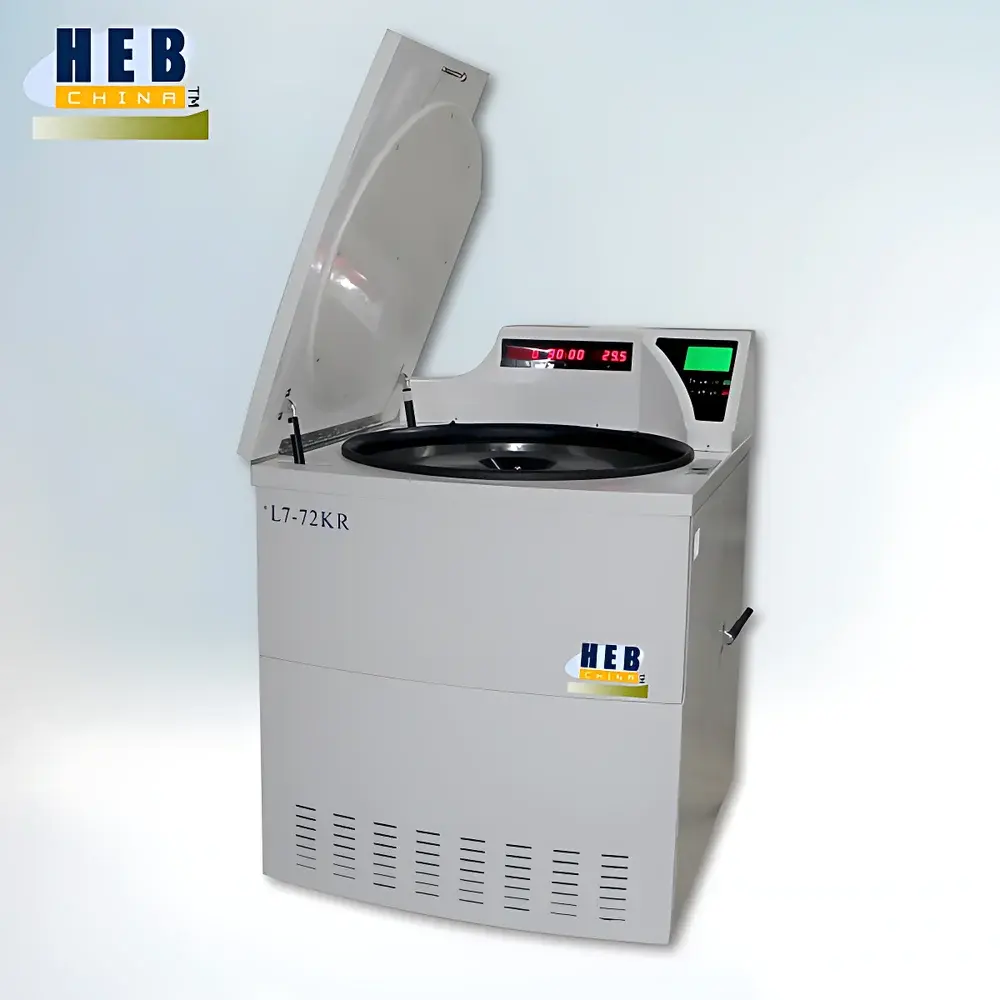
English Product Name
| Brand | HePu (Jihepu) |
|---|---|
| Origin | Shandong, China |
| Model | L7-72KR |
| Instrument Type | Floor-standing refrigerated centrifuge |
| Max. Speed | 8,000 rpm |
| Max. RCF | 12,166 × g |
| Max. Capacity | 6 × 2,400 mL |
| Temperature Range | –20 °C to +40 °C |
| Temp. Accuracy | ±2.0 °C |
| Timer Range | 1 min – 23 h 59 min |
| Speed Accuracy | ±20 rpm |
| Power Supply | AC 220 V ±10 %, 50 Hz, 50 A |
| Total Power | 7.5 kW |
| Noise Level | ≤65 dB(A) |
| Dimensions (W×D×H) | 975 × 860 × 1180 mm |
| Net Weight | 500 kg |
| Refrigerant | R404a |
| Rotor Compatibility | Fixed-angle (e.g., 26 × 1,000 mL @ 7,200 rpm), Swing-bucket (e.g., 6 × 2 × 1,000 mL @ 4,200 rpm |
Overview
The HePu L7-72KR is a floor-standing, low-speed refrigerated centrifuge engineered for high-volume, temperature-sensitive separation tasks in blood banking, biopharmaceutical manufacturing, and large-scale cell processing. Unlike high-speed or ultracentrifuge platforms, the L7-72KR operates within the 0–8,000 rpm range—optimized for gentle yet efficient pelleting of whole blood components, mammalian cells, yeast, and large biomolecular aggregates without shear-induced denaturation. Its refrigeration system employs environmentally compliant R404a refrigerant and dual-path thermal control (cooling + heating), enabling precise maintenance of sample integrity across extended runs—from cryopreservation-grade separations at –20 °C to ambient or mildly elevated temperatures up to +40 °C. The unit’s robust cast-iron base, direct-drive inverter motor (eliminating brush wear and carbon dust), and reinforced rotor chamber (Φ700 mm internal diameter) collectively ensure mechanical stability under full-load operation at maximum capacity (14,400 mL per run). Designed for GLP-compliant environments, it meets structural and thermal performance benchmarks aligned with ISO 13485 preconditions for medical device manufacturing support equipment.
Key Features
- Intuitive 7-inch TFT LCD touchscreen interface with dual-language (English/Chinese) firmware, supporting real-time display of speed, RCF, temperature, elapsed time, and dynamic curves for acceleration/deceleration and thermal response.
- 40 programmable protocols with editable parameters—including ramp/dwell profiles, automatic RCF recalculation upon speed change, and on-the-fly parameter adjustment during active runs.
- 9-step selectable acceleration/deceleration profiles, including soft-stop and free-spin options, minimizing sediment resuspension and enhancing reproducibility in clinical blood fractionation.
- Triple-layer safety architecture: electronic door interlock with force-sensing latch, real-time imbalance detection (vibration spectrum analysis), overspeed cutoff, and independent overtemperature protection for both rotor chamber and compressor circuitry.
- Energy-efficient refrigeration subsystem featuring optimized finned condenser layout, low-noise axial fans, and intelligent load-based compressor modulation—achieving ≤65 dB(A) acoustic emission even at full power.
Sample Compatibility & Compliance
The L7-72KR accommodates industry-standard primary containers used in transfusion medicine and upstream bioprocessing: triple- and quadruple-bag blood sets (up to 12 units per run), 2,400 mL disposable centrifuge bottles (6 positions), and modular swing-bucket configurations supporting 2 × 1,000 mL tubes per carrier (6 carriers total). Fixed-angle rotors enable rapid harvesting of dense pellets (e.g., RBCs, platelet concentrates), while swing-bucket assemblies facilitate gradient-based separations (e.g., Ficoll-Paque® density gradients) and large-volume supernatant recovery. All rotors are certified to ISO 15830:2019 for fatigue resistance and undergo hydrostatic pressure testing per EN 61000-6-3. The system supports audit-ready documentation workflows compatible with FDA 21 CFR Part 11 requirements when integrated with validated LIMS or ELN platforms.
Software & Data Management
Embedded firmware logs all operational events—including start/stop timestamps, setpoint deviations, alarm triggers, and rotor usage cycles—with timestamped CSV export via USB 2.0 port. Optional Ethernet connectivity enables remote monitoring through HePu’s CentriLink™ Web Server (HTTPS-secured), permitting real-time status checks, protocol push-down, and centralized fleet diagnostics. Audit trails retain operator ID, parameter modifications, and calibration history for ≥12 months, satisfying GLP record retention mandates. No proprietary software installation is required for basic data retrieval; raw log files conform to ASTM E2500-18 metadata conventions for analytical instrument traceability.
Applications
- Blood bank operations: Large-scale red blood cell (RBC) washing, platelet-rich plasma (PRP) preparation, and cryoprecipitate isolation from pooled donor units.
- Biopharmaceutical manufacturing: Harvesting CHO or HEK293 cells post-bioreactor culture, clarifying lysates prior to chromatography, and concentrating viral vectors in AAV/LV production suites.
- Veterinary and agricultural research: Processing bovine colostrum, equine serum, or avian egg yolk fractions where thermal sensitivity and volume throughput are critical.
- Public health laboratories: High-throughput serology sample prep, pathogen pellet concentration (e.g., Mycobacterium tuberculosis sputum processing), and environmental waterborne pathogen recovery.
FAQ
What is the maximum permissible imbalance tolerance for safe operation?
The L7-72KR detects mass asymmetry exceeding 50 g per rotor half and halts acceleration immediately—compliant with IEC 61000-6-2 immunity thresholds for medical electrical equipment.
Can this centrifuge be validated for GMP environments?
Yes. Full IQ/OQ documentation packages—including as-built drawings, sensor calibration certificates (temperature, speed, timer), and factory performance test reports—are available upon request and align with Annex 15 (EU GMP) and USP guidelines.
Is rotor autoclaving supported?
No. Aluminum and stainless-steel rotors are designed for chemical disinfection (e.g., 70 % ethanol, 0.5 % sodium hypochlorite) only; steam sterilization exceeds material thermal limits and voids certification.
How often does the refrigeration system require maintenance?
Compressor oil and filter-drier replacement is recommended every 36 months or 6,000 operating hours—whichever occurs first—under typical use (≤4 hrs/day, –10 °C to +25 °C ambient).
Does the system support third-party rotor compatibility?
Only HePu-certified rotors may be used. Non-OEM rotors invalidate safety certifications and void warranty coverage per ISO/IEC 17025 clause 5.5.2.



