
English Product Name
| Brand | OEM / Private Label |
|---|---|
| Origin | Imported |
| Manufacturer Type | Authorized Distributor |
| Price | USD 3,100 (approx.) |
| Compliance | GB/T 5170.2–1996, GB/T 5170.5–1996, GB 2423.1–1989, GB 2423.2–1989, GB 2423.22–1987, GB 10589–1989, GB 10592–1989, GB 11158–1989 |
Overview
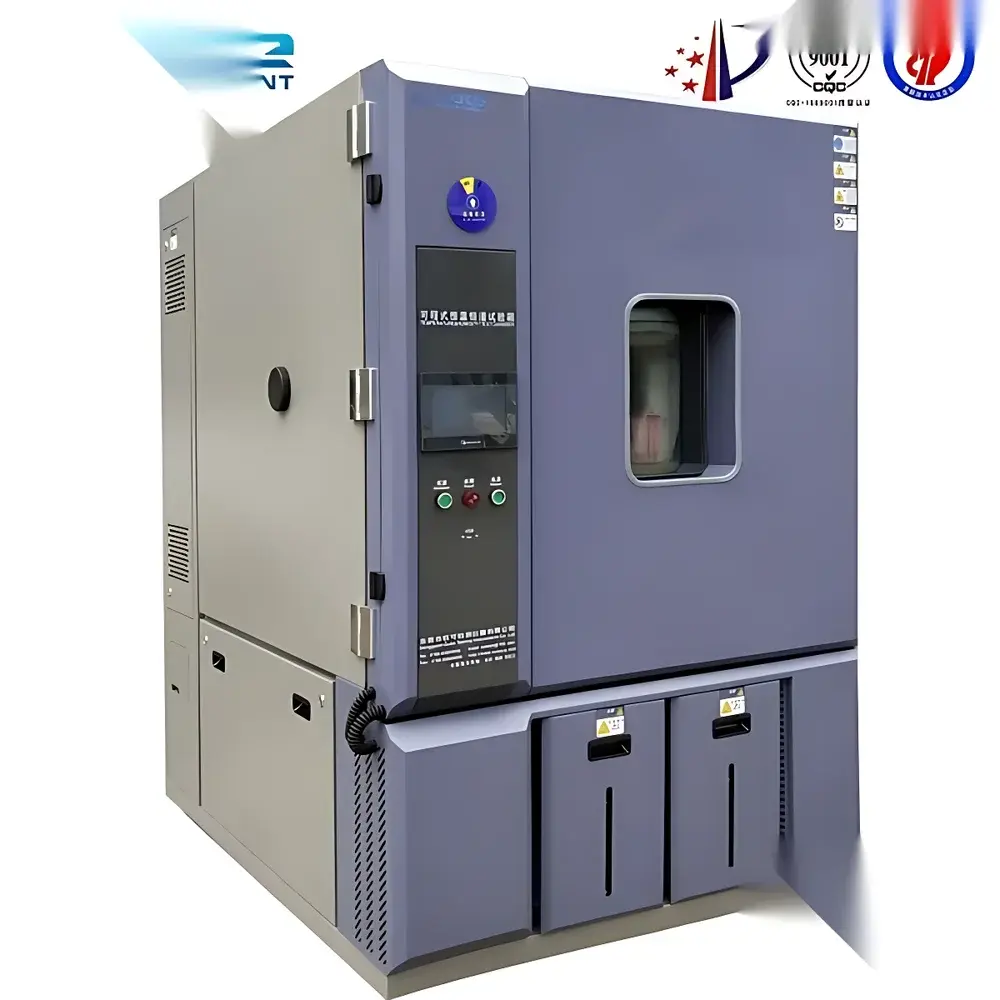
The Economical Temperature and Humidity Controlled Environmental Test Chamber is a precision-engineered environmental simulation system designed for reliable, repeatable thermal and hygrothermal conditioning of materials, components, and finished products under standardized test conditions. Operating on the principle of balanced heating, cooling, humidification, and dehumidification—governed by a dual-loop BTHC (Balanced Temperature & Humidity Control) architecture—the chamber maintains stable setpoints across defined temperature ranges (–70 °C to +150 °C, model-dependent) and relative humidity levels (20–98% RH). Its core thermodynamic control relies on PID-regulated SSR-driven heating elements, refrigerant-based cooling via capillary tube expansion technology, and steam-type humidification with integrated condensate drainage. Designed for laboratory- and production-floor integration, it supports long-duration static and cycling tests per international environmental testing standards applicable to electronics, automotive parts, packaging, polymers, and pharmaceutical primary packaging.
Key Features
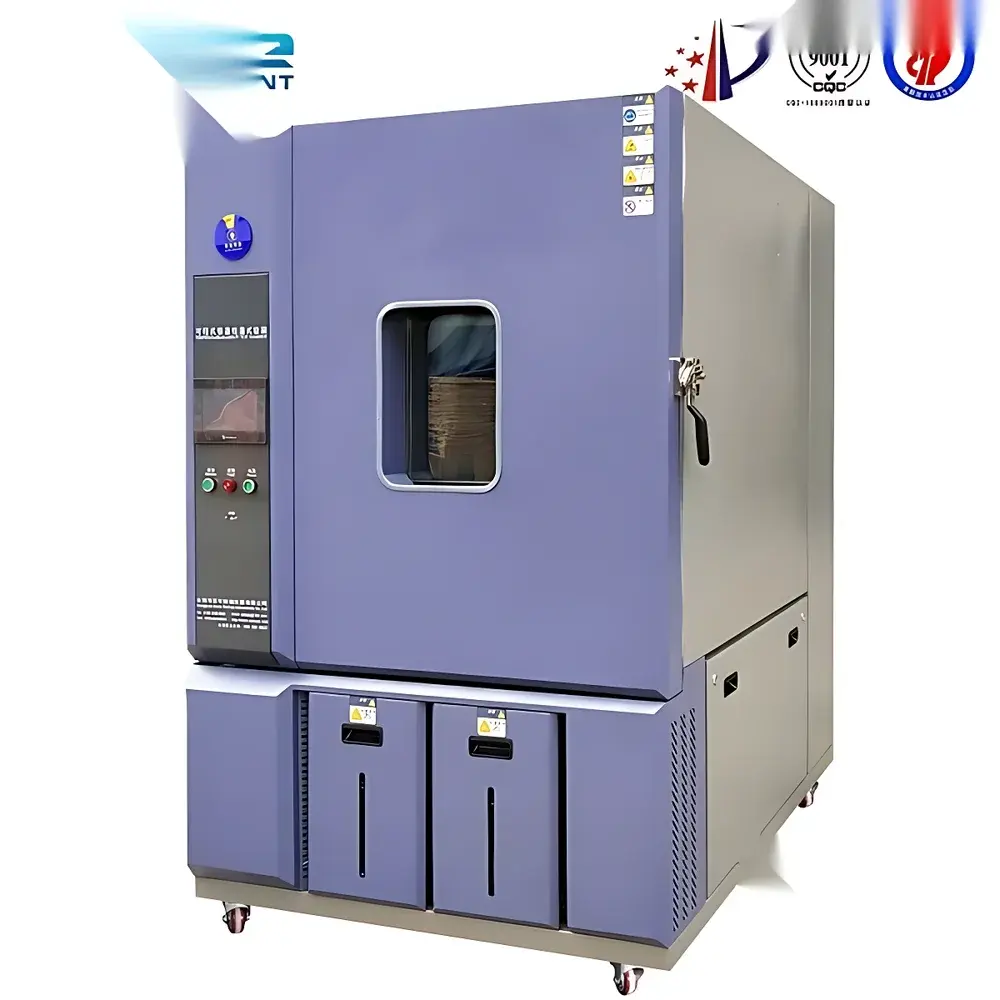
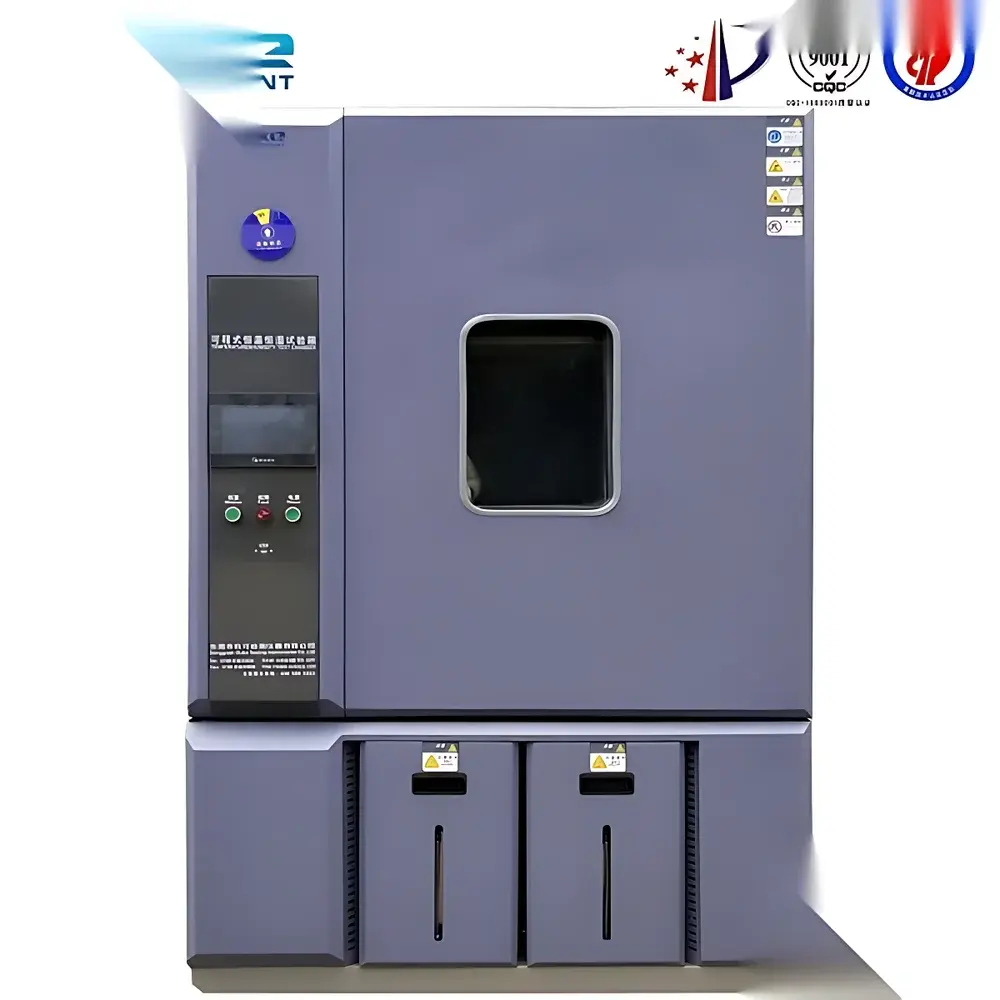
- Modern arc-shaped enclosure design with high-gloss, corrosion-resistant stainless steel interior and insulated double-wall construction for thermal efficiency and structural integrity.
- Imported multi-function touchscreen controller with intuitive GUI, real-time trend display, programmable ramp-soak profiles, and password-protected parameter lockdown for operational security.
- BTHC control logic ensures dynamic equilibrium between thermal/hygric input and chamber losses—enabling stable operation over extended durations without manual recalibration.
- Capillary tube refrigeration system with automatic capacity modulation replaces traditional thermostatic expansion valves, delivering smoother temperature transitions, reduced mechanical wear, and improved low-temperature stability.
- Flat, ergonomic door handle with no-rebound mechanism enhances safety and accessibility during frequent sample loading/unloading cycles.
- Standardized mounting interfaces and optional I/O ports support integration with facility monitoring systems (e.g., Modbus RTU, Ethernet/IP) for centralized lab management.
Sample Compatibility & Compliance
This chamber accommodates non-volatile, non-corrosive solid and packaged samples up to standard internal volume configurations (customizable upon request). It is validated for compliance with major national and industry-specific environmental test standards—including GB/T 5170.2 (temperature performance verification), GB/T 5170.5 (humidity uniformity and stability), and GB 2423 series (cold, dry heat, temperature change, and damp heat testing protocols). While not certified to ISO/IEC 17025 or accredited to GLP/GMP out-of-the-box, its traceable calibration procedures and documented uncertainty budgets align with pre-audit readiness requirements for laboratories preparing for regulatory submissions (e.g., IEC 60068-2, MIL-STD-810H, or automotive AEC-Q200 qualification workflows).
Software & Data Management
The embedded controller logs timestamped temperature and humidity data at user-selectable intervals (1–60 seconds), storing up to 1,000 hours of continuous records internally. Optional PC software enables CSV export, graphical overlay of multiple test runs, deviation alarm configuration, and PDF report generation with header metadata (operator ID, test ID, chamber serial number). Audit trail functionality meets baseline requirements for 21 CFR Part 11–aligned environments when deployed with external network authentication and electronic signature modules. Data integrity safeguards include write-protection modes, cyclic memory buffering, and automatic backup upon power interruption.
Applications
- Accelerated aging studies of polymer films, adhesives, and composite laminates under controlled thermal-hygric stress.
- Pre-conditioning of PCB assemblies and electro-mechanical sensors prior to functional validation or HALT/HASS screening.
- Stability testing of medical device packaging per ISO 11607–2 and ASTM F1980 guidelines.
- Environmental qualification of consumer electronics per IEC 60068-2-1 (cold), -2 (dry heat), -30 (damp heat cyclic), and -78 (condensation).
- Material property benchmarking—including dimensional stability, moisture absorption kinetics, and glass transition shifts—in R&D labs supporting automotive, aerospace, and packaging development.
FAQ
What is the typical temperature and humidity range for this chamber?
Standard configurations support –40 °C to +150 °C and 20–98% RH; extended low-temperature variants (–60 °C, –70 °C) are available as custom builds.
Does the chamber meet international standards such as IEC 60068 or MIL-STD-810?
It is engineered to replicate the test conditions specified in those standards; however, full compliance certification requires third-party validation per the specific test method and specimen mounting protocol.
How is temperature uniformity verified?
Uniformity is assessed per GB/T 5170.2–1996 using nine calibrated PT100 sensors placed on a 3×3 grid at working volume center height; typical deviation is ≤±1.5 °C at steady state.
Can the chamber be integrated into a Lab Information Management System (LIMS)?
Yes—via optional RS485/Modbus or Ethernet interface, enabling bidirectional communication for job scheduling, real-time status polling, and automated data ingestion.
What cooling water specifications are required for optimal performance?
For models with water-cooled condensers: inlet temperature 10–28 °C, pressure 0.1–0.3 MPa, flow rate ≥2.5 L/min; chiller compatibility must be confirmed prior to installation.



