
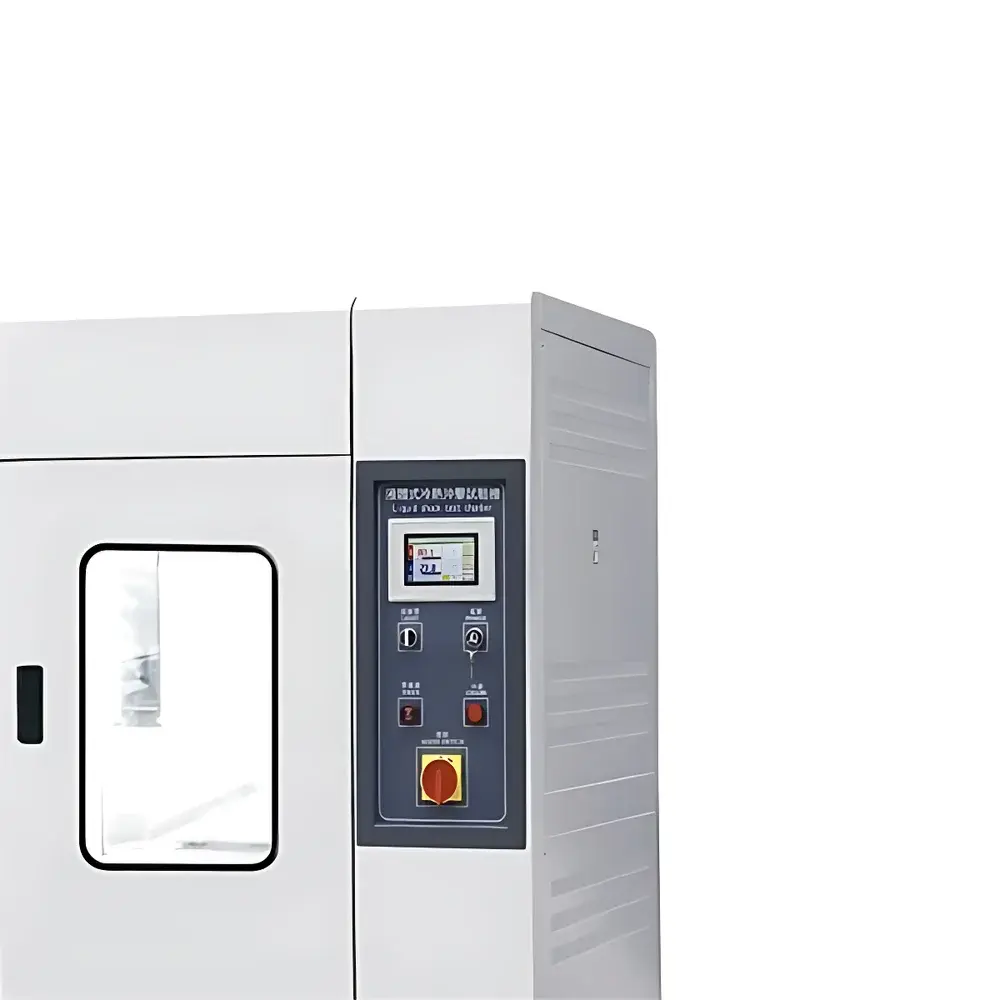
English Product Name
| Brand | OEM / Other Brands |
|---|---|
| Origin | Imported |
| Manufacturer Type | Authorized Distributor |
| Price | USD 12,500 (FOB) |
| Internal Dimensions (W×H×D) | 40×35×30 cm to 70×60×60 cm |
| External Dimensions (W×H×D) | 145×180×140 cm to 190×170×270 cm |
| Hot Zone Temperature Range | RT to +200 °C |
| Cold Zone Temperature Range | RT to −70 °C |
| Test Zone Temperature Range | +60 °C to +150 °C (hot shock) |
| Temperature Control Accuracy | ±0.5 °C |
| Temperature Uniformity | ±2.0 °C |
| Recovery Time | <5 min |
| Preheat Time (RT → 150 °C) | ~30 min |
| Precool Time (RT → −70 °C) | ~85 min |
| Refrigeration System | Hermetic or Semi-Hermetic Compressor with R404A/R23 Eco-Friendly Refrigerant |
| Construction | Interior – SUS#304 Mirror-Finish Stainless Steel |
| Insulation | High-Density Fire-Retardant PU Foam |
| Power Supply | AC 380 V ±5%, 50 Hz ±0.5 Hz, 3-Phase 5-Wire |
Overview
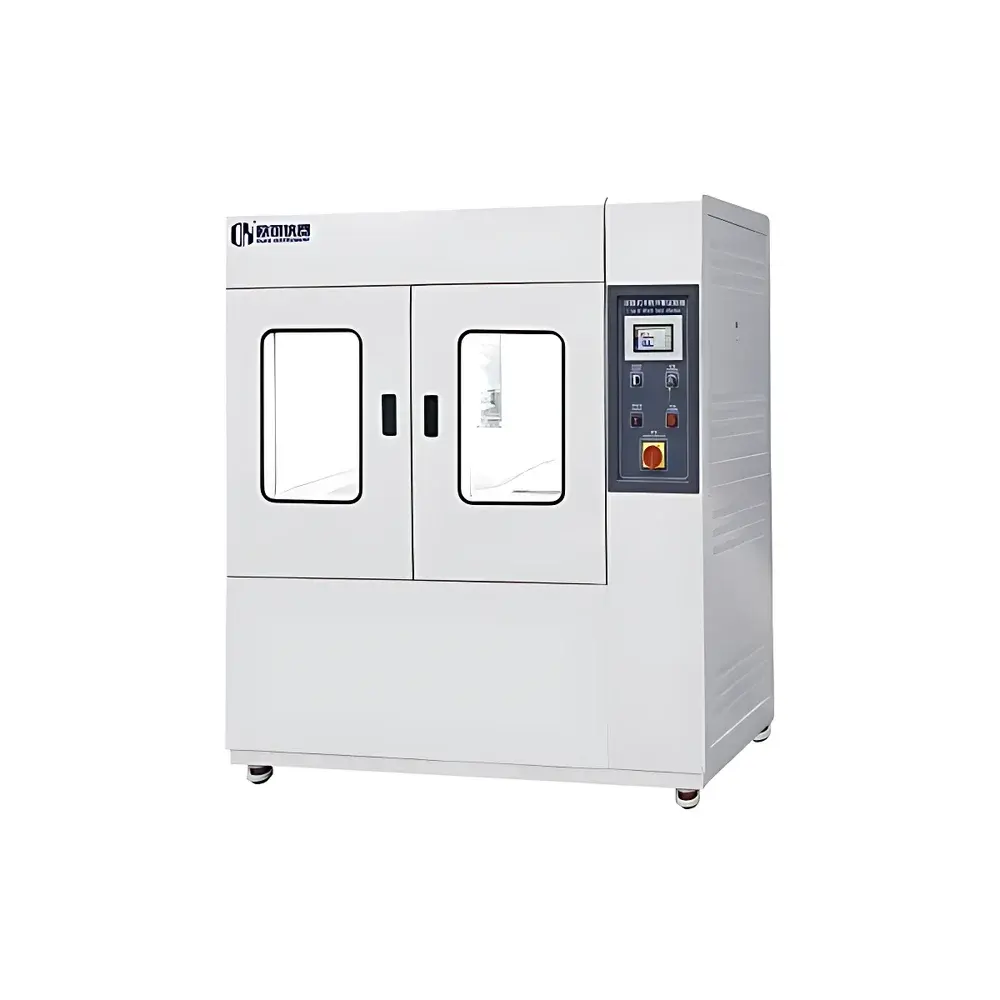
The OK-YT Series Liquid-Based Thermal Shock Test Chamber is an engineered environmental simulation system designed for accelerated reliability assessment of materials and components under rapid, repeated transitions between extreme high and low temperatures. Unlike air-based thermal shock chambers, this system employs dual liquid-coupled thermal reservoirs—separate hot and cold zones—connected via a pneumatically actuated transfer mechanism that moves test specimens between zones without exposing them to ambient air. This architecture minimizes thermal lag, ensures precise temperature boundary control, and delivers reproducible shock profiles critical for qualification testing in aerospace, defense, medical device, and automotive electronics sectors. The chamber operates on the principle of controlled thermal inertia: high-capacity heat storage (via electric heating elements and glycol-based thermal mass) and cryogenic cooling (via cascade refrigeration) enable rapid zone stabilization. Its design complies with fundamental thermodynamic constraints of ISO 16750-4, IEC 60068-2-14, and MIL-STD-810H Method 503.5, making it suitable for both developmental screening and compliance verification per regulatory submission requirements.
Key Features
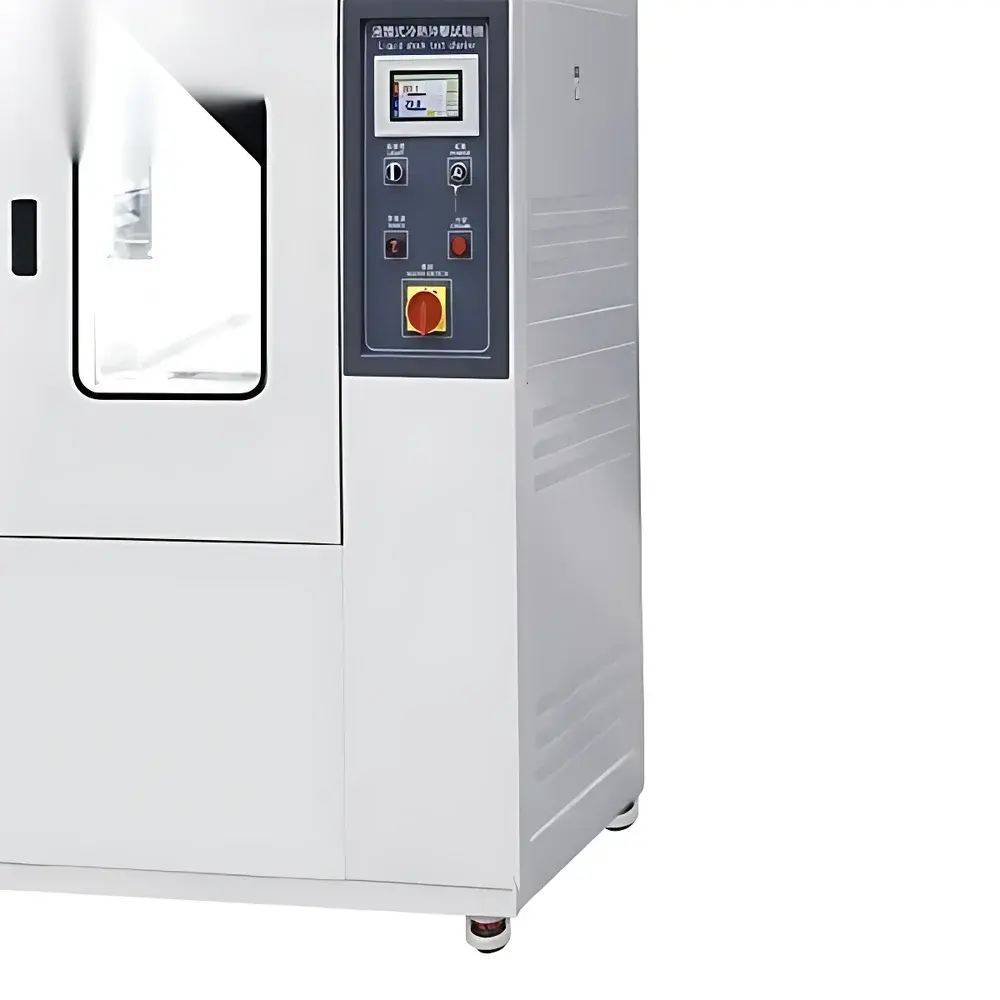
- Large-format 7-inch color LCD touchscreen controller with intuitive graphical interface, real-time trend plotting, and multilingual support (English, German, Japanese, Chinese)
- Dual-zone thermal architecture: independent hot zone (RT to +200 °C) and cold zone (RT to −70 °C), each equipped with dedicated heating/cooling circuits and PID-controlled thermal management
- Pneumatic lift-and-transfer mechanism with stainless-steel sample basket—ensures zero mechanical vibration during transit and eliminates airflow-induced thermal perturbation
- Cascade refrigeration system utilizing environmentally compliant R404A (high-stage) and R23 (low-stage) refrigerants, integrated with plate-type heat exchangers for enhanced efficiency and reduced maintenance intervals
- Laboratory-grade temperature stability: ±0.5 °C control accuracy and ±2.0 °C uniformity across the full test volume, validated per ASTM E742 and IEC 60068-3-5
- Network-enabled operation: standard Ethernet (LAN) interface supporting remote monitoring, parameter upload/download, and integration into centralized lab management systems via Modbus TCP or custom API
- Programmable operational modes: standalone high-temperature test, standalone low-temperature test, or fully configurable thermal shock cycles—including dwell time, transition rate, total cycle count, and automatic defrost scheduling
Sample Compatibility & Compliance
The OK-YT chamber accommodates rigid and semi-rigid samples up to 30 kg per cycle, including printed circuit assemblies (PCBAs), hermetically sealed sensors, polymer housings, metallic fasteners, and ceramic substrates. Its internal chamber dimensions (40–70 cm W × 35–60 cm H × 30–60 cm D) support standard test fixtures and accommodate dual-layer SUS#304 stainless steel shelves. All structural materials meet UL 94 V-0 flammability ratings, and insulation complies with EU RoHS Directive 2011/65/EU and REACH Annex XVII restrictions. The system satisfies mandatory test standards including GB/T 2423.1 (cold), GB/T 2423.2 (dry heat), GB/T 2423.22 (temperature change), GJB 150.5A (military thermal shock), and ISO 16750-4 (road vehicles). Calibration traceability follows ISO/IEC 17025 requirements, with optional NIST-traceable certificate available upon request.
Software & Data Management
Embedded firmware supports up to 100 user-defined test programs, each with up to 99 segments and programmable ramp rates (0.1–30 °C/min). Real-time data logging records temperature at three spatially distributed points (top/mid/bottom of test zone) at 1-second intervals, storing >30 days of continuous data onboard. Export formats include CSV and PDF reports with timestamped metadata, pass/fail status flags, and deviation alerts. Optional PC software provides advanced analysis tools—including thermal gradient mapping, cycle-to-failure prediction models, and statistical process control (SPC) charts aligned with AIAG CQI-9 guidelines. Audit trail functionality complies with FDA 21 CFR Part 11 for electronic records and signatures when configured with user authentication and role-based access control.
Applications
This chamber is routinely deployed for failure mode identification in solder joint fatigue (IPC-J-STD-020D), polymer embrittlement evaluation (ASTM D790), seal integrity validation (ISO 11607-2), and MEMS package delamination screening. It supports qualification of avionics modules per DO-160G Section 4.5, battery cell thermal runaway propagation studies (UN 38.3 thermal cycling), and accelerated aging of optical coatings per MIL-C-48497A. Universities and national metrology institutes use it for inter-laboratory comparison exercises in thermal stress metrology, while QC labs in semiconductor packaging facilities apply it for lot acceptance testing of flip-chip assemblies prior to burn-in.
FAQ
What is the difference between liquid-based and air-based thermal shock chambers?
Liquid-based systems utilize thermally massive fluid reservoirs and direct-contact transfer mechanisms, achieving faster transition times (<5 min) and tighter temperature control than forced-air designs, which rely on ducted airflow and suffer from thermal inertia and stratification.
Can the chamber be validated for GLP/GMP environments?
Yes—when equipped with IQ/OQ documentation packages, calibrated reference sensors, and 21 CFR Part 11-compliant software, it meets GLP (OECD Principles) and GMP (ICH Q5C) requirements for stability-indicating testing.
Is remote diagnostics supported?
Standard Ethernet connectivity enables secure remote access via VPN for firmware updates, log retrieval, and diagnostic troubleshooting by authorized service engineers.
What maintenance intervals are recommended?
Compressor oil and filter replacement every 12 months; refrigerant leak check and system performance verification every 6 months; calibration of all temperature sensors annually against NIST-traceable references.
Are custom test fixtures available?
Yes—custom-designed stainless-steel baskets, thermal mass simulators, and multi-point sensor mounts can be fabricated to match specific DUT geometries and thermal loading profiles.



