
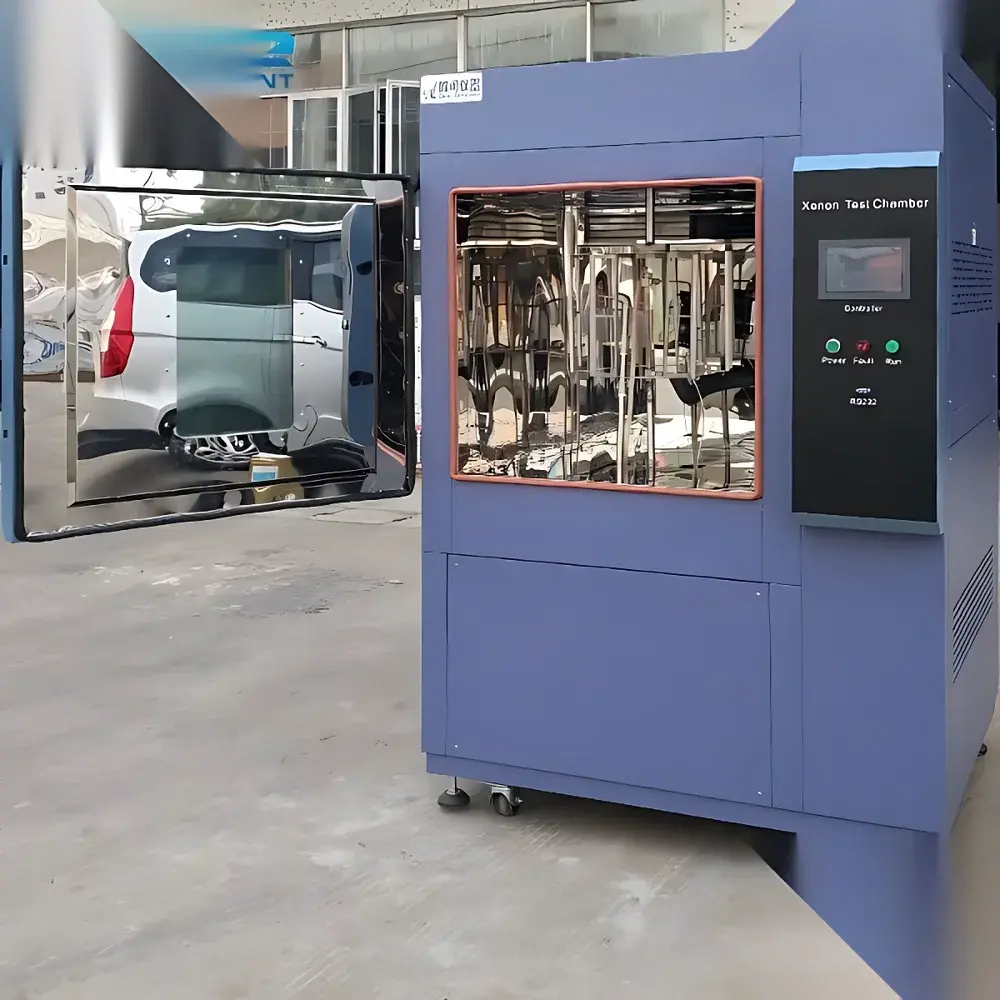
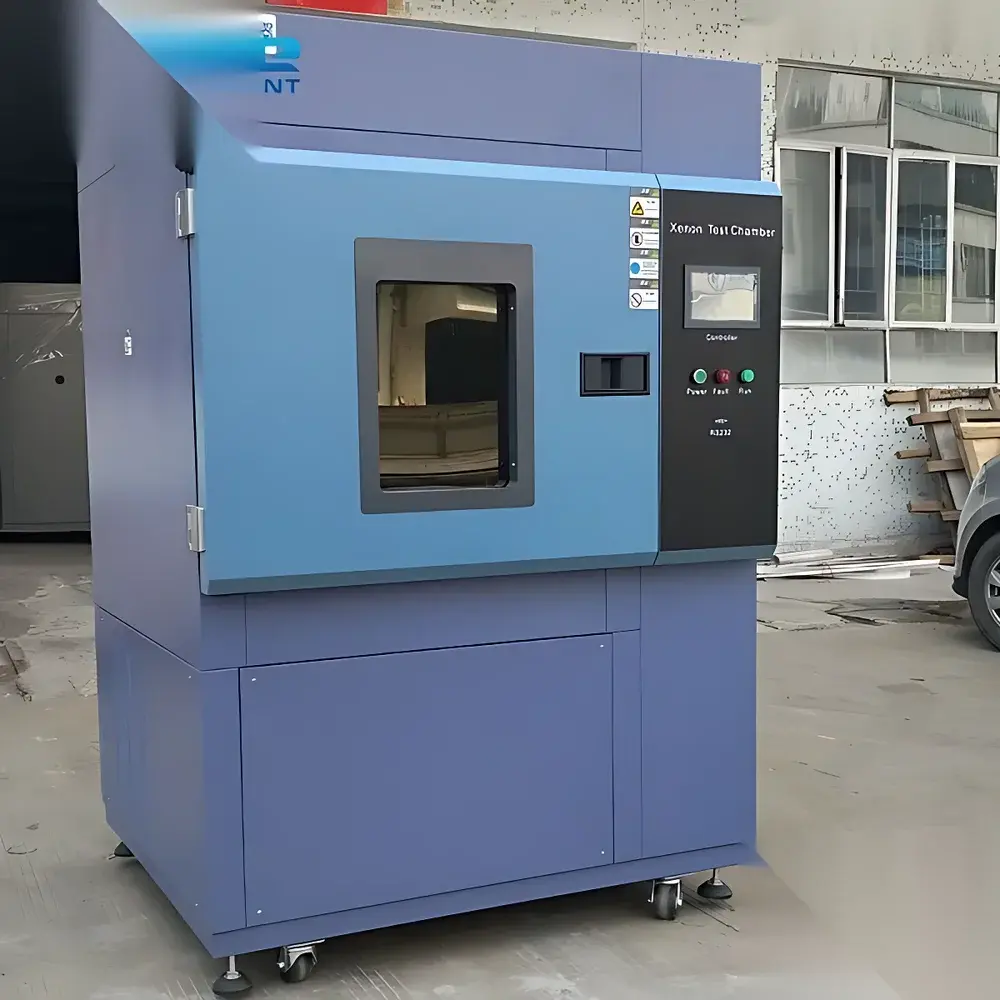
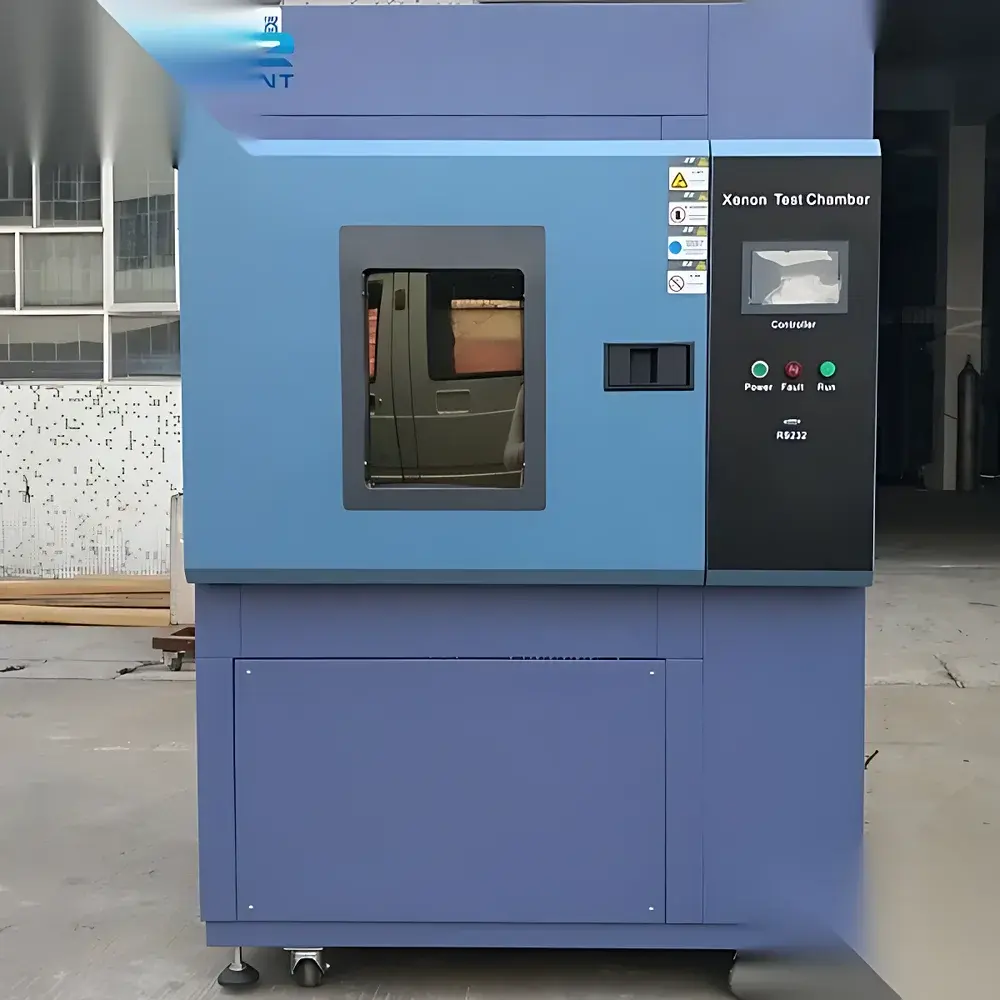
English Product Name
| Brand | OK Instruments |
|---|---|
| Origin | Imported |
| Manufacturer Type | Authorized Distributor |
| Price | USD 5,200 (FOB) |
| Internal Dimensions (cm) | 50×50×40 / 50×75×60 / 80×80×80 / 100×100×100 |
| Temperature Range | 0–150°C (chamber), 40–85°C (black panel) |
| Humidity Range | 20–75% RH (light cycle), 20–98% RH (dark cycle) |
| Irradiance | 550 W/m² ±10% (300–800 nm), 1000 W/m² ±10% (300–1200 nm) |
| Xenon Lamp Power | 1.8 kW / 2.5 kW / 6 kW |
| Lamp Life | ≈1,500 h |
| Spray Duration | 1–999 min (intermittent or continuous) |
| Spray Pressure | 70–127 kPa |
| Sample Mounting | Dual-layer flat mesh rack or 500-mm-diameter rotating turntable (0–3 rpm) |
| Construction | Interior — SUS304 stainless steel |
| Power Supply | AC 380 V ±5%, 50 Hz ±0.5 Hz |
Overview
The OK-XD Series Water-Cooled Xenon Arc Weathering Test Chamber is engineered for accelerated simulation of full-spectrum solar radiation, temperature, humidity, and moisture exposure in controlled laboratory environments. It employs a long-arc, water-cooled xenon lamp as its primary radiation source—designed to replicate the spectral power distribution (SPD) of natural sunlight across 290–2500 nm, with optical filtering systems ensuring fidelity to CIE Standard Illuminant D65 and ISO 4892-2 reference spectra. Unlike air-cooled alternatives, the water-cooling architecture enables stable irradiance output at high intensity levels (up to 1000 W/m² over 300–1200 nm), minimizing thermal drift and extending lamp service life. This system is purpose-built for evaluating photostability, colorfastness, gloss retention, cracking, chalking, and mechanical degradation in polymeric, textile, coating, and automotive materials under standardized climatic stress sequences—including light/dark cycles, rain simulation, and concurrent thermal-hygrometric modulation.
Key Features
- Full-spectrum xenon arc lamp with precision optical filtration to maintain spectral match per ISO 4892-2 and ASTM G155 requirements
- Integrated water-cooling system for thermal stabilization of lamp envelope and consistent irradiance output over extended test durations
- Programmable spray function with adjustable duration (1–999 min), pressure control (70–127 kPa), and intermittent/continuous modes to simulate natural rainfall or dew formation
- Dual-mode sample mounting: configurable flat mesh racks (2-tier) or motorized 500-mm-diameter turntable (0–3 rpm) for uniform exposure and rotational homogeneity
- Independent black panel thermometer (BPT) and chamber air temperature/humidity sensors with PID-controlled feedback loops
- High-precision environmental control: ±0.5°C temperature accuracy, ±2.0% RH accuracy, ±2.0°C temperature uniformity, ±3.0% RH uniformity
- SUS304 stainless steel interior construction for corrosion resistance and long-term calibration stability
Sample Compatibility & Compliance
The OK-XD chamber accommodates flat, curved, or irregularly shaped specimens—including fabric swatches, painted panels, injection-molded plastic parts, elastomeric seals, and automotive exterior trim—via its adaptable fixture design. Its operational parameters align with internationally recognized weathering standards including ISO 4892-2 (xenon arc exposure), ASTM D529 (textile colorfastness to light), GB/T 8427 (ISO 105-B02 equivalent), GB/T 16422.2, ISO 4892-3 (for comparative analysis), and USP for polymer extractables assessment. The system supports GLP-compliant testing workflows through traceable sensor calibration records and audit-ready environmental logging. While not pre-certified to FDA 21 CFR Part 11, it provides timestamped, non-editable irradiance, temperature, humidity, and spray event logs exportable in CSV format for regulatory submission.
Software & Data Management
The chamber operates via an embedded industrial-grade controller with intuitive touchscreen interface, supporting multi-step programmable test profiles (e.g., 102-min light + 18-min dark + 12-min spray). Real-time monitoring includes irradiance (W/m²), black panel temperature (°C), chamber air temperature (°C), relative humidity (% RH), and elapsed spray time (min). All parameters are logged at user-defined intervals (1–60 sec) and stored onboard for ≥30 days. Data export is performed via USB 2.0 port; no cloud connectivity or proprietary software installation is required. Optional RS485/Modbus RTU interface enables integration into centralized lab management systems (LIMS) for automated report generation and cross-instrument correlation.
Applications
This instrument serves critical quality assurance and R&D functions across regulated and industrial sectors: textile laboratories validating ISO 105-B02 colorfastness to artificial light; paint and coatings manufacturers assessing ASTM D4587 QUV-equivalent durability; automotive suppliers conducting OEM-specific weathering protocols (e.g., GMW14872, Ford CETP 00.00-L-467); and polymer compounders screening UV stabilizer efficacy per ISO 4892-2 Cycle 1–4. It is routinely deployed for comparative aging studies, formulation optimization, shelf-life prediction modeling, and failure mode analysis of outdoor-exposed components—particularly where spectral fidelity, thermal management, and reproducible wet/dry cycling are essential.
FAQ
What is the typical service life of the xenon lamp under standard irradiance settings?
Under nominal 550 W/m² (300–800 nm) operation with proper cooling and voltage regulation, lamp life averages 1,500 hours. Actual longevity depends on irradiance setpoint, duty cycle, and ambient facility water temperature.
Can the chamber be configured for continuous light-only exposure without humidity or spray?
Yes—the control system allows independent activation or deactivation of humidity control, spray function, and dark-cycle segments within any test profile.
Is calibration documentation provided with shipment?
Each unit ships with factory calibration certificates for temperature, humidity, and irradiance sensors, traceable to NIST-recognized national metrology institutes.
Does the system meet IEC 60068-2-5 for solar radiation testing?
While optimized for ISO 4892-2, the OK-XD series meets the irradiance and spectral requirements of IEC 60068-2-5 Annex A when operated within specified lamp/filter configurations and monitoring parameters.
What maintenance is required beyond lamp replacement?
Routine tasks include quarterly cleaning of quartz filter sleeves, biannual verification of spray nozzle integrity, annual inspection of water-cooling lines for scale accumulation, and semi-annual recalibration of environmental sensors.



