
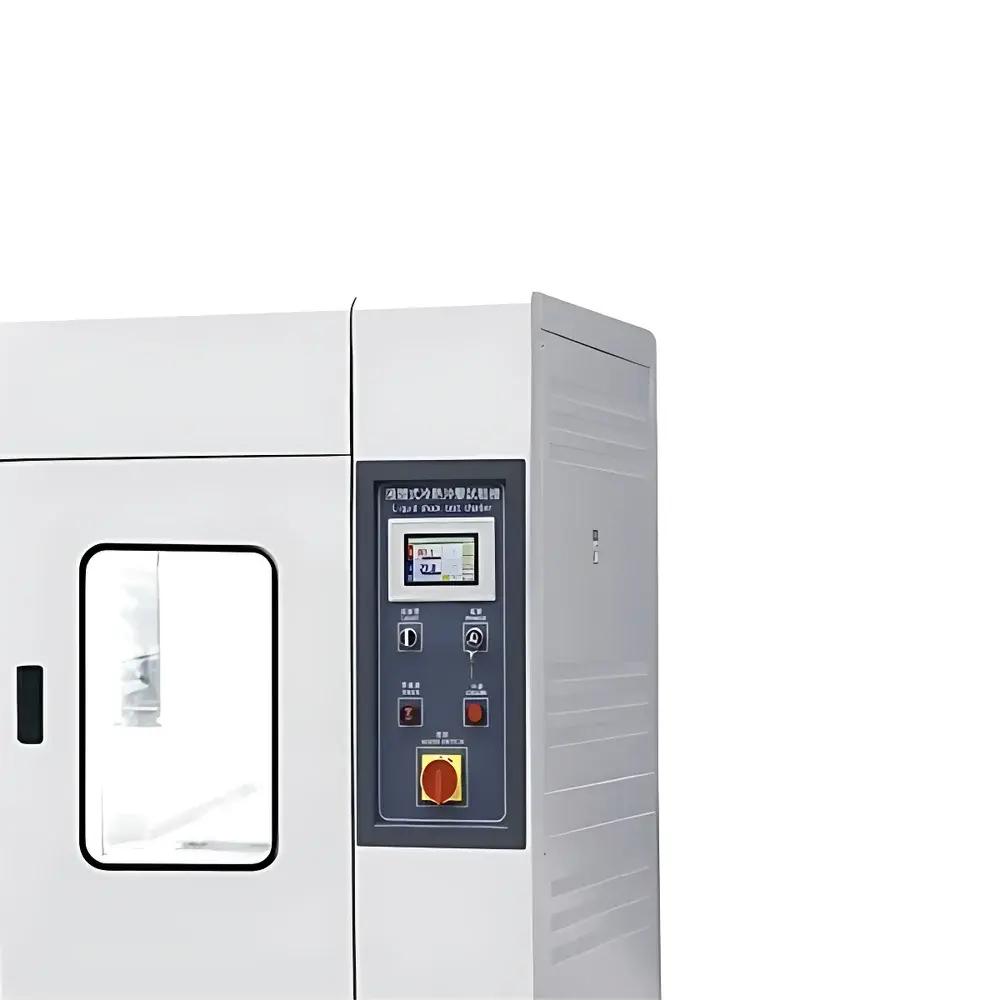
English Product Name
| Brand | OK-YT |
|---|---|
| Origin | Imported |
| Manufacturer Type | Authorized Distributor |
| Temperature Range (Hot Zone) | RT to +200 °C |
| Temperature Range (Cold Zone) | RT to −70 °C |
| Test Zone Temperature Range | Hot Shock (+60 °C to +150 °C) |
| Thermal Transition Time (Hot ↔ Cold) | < 5 min |
| Temperature Uniformity | ±2.0 °C |
| Temperature Control Accuracy | ±0.5 °C |
| Preheating Time (RT → 150 °C) | ~30 min |
| Precooling Time (RT → −70 °C) | ~85 min |
| Internal Dimensions (W×H×D, cm) | 40×35×30 to 70×60×60 |
| External Dimensions (W×H×D, cm) | 145×180×140 to 190×170×270 |
| Refrigeration System | Hermetic or Semi-Hermetic Compressor with Eco-Friendly Refrigerants (R404A/R23) |
| Construction | Interior – SUS#304 Mirror-Finish Stainless Steel |
| Insulation | High-Density Fire-Retardant PU Foam |
| Standard Accessories | One Φ50 mm Cable Port |
| Power Supply | AC 380 V ±5%, 50 Hz ±0.5 Hz, 3-Phase 5-Wire, 2.5 m Cord |
Overview
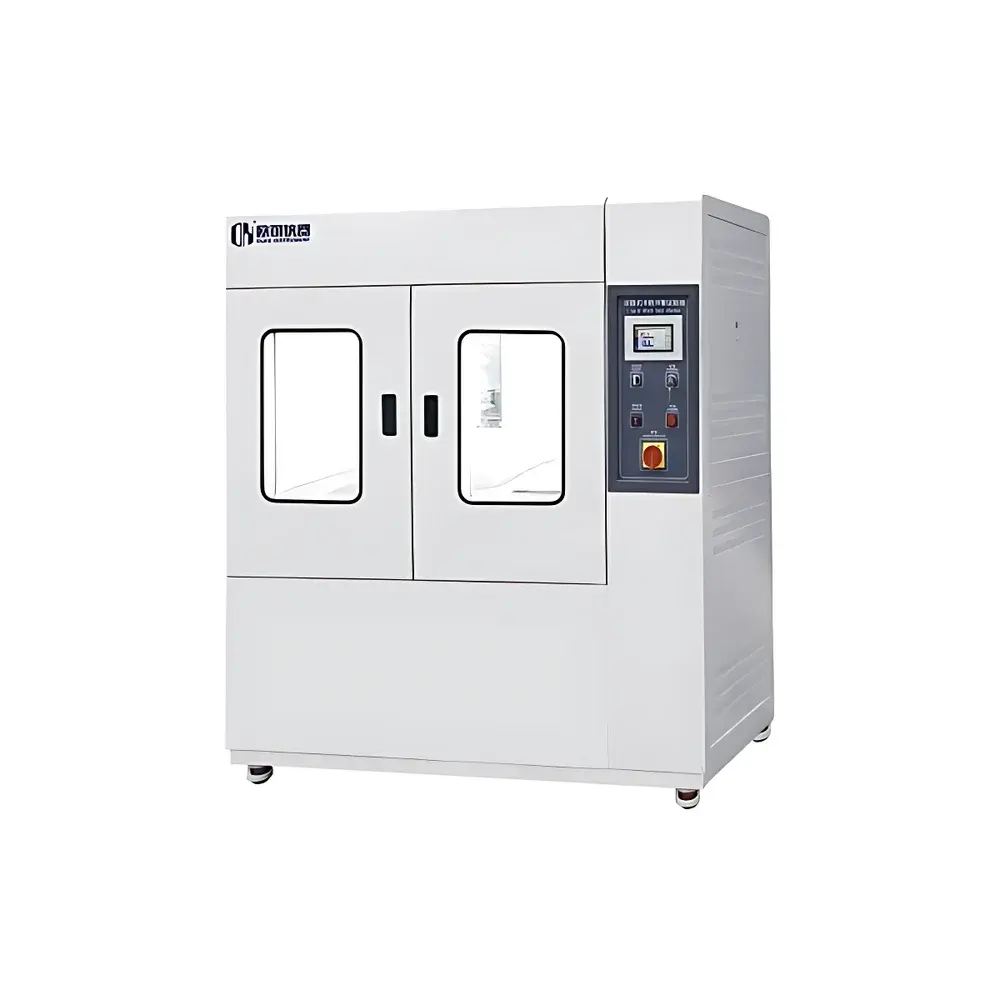
The OK-YT Series Liquid Immersion Thermal Shock Test Chamber is an engineered environmental test system designed for rapid, high-fidelity thermal cycling under controlled liquid-immersion or air-based thermal shock conditions. Unlike conventional air-to-air thermal shock chambers, this system employs a dual-zone architecture—comprising independent hot and cold reservoirs—with a pneumatically actuated sample carrier that transfers test specimens between zones in under five minutes. The chamber operates on the principle of accelerated thermal stress induction: by subjecting materials and assemblies to abrupt, repeatable transitions between extreme temperature extremes, it quantifies susceptibility to microcracking, interfacial delamination, solder joint fatigue, seal integrity loss, and other thermomechanical degradation mechanisms. Its design adheres to the physical basis of transient heat transfer analysis, where thermal strain (Δεth = α·ΔT) governs material response, and cumulative damage is assessed via cycle-dependent failure thresholds. This makes the OK-YT chamber particularly relevant for qualification testing in aerospace, defense electronics, medical device packaging, nuclear instrumentation, and advanced polymer composites—where reliability under operational thermal transients is mission-critical.
Key Features
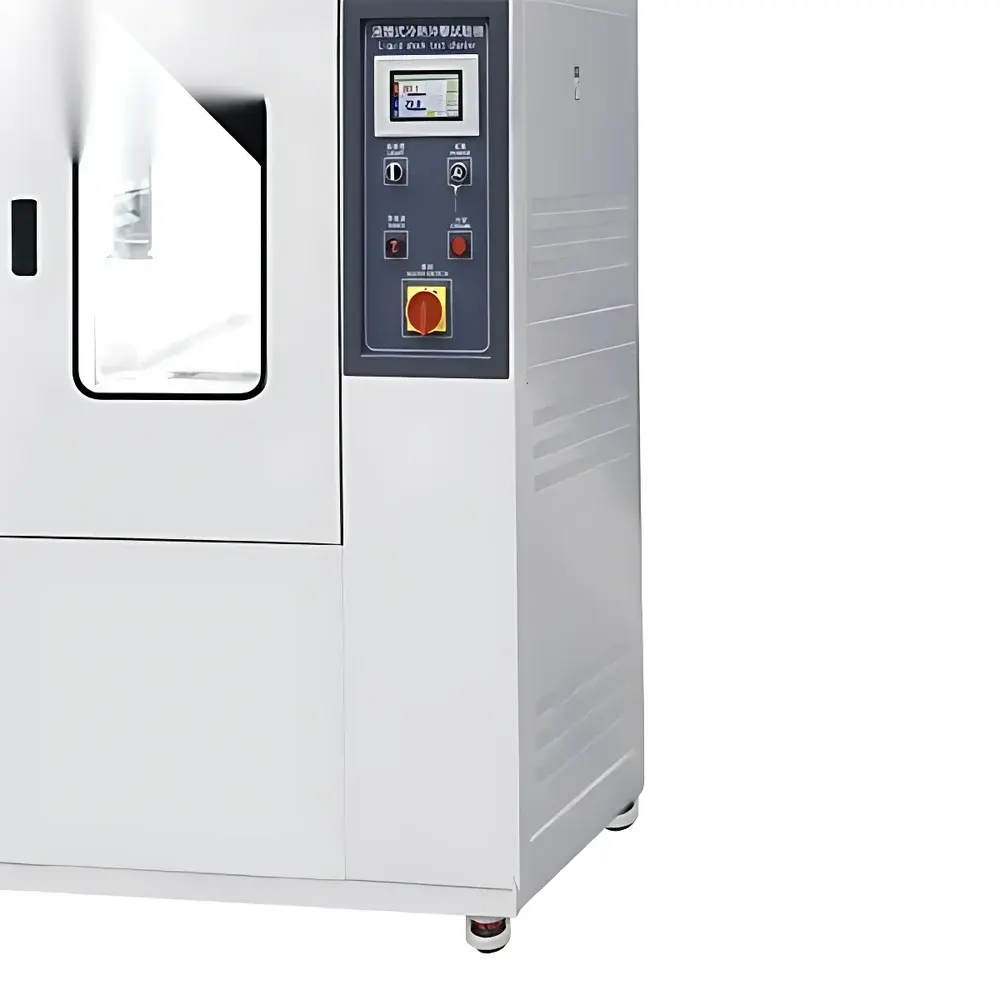
- Large-format color LCD touchscreen controller with intuitive graphical interface, real-time trend plotting, and multilingual support (English, German, Japanese)
- Dual independent thermal reservoirs: hot zone (RT to +200 °C) and cold zone (RT to −70 °C), each equipped with high-efficiency plate-type heat exchangers
- Two-stage cryogenic refrigeration circuit using environmentally compliant refrigerants R404A (primary stage) and R23 (secondary cascade stage)
- Integrated LAN port supporting TCP/IP communication for remote monitoring, parameter upload/download, and integration into centralized lab management systems
- Flexible test mode selection: standalone high-temperature soak, low-temperature soak, or programmable thermal shock cycles with user-defined dwell times, transition rates, and repetition counts
- Auto-preconditioning function: automatic pre-cooling or pre-heating during standby to minimize test cycle latency
- Intelligent defrost management: configurable automatic or manual defrost cycles with adjustable frequency and duration
- Fault diagnostics with on-screen error codes, historical alarm logging, and root-cause guidance for maintenance personnel
Sample Compatibility & Compliance
The OK-YT chamber accommodates a broad spectrum of test specimens—including printed circuit board assemblies (PCBAs), hermetically sealed sensors, MEMS devices, battery modules, optical housings, and structural composite coupons—within its standardized internal volumes (49 L to 225 L). Specimen mounting utilizes non-reactive SUS#304 stainless steel shelves and optional fixture adapters to ensure mechanical stability without thermal interference. All models comply with international standards governing thermal shock evaluation protocols, including ISO 16750-4 (Road Vehicles – Environmental Conditions), IEC 60068-2-14 (Environmental Testing – Part 2-14: Tests – Test N: Change of Temperature), MIL-STD-810H Method 503.6, and the referenced Chinese national and military standards (GB/T 2423.22, GJB 150.5, GJB 360.7). While not certified for GLP or FDA 21 CFR Part 11 out-of-the-box, the system’s audit-ready data logging architecture supports validation documentation required for regulated industries when configured with time-stamped, password-protected user access and electronic signature modules.
Software & Data Management
The embedded controller firmware records all critical parameters—including chamber setpoints, actual zone temperatures, specimen carrier position status, compressor discharge pressure, and runtime alarms—at user-configurable intervals (1–60 seconds). Raw data exports to CSV format via USB drive or Ethernet transfer. Optional PC-based software provides extended functionality: multi-chamber fleet monitoring, statistical process control (SPC) charting of temperature deviation over time, automated report generation (PDF/Excel), and compliance traceability mapping against test plan IDs and revision-controlled procedures. Data integrity safeguards include cyclic redundancy check (CRC) verification, write-once-read-many (WORM) archive options, and configurable retention policies aligned with ISO/IEC 17025 Clause 7.5.2 requirements for record preservation.
Applications
This thermal shock chamber serves as a core qualification tool across multiple engineering domains. In aerospace electronics, it validates avionics housing resilience during ascent/descent thermal transients. For automotive suppliers, it replicates under-hood thermal cycling experienced by ADAS ECUs and power inverters. Medical device manufacturers use it to verify sterilization-resistant packaging integrity after repeated autoclave-to-freezer transitions. Research laboratories apply it to study phase transformation kinetics in shape-memory alloys or glass transition hysteresis in thermosetting resins. Additionally, it supports accelerated life testing (ALT) programs where Arrhenius-based acceleration factors are derived from failure rate shifts across defined thermal shock severity levels.
FAQ
What distinguishes liquid immersion thermal shock from air-based thermal shock?
Liquid immersion (e.g., silicone oil baths) enables higher heat transfer coefficients and more uniform specimen surface cooling/heating—but the OK-YT series uses forced-air convection within insulated reservoirs to avoid fluid contamination risks while maintaining reproducible ΔT rates exceeding 15 °C/s at specimen level.
Can the chamber perform ramp-and-soak profiles in addition to shock cycles?
Yes. The controller supports custom multi-step programs combining linear ramps, fixed-temperature soaks, dwell periods, and conditional branching based on elapsed time or sensor feedback.
Is external calibration support available?
Third-party accredited calibration services (traceable to NIST or CNAS standards) are available upon request, covering temperature uniformity, control accuracy, and transition timing verification per ASTM E2203.
How is safety ensured during rapid thermal transitions?
Dual redundant over-temperature and over-pressure cutouts, door interlock switches, refrigerant leak detection, and real-time compressor motor current monitoring prevent hazardous operating states.
What maintenance intervals are recommended?
Compressor oil and filter replacement every 12 months; refrigerant charge verification every 24 months; full system performance validation (per ISO 17025 Annex C) every 36 months or after major component replacement.



