
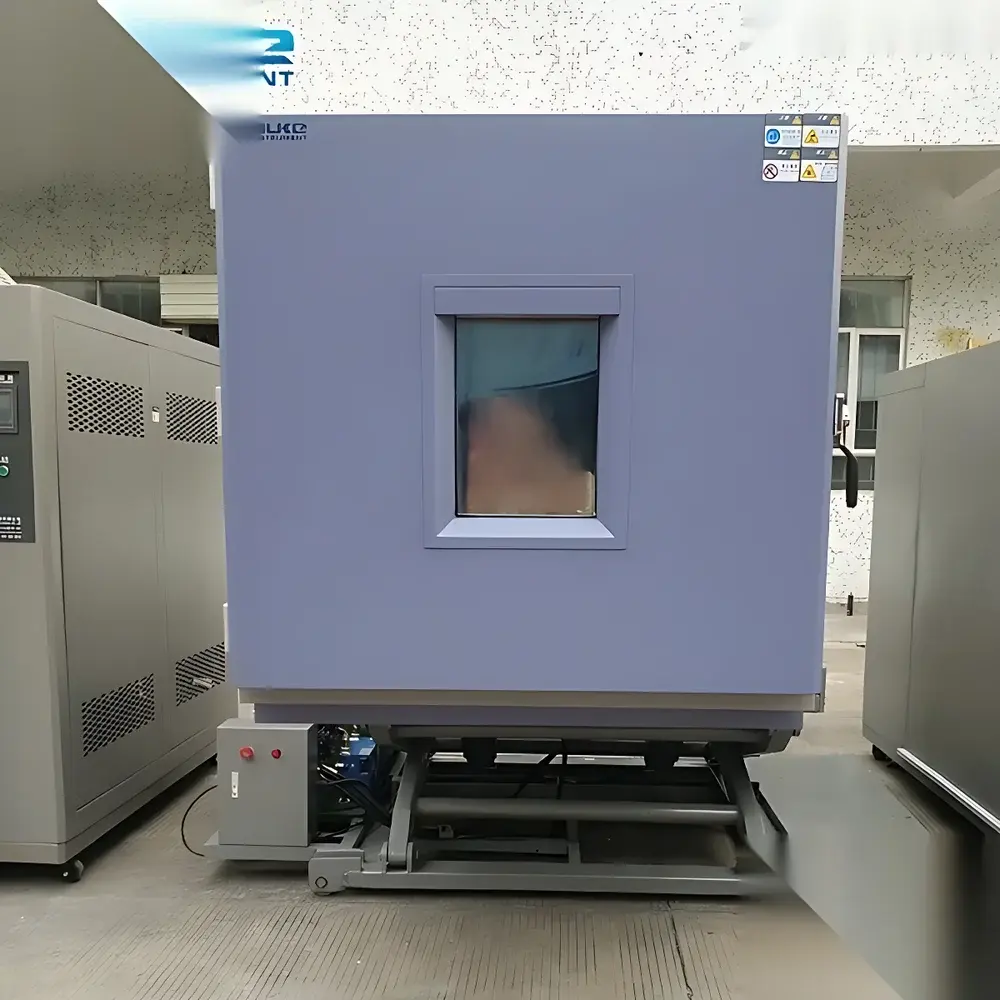
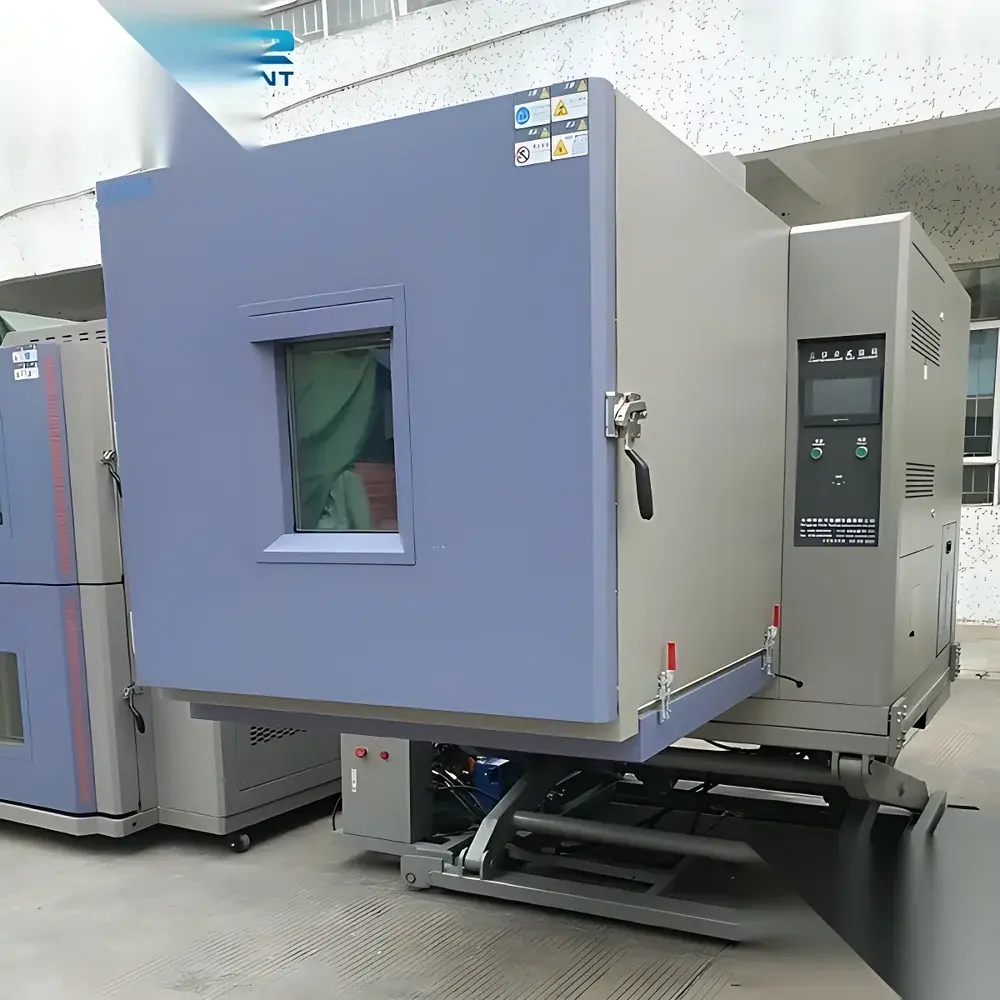
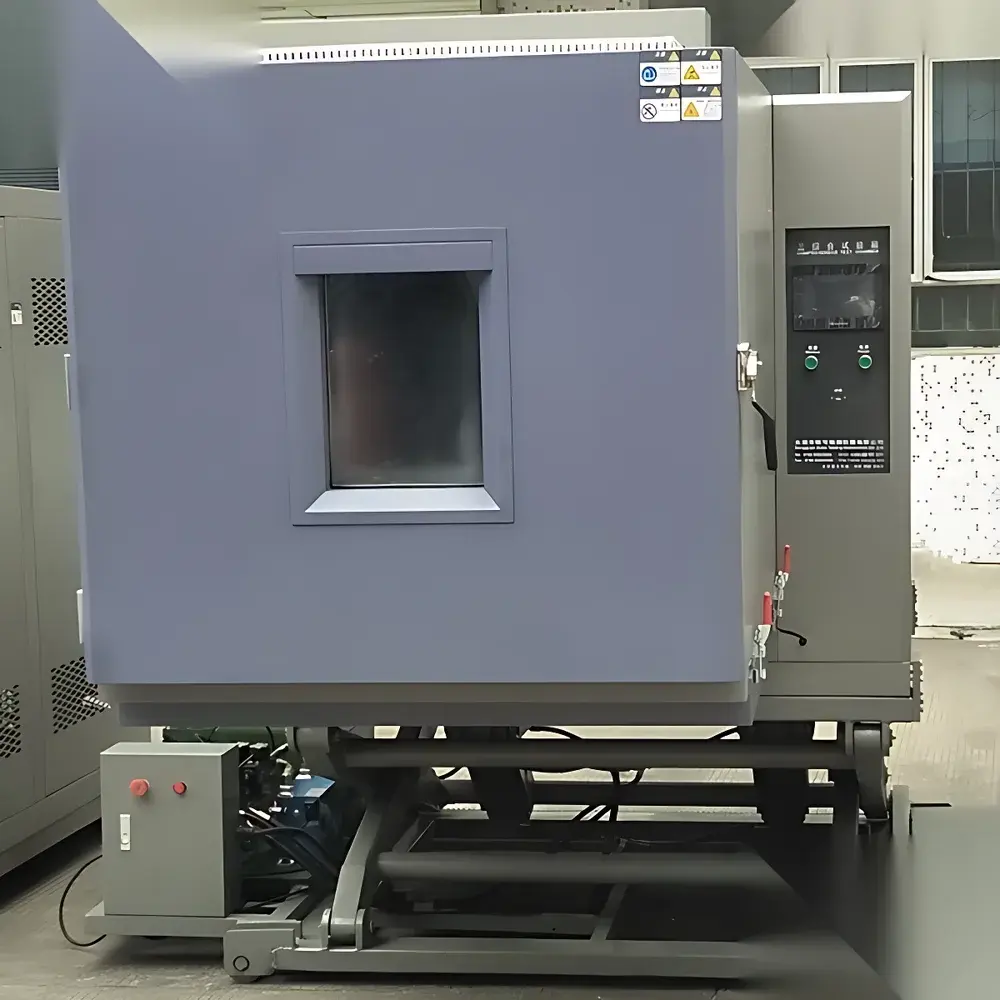
English Product Name
| Brand | OK |
|---|---|
| Model Range | OK-ZTH-80L to OK-ZTH-1000L |
| Temperature Range | −20 °C to +150 °C / −40 °C to +150 °C / −50 °C to +150 °C / −60 °C to +150 °C / −70 °C to +150 °C / −85 °C to +150 °C |
| Temperature Uniformity | ±1.5 °C |
| Temperature Stability | ±0.5 °C |
| Heating Rate (20 °C → 150 °C) | ≤45 min (non-linear, unloaded) |
| Cooling Rate (20 °C → −20 °C) | ≤45 min |
| (20 °C → −85 °C) | ≤100 min |
| Refrigerant | R404A/R23 (zero-ozone-depletion HFC blend) |
| Noise Level | ≤65 dB(A) |
| Control Interface | 5.7″ color LCD, 320×240 resolution, bilingual (EN/CN), 100 programs × 1000 segments, up to 999 cycles per segment |
| Compliance | GB/T 10589, GB/T 10592, GB/T 2423.4, GB/T 2423.34, MIL-STD-810 Method 507.2 |
Overview
The OK-ZTH Series Combined Environmental Test Chamber with Vibration is an integrated tri-stress test system engineered for simultaneous or sequential application of temperature extremes, humidity (optional configuration), and mechanical vibration—enabling rigorous validation of product reliability under real-world operational and storage conditions. Designed in accordance with the physical principles of thermodynamic equilibrium, forced convection heat transfer, and electrodynamic or servo-hydraulic excitation, this chamber supports accelerated life testing, design verification, and qualification per military, aerospace, automotive, and medical device standards. Its modular architecture separates the refrigeration subsystem from the test chamber body to minimize thermal interference and improve long-term calibration stability. The system is particularly suited for evaluating solder joint integrity, material embrittlement, seal performance, PCB warpage, and connector retention across wide thermal gradients while subjected to broadband or swept-sine vibration profiles.
Key Features
- Integrated tri-environmental stress platform supporting concurrent temperature cycling and vibration—configurable for vertical or horizontal axis excitation (vibration module sold separately or as bundled system)
- High-precision dual-PID temperature controller with 100 programmable profiles, each accommodating up to 1000 time-temperature segments and 999 loop repetitions; user-definable ramp rates and dwell times
- Robust refrigeration system utilizing hermetically sealed compressors (European or U.S.-sourced), capillary tube expansion technology, and automatic capacity modulation for stable low-temperature hold at −85 °C
- Triple-layer vacuum-coated observation window with integrated resistive heating film to prevent condensation and ensure optical clarity during sub-zero operation
- Forced-air circulation via vertically mounted long-life AC induction motor and dual-axis adjustable louvered ducting—guaranteeing ±1.5 °C temperature uniformity throughout the working volume
- Structural integrity reinforced with ASTM A36 steel base frame (angle iron + channel steel), PU rigid foam + fiberglass insulation (≥100 mm thickness), and electropolished SUS304 stainless steel interior
- Comprehensive safety architecture including independent electronic overtemperature cut-off, phase failure protection, refrigerant high-pressure shutdown, dry-run heater protection, and earth-leakage circuit interruption
- Acoustically optimized enclosure achieving ≤65 dB(A) at 1 m distance—critical for laboratory environments requiring low ambient noise interference
Sample Compatibility & Compliance
The OK-ZTH series accommodates a broad range of sample geometries—from compact microelectronics assemblies and MEMS sensors to full-scale automotive ECUs and avionics enclosures—via standardized 50 mm diameter test ports and two-tier stainless steel sample trays. Internal dimensions span 80 L to 1000 L, enabling scalability from component-level screening to system-level environmental stress screening (ESS). The chamber meets and exceeds requirements defined in GB/T 10589–1989 (Low-Temperature Test Chambers), GB/T 10592–1989 (Climatic Test Chambers), GB/T 2423.4–1993 (Damp Heat, Cycle), and GB/T 2423.34–2005 (Combined Temperature/Humidity/Vibration Testing). It also aligns with MIL-STD-810H Method 507.2 (Temperature Shock) and supports optional IEC 60068-2-14 compliance when paired with certified vibration shakers. For regulated industries, the control firmware supports audit-ready event logging (time-stamped alarms, setpoint changes, power interruptions) compatible with GLP/GMP documentation workflows.
Software & Data Management
The embedded controller provides local data acquisition at 1 Hz resolution for temperature (and optional humidity) with onboard storage for ≥30 days of continuous operation. Export formats include CSV and Excel-compatible .xls for post-processing in MATLAB, JMP, or Minitab. Optional Ethernet or RS485 interface enables integration into centralized test management systems (e.g., NI TestStand, Keysight PathWave) and supports Modbus TCP protocol for SCADA-level monitoring. While the base unit does not include FDA 21 CFR Part 11-compliant electronic signatures, third-party validation packages are available for pharmaceutical and Class III medical device applications requiring full traceability, role-based access control, and immutable audit trails.
Applications
- Aerospace: Qualification of flight-critical actuators, inertial measurement units (IMUs), and satellite thermal control subsystems under combined thermal-vibrational load
- Automotive: Validation of ADAS radar modules, battery management systems (BMS), and powertrain electronics per ISO 16750-4 and LV-124 specifications
- Electronics Manufacturing: HALT/HASS pre-screening of PCBAs, connectors, and optoelectronic packages prior to burn-in
- Medical Devices: Biocompatibility and functional stability assessment of implantable pulse generators and diagnostic imaging subsystems per ISO 14971 risk management protocols
- Materials Science: Investigation of polymer crystallinity shifts, elastomer hysteresis, and adhesive bond degradation under cyclic thermal-mechanical stress
FAQ
Does the OK-ZTH chamber support humidity control?
Standard configurations are temperature–vibration (TV) only. Humidity capability (THV) is available as a factory-installed option with steam generator and capacitive RH sensor, compliant with GB/T 2423.3.
What vibration equipment is compatible?
The chamber integrates with standard electrodynamic shakers (5–1000 Hz, 50–1000 N force rating) and servo-hydraulic systems (0.1–200 Hz). Mechanical interface follows ISO 5344 mounting patterns; custom adapters available upon request.
Is remote monitoring supported out-of-the-box?
Yes—Ethernet port enables real-time parameter viewing and basic alarm notification via web browser; advanced telemetry and alarm escalation require optional software license.
Can the system perform thermal shock testing?
While optimized for ramp-and-soak profiles, the chamber achieves rapid transitions (e.g., 20 °C → −70 °C in ≤75 min) meeting MIL-STD-810H Method 507.2 criteria for non-liquid thermal shock.
What maintenance intervals are recommended?
Refrigerant circuit inspection every 24 months; air filter replacement every 3 months; calibration verification annually using NIST-traceable PT100 probes.



