
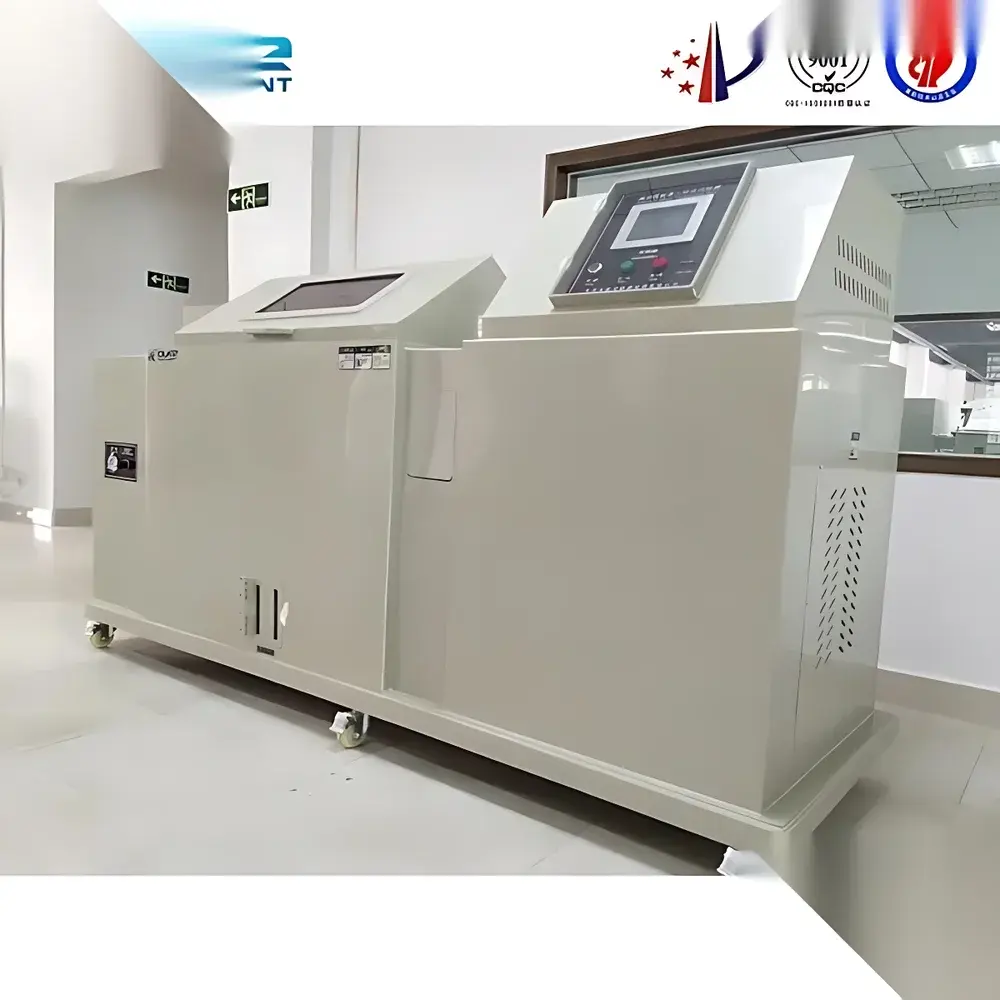
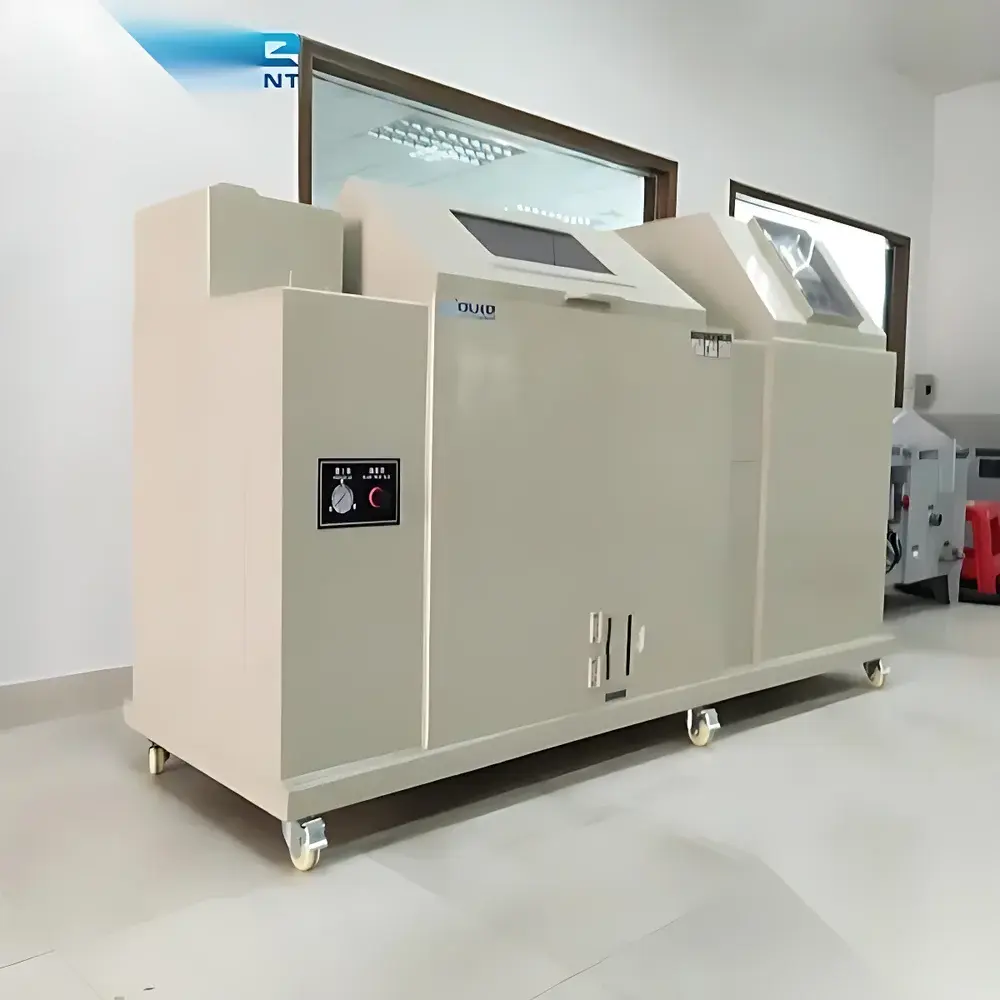
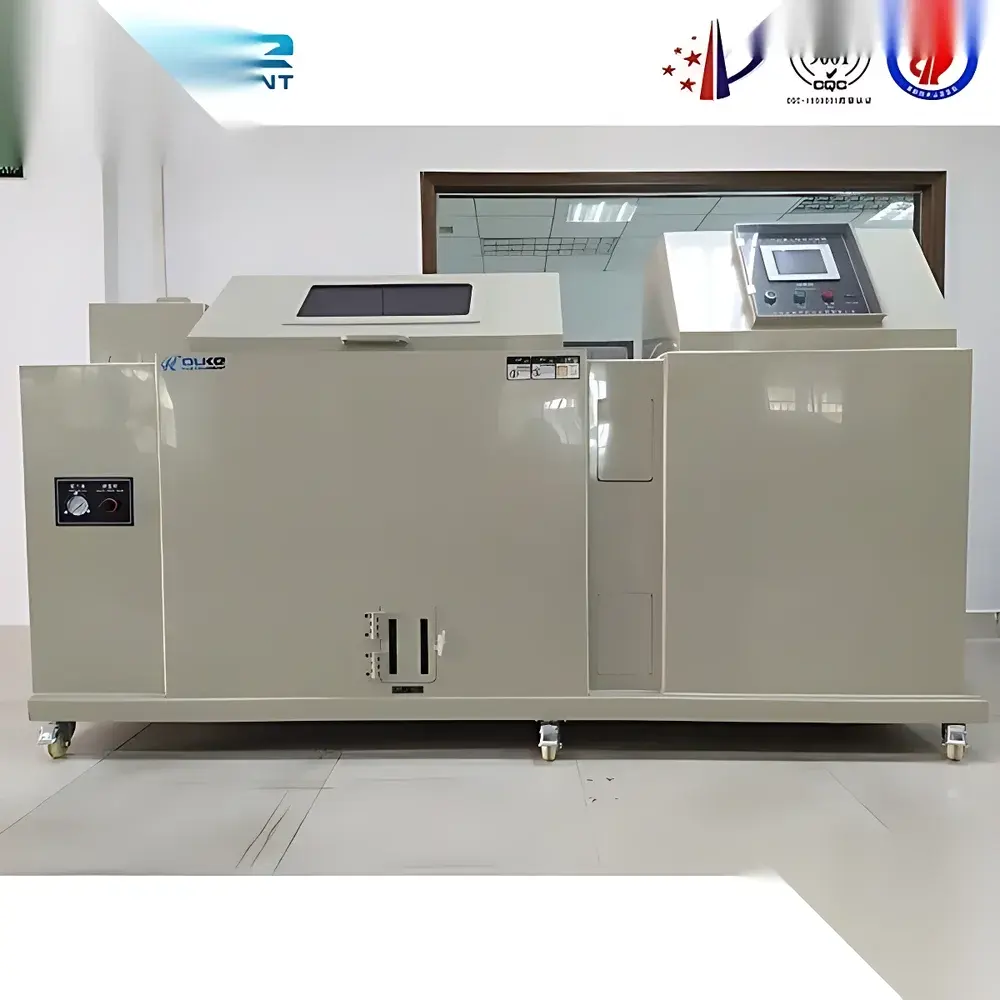
English Product Name
| Brand | OEM / Custom-Built |
|---|---|
| Origin | Imported |
| Supplier Type | Authorized Distributor |
| Price | USD 12,500 (FOB) |
| Chamber Material | 8 mm HCPVC inner tank & lid, 8 mm PVC outer shell with stainless steel frame |
| Saturator | 3 mm SUS304 stainless steel with level indicator |
| Heater | Titanium alloy corrosion-resistant heating element |
| Blower | Oriental Motor multi-wing centrifugal blower (Japan) |
| Pump | Acid-resistant magnetic drive pump |
| Solenoid Valve | SMC series (Japan) |
| SSR | Yaming SSR (Taiwan) |
| Standards Compliance | ASTM B117, ISO 9227, IEC 60068-2-11, JIS Z2371, DIN 50021, GB/T 2423.17 |
| Test Modes | NSS, ASS, CASS, Dry Heat (RT+10°C to 70°C ±1°C), Wet Heat (RT+10°C to 60°C ±1°C, 60–98% RH), Cyclic Corrosion Testing (CCT) |
Overview
The Multi-Function Environmental Test Chamber for Combined Salt Spray, Humidity, and Temperature Cycling is an engineered solution for accelerated corrosion testing under dynamically controlled, multi-stress environmental conditions. Unlike conventional static salt spray chambers, this system implements programmable cyclic exposure sequences—integrating neutral salt spray (NSS), acetic acid salt spray (ASS), copper-accelerated acetic acid salt spray (CASS), thermal drying, and high-humidity conditioning within a single chamber. Its operational principle relies on precise coordination between three independent subsystems: a corrosion-inducing salt fog generator, a humidity-controlled steam injection module, and a thermally regulated air circulation loop. The chamber is designed to replicate real-world service environments where electrochemical degradation results from synergistic interactions among chloride ion deposition, temperature gradients, and hygroscopic condensation—critical for validating coating integrity, galvanic compatibility, and passivation layer stability in automotive, aerospace, marine, and electronics components.
Key Features
- Corrosion-resistant construction: 8 mm HCPVC inner tank and lid withstand prolonged exposure to 5% NaCl, pH-adjusted solutions, and acidic aerosols without leaching or warping.
- Structural rigidity: Outer enclosure fabricated from 8 mm PVC sheet reinforced with welded SUS304 stainless steel framing—ensuring dimensional stability during thermal cycling and long-term pressure equilibrium.
- Precision saturator: 3 mm SUS304 saturated air chamber with integrated float-level sensor and PID-controlled heating—maintaining ±1°C accuracy at 47°C (NSS) and 63°C (CASS) per ISO 9227 requirements.
- Titanium heating elements: Chemically inert, non-oxidizing resistive heaters eliminate metal ion contamination and ensure uniform thermal distribution across the test volume.
- High-reliability fluid handling: Japanese SMC solenoid valves regulate compressed air supply to the atomizer; Taiwan Yaming solid-state relays provide zero-crossing switching for extended SSR lifespan and EMI suppression.
- Forced-air conditioning: Oriental Motor multi-wing blower delivers laminar airflow with adjustable velocity—enabling rapid transition between dry, wet, and salt-laden states while minimizing stratification.
Sample Compatibility & Compliance
This chamber accommodates flat-panel specimens up to 600 × 450 × 200 mm (W × D × H), including coated metal substrates, printed circuit boards (PCBs), fasteners, and polymer-sealed assemblies. It supports standardized sample mounting via non-conductive PVC racks and adjustable angle holders compliant with ASTM B117 orientation guidelines. All operational parameters—including chamber temperature, saturation temperature, relative humidity, spray duration, and dwell intervals—are traceable to NIST-traceable reference instruments and fully documented per GLP audit requirements. The system meets mandatory clauses of ISO/IEC 17025 for laboratory accreditation and is preconfigured for FDA 21 CFR Part 11-compliant electronic record retention when paired with optional validation software packages.
Software & Data Management
Equipped with a 7-inch industrial touchscreen HMI running embedded Linux, the controller supports up to 99 programmable test cycles with nested subroutines (e.g., 4-hr salt spray → 2-hr dry → 4-hr RH95% → 2-hr rest). Real-time logging records temperature, humidity, spray pressure, saturator level, and SSR status at 1-second intervals, exporting CSV files via USB or Ethernet. Optional PC-based software enables remote monitoring, statistical process control (SPC) charting, deviation alerts, and automated report generation aligned with ISO 9001 clause 8.2.4. Audit trails include user login history, parameter modification timestamps, and calibration event logs—all encrypted and tamper-evident per IEC 62443-3-3 security profiles.
Applications
- Qualification of zinc-nickel, epoxy-polyester, and chromate conversion coatings per ASTM D609 and ISO 2081.
- Evaluation of crevice corrosion resistance in stainless steel fasteners under cyclic CASS exposure (ISO 9227 Annex B).
- Validation of conformal coating adhesion on PCBAs subjected to alternating thermal-hygric stress per IPC-TM-650 2.6.25.
- Accelerated aging of automotive trim components exposed to coastal atmospheric conditions (SAE J2334).
- Material screening for offshore wind turbine nacelle enclosures requiring IP66-rated corrosion resilience.
FAQ
What standards does this chamber support for cyclic corrosion testing?
It fully complies with ASTM G85 Annex A5 (Prohesion), ISO 11997-1, and VDA 621-415 protocols when configured with optional dew point control and condensation sensors.
Can the chamber operate continuously for 1,000-hour tests?
Yes—the titanium heater, sealed bearing blower, and redundant level-sensing saturator enable unattended operation with scheduled maintenance intervals exceeding 2,000 hours MTBF.
Is third-party IQ/OQ/PQ documentation available?
Factory-certified installation and operational qualification kits are provided; performance qualification requires site-specific verification using calibrated thermohygrometers and salt concentration analyzers.
Does the system meet CE and UKCA marking requirements?
All electrical components carry CE-marked declarations of conformity; mechanical design adheres to EN 61000-6-2/6-4 EMC directives and EN 61010-1 safety standards.
What maintenance is required for long-term reliability?
Monthly inspection of nozzle orifices, quarterly descaling of the saturator, biannual verification of SSR zero-crossing timing, and annual calibration of humidity sensors using saturated salt solutions.



