
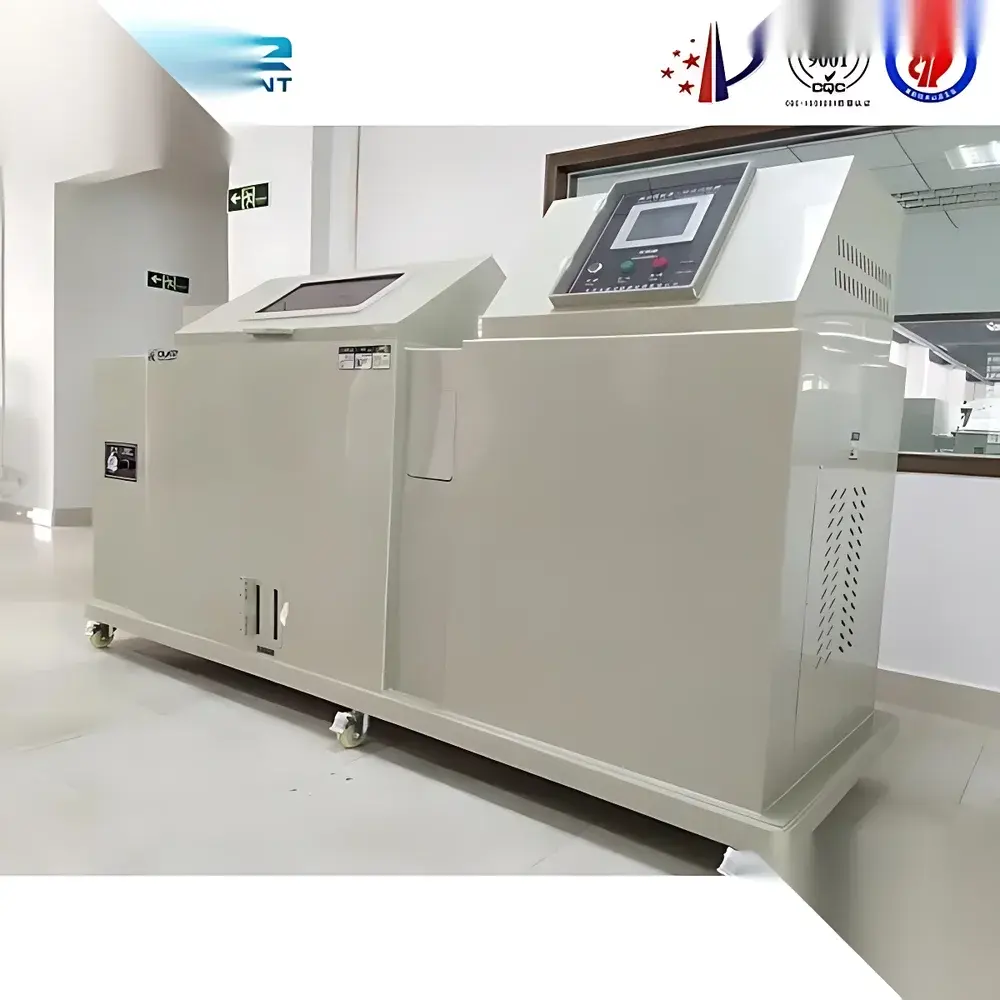
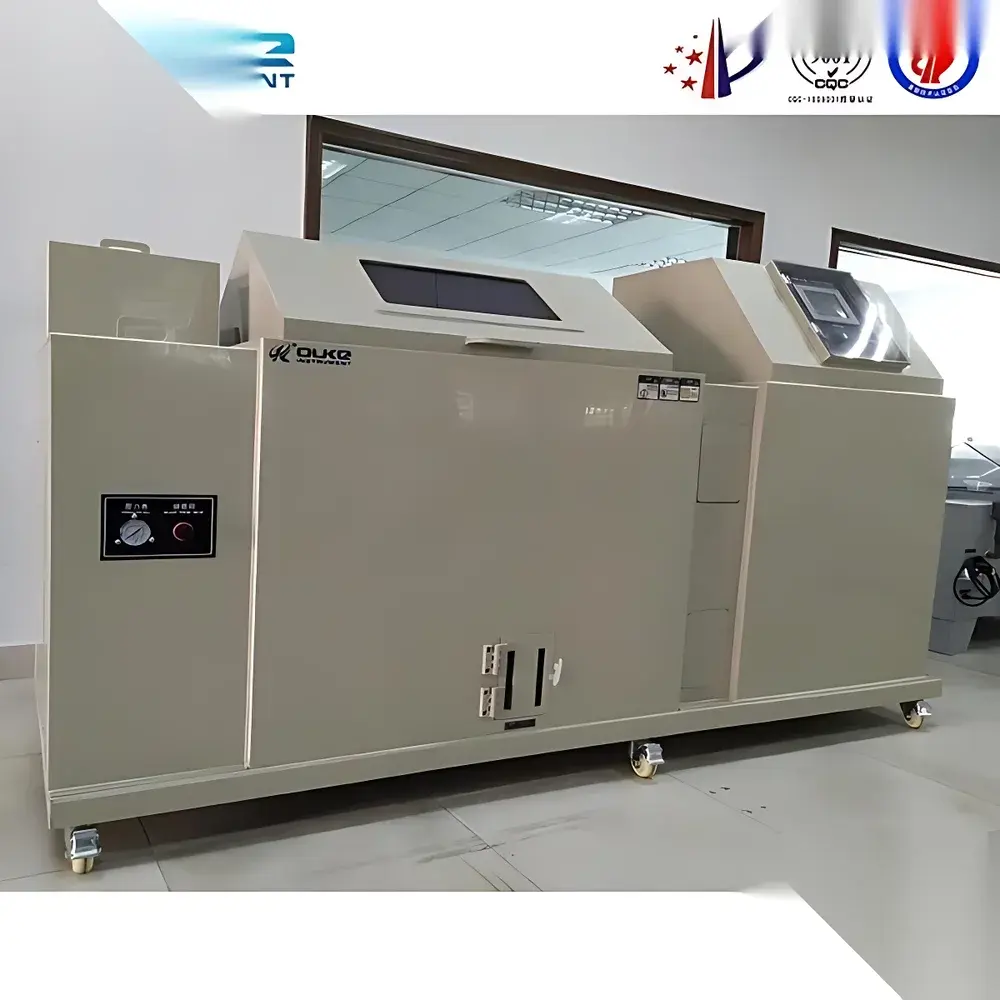
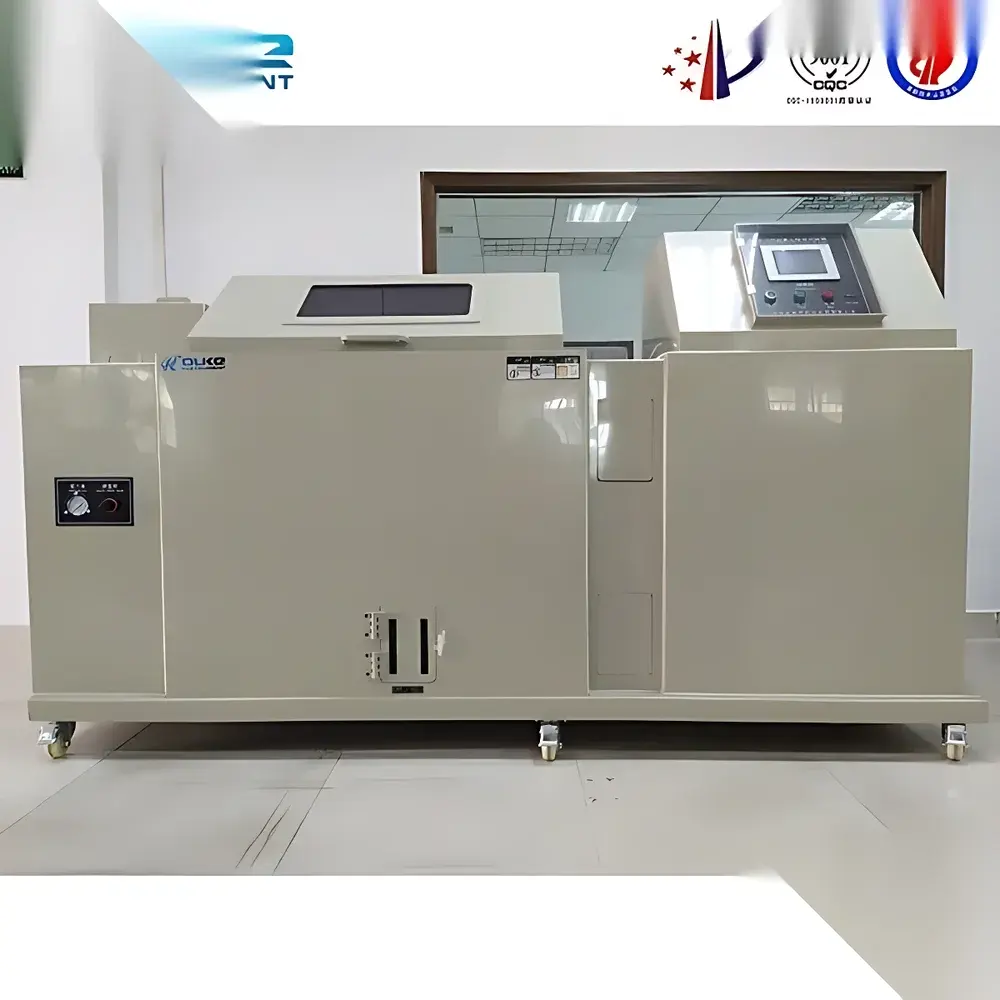
English Product Name
| Brand | OEM / Private Label |
|---|---|
| Origin | Imported |
| Manufacturer Type | Authorized Distributor |
| Quotation | USD 12,500 (FOB) |
| Test Chamber Dimensions | W120 × H50 × D100 cm |
| Temperature Uniformity | ±2°C |
| Temperature Stability | ±0.5°C |
| Salt Spray Deposition Rate | 1–2 mL / 80 cm²·h |
| Operating Temperature Range | +5°C to 60°C |
| Spray Mode | Continuous or Cyclic Programmable |
| Chamber Material | High-Purity Grey PVC (Acid/Alkali Resistant, UV-Stabilized) |
| Saturated Air Tank | Grey PVC Cylindrical Design |
| Viewing Window | 5 mm Thick Acrylic, 100° Angled Roof Geometry |
| Sample Rack | V-Shaped PVC Support with 10 mm O-Ring Glass Rods (15°–30° Adjustable Tilt) |
| Nozzle Material | Fused Quartz Glass, Bernoulli-Optimized Orifice |
| Rated Nozzle Lifetime | ≥10,000 h (Under Normal Maintenance & NaCl Solution Use) |
Overview
The Multi-Climate Salt Spray Corrosion Test Chamber with Temperature & Humidity Cycling Capability is an engineered environmental simulation system designed to accelerate corrosion evaluation of metallic substrates, coated components, and electroplated assemblies under controlled, reproducible marine-atmosphere conditions. It integrates three critical stress vectors—neutral salt fog (NSS), acidic salt spray (AASS), and cyclic temperature/humidity variation—into a single test sequence per ISO 9227, ASTM B117, ASTM G85 Annex A5 (Prohesion), and JIS Z2371. Unlike conventional static salt chambers, this system enables programmable transitions between high-humidity soak phases (up to 98% RH at 40°C), elevated temperature drying cycles (up to 60°C), and active salt mist exposure—all within the same chamber volume. The chamber’s dual-function architecture supports both continuous salt fog immersion and multi-stage corrosion protocols required for automotive OEM qualification (e.g., GMW 14872, Ford CETP 00.00-L-467), aerospace fastener testing (AMS 2700), and electronics enclosure validation (IEC 60068-2-52). Its closed-loop saturation air system ensures stable fog generation without condensation carryover, while the precisely angled acrylic roof prevents saline droplet fall-back onto specimens—a known source of localized over-corrosion and non-uniform test results.
Key Features
- Corrosion-resistant chamber construction using UV-stabilized, high-purity grey PVC板材 (not standard PVC-U), welded via orbital thermal bonding to eliminate micro-gaps and ensure long-term chemical integrity against 5% NaCl, CuCl₂-acidified solutions, and acetic acid fog.
- Integrated temperature/humidity cycling control with independent PID-regulated heating, humidification, and dehumidification subsystems—enabling seamless transition between 25°C/50% RH, 40°C/98% RH, and 60°C/dry phases per user-defined test profiles.
- Tower-type quartz nozzle array with Bernoulli-optimized internal geometry delivers uniform fog distribution (±5% spatial variance across 80 cm² collector area) and sub-10 µm median droplet size—critical for replicating natural sea-spray deposition kinetics.
- Saturated air tank fabricated from seamless grey PVC in pressure-rated cylindrical configuration; eliminates stainless steel corrosion fatigue and maintains consistent vapor pressure at 47°C ± 1°C, ensuring stable fog density over extended operation.
- Adjustable sample mounting system with V-groove PVC rails and 10 mm diameter tempered glass rods allows precise angular positioning (15°–30°) per ISO 7253 and ASTM B117 specimen orientation requirements.
- Front-access maintenance design: quick-release nozzles, modular saturation tank, and tool-free chamber liner inspection ports reduce scheduled downtime and simplify GLP-compliant calibration verification.
Sample Compatibility & Compliance
This chamber accommodates flat panels (max. 100 × 75 cm), machined fasteners, PCB assemblies, painted automotive trim, galvanized sheet metal, and passivated stainless steel components. All internal surfaces comply with ISO 17025 traceability requirements for material certification (PVC lot traceability, quartz nozzle spectral purity documentation). The system meets mechanical safety standards IEC 61000-6-2/6-4 and carries CE marking under the EU Machinery Directive 2006/42/EC. Calibration procedures align with ISO/IEC 17025-accredited labs for temperature uniformity (ASTM E744), spray deposition rate (ISO 9227 Annex B), and humidity sensor drift verification (NIST-traceable hygrometer reference). Optional IQ/OQ documentation packages support FDA 21 CFR Part 11–compliant validation for medical device coating qualification.
Software & Data Management
Equipped with embedded 7-inch TFT touchscreen HMI running real-time Linux OS, the controller logs all operational parameters—including chamber temperature, saturation tank temperature, relative humidity, spray on/off status, and cumulative cycle count—at 1-second intervals. Data export is supported via USB 2.0 and Ethernet (Modbus TCP) to LIMS or MES platforms. Audit trail functionality records operator login/logout, parameter modifications, and alarm events with time stamps and user IDs—fully compliant with ALCOA+ data integrity principles. Optional PC-based software (Windows 10/11 compatible) provides graphical test profile editing, multi-chamber synchronization, statistical trend analysis (Cp/Cpk calculation per test phase), and automated PDF report generation per ISO/IEC 17025 clause 7.8.2.
Applications
- Automotive: Evaluation of zinc-nickel plating adhesion on brake calipers, e-coat durability on chassis components, and corrosion resistance of aluminum die-cast housings under GMW 14872 Cycle E.
- Aerospace: Qualification of cadmium-plated fasteners per AMS 2700 and titanium alloy surface treatments exposed to simulated coastal storage environments.
- Electronics: Reliability assessment of conformal coatings (acrylic, silicone, urethane) on PCBs subjected to combined thermal shock and chloride ion ingress.
- Construction: Testing of galvanized rebar coatings, stainless steel architectural cladding, and powder-coated aluminum curtain wall systems per ASTM D1654 and ISO 12944-9.
- Renewables: Corrosion performance validation of offshore wind turbine gearbox housings and solar mounting hardware under accelerated tropical marine exposure.
FAQ
What salt solutions are supported beyond standard 5% NaCl?
The chamber is validated for neutral salt spray (NSS), acetic acid salt spray (AASS), copper-accelerated acetic acid salt spray (CASS), and Prohesion (cyclic NaCl/NH₄SO₄) per ASTM G85 Annexes A1–A5.
Is external compressed air required for雾 generation?
Yes—a clean, oil-free, dry air supply at 2–3 bar (29–44 psi) is mandatory for the saturated air system; integrated air dryer and particulate filtration are recommended for long-term nozzle reliability.
Can the chamber operate unattended for 1,000-hour tests?
Yes—continuous operation capability is certified for up to 1,440 hours with scheduled solution replenishment every 72 hours and quarterly preventive maintenance per OEM service manual.
How is temperature uniformity verified during qualification?
Using nine NIST-traceable PT100 sensors placed per ISO 9227 Figure 2 layout, measured over 3 consecutive hours at 35°C and 50°C setpoints; deviation must remain within ±2°C across all positions.
Does the system include calibration certificates for factory delivery?
Yes—each unit ships with a full Factory Acceptance Test (FAT) report including temperature uniformity, spray deposition rate, and saturation tank pressure stability data, signed by a qualified metrologist.



