
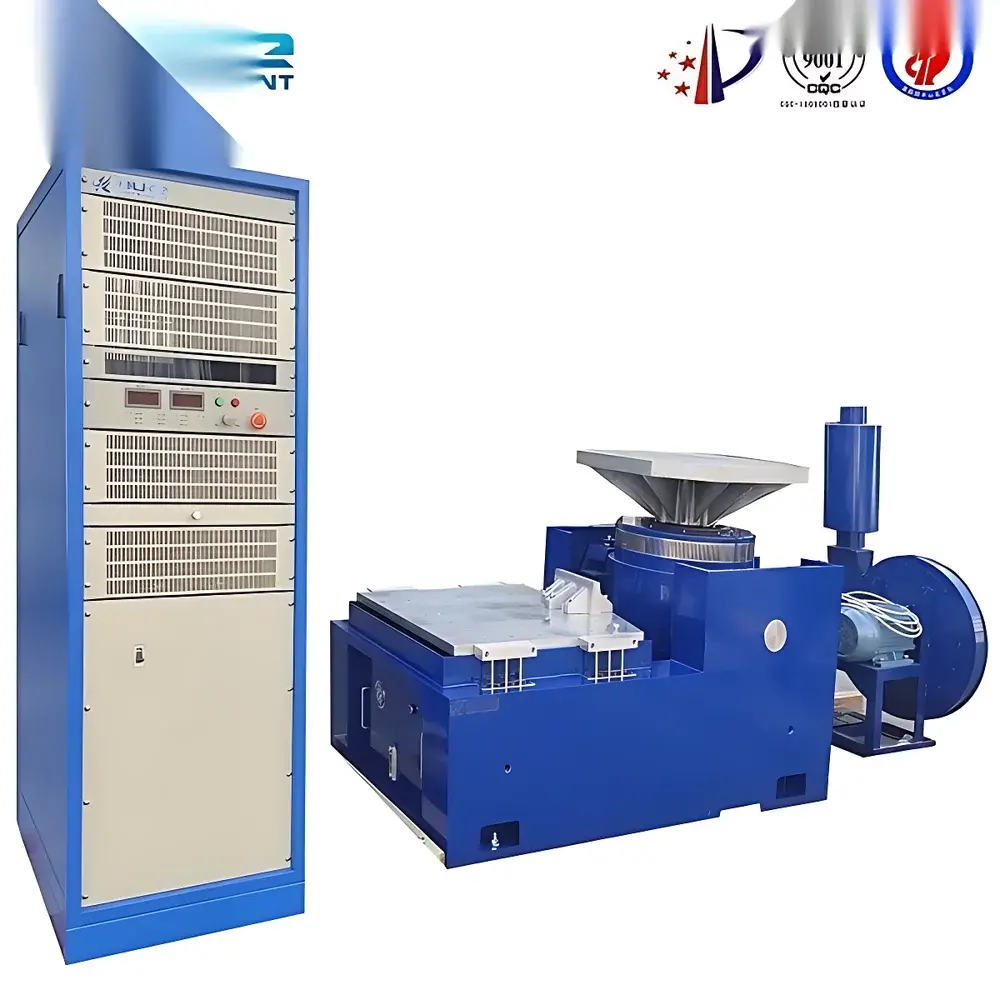
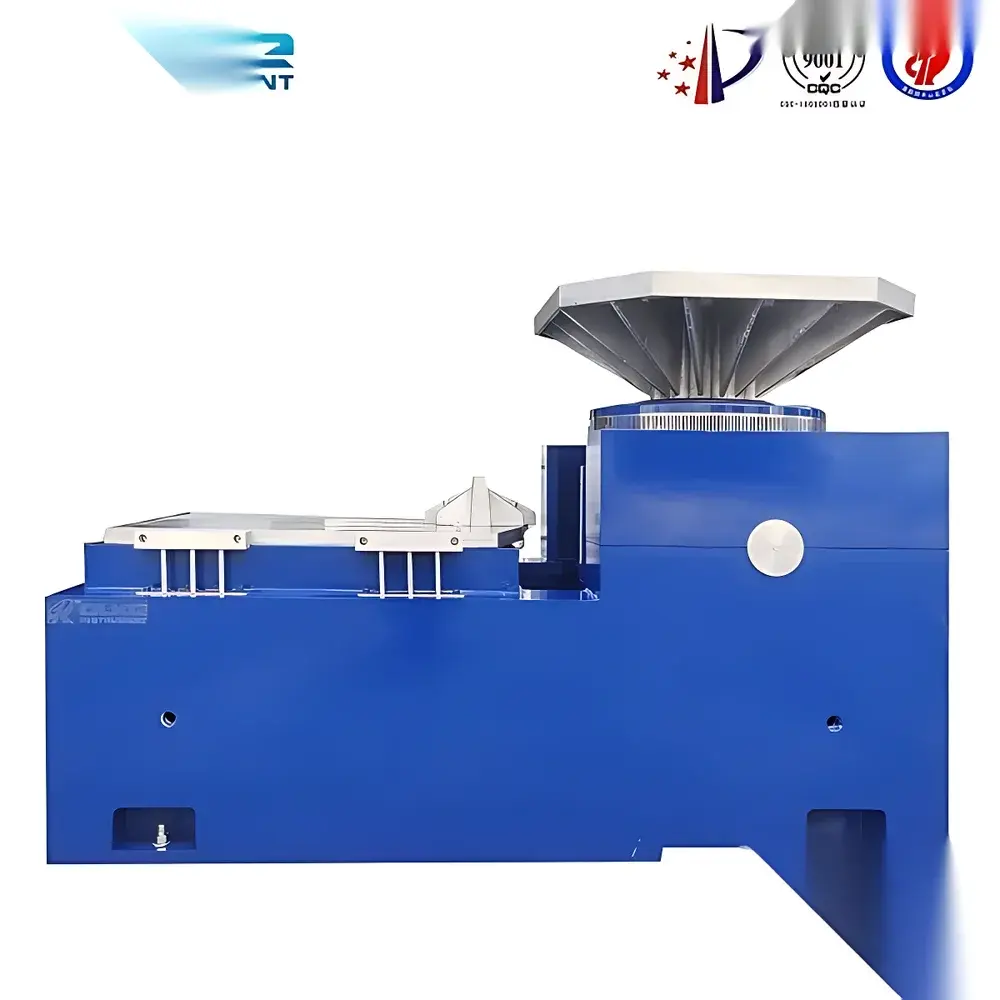
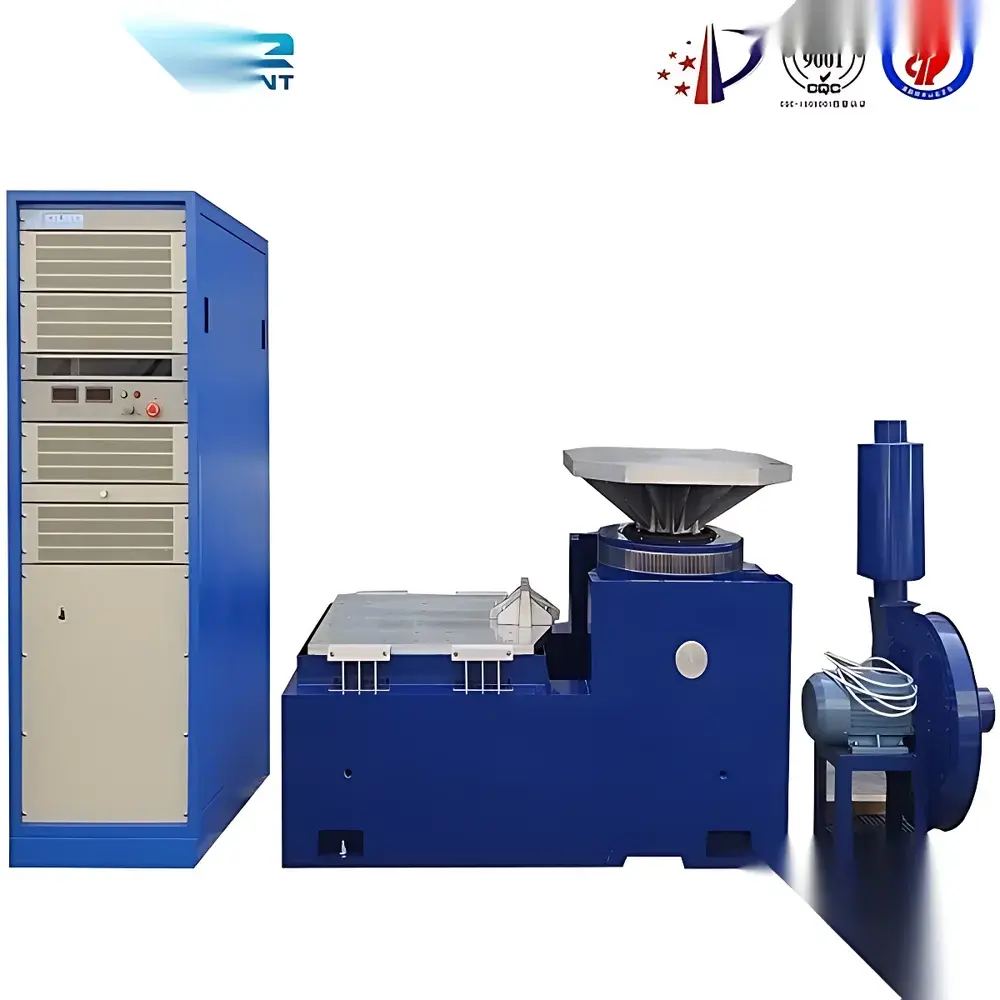
English Product Name
| Brand | OKE Instruments |
|---|---|
| Origin | China (Domestically Manufactured, Designed for Global Compliance) |
| Manufacturer Type | OEM/ODM Manufacturer |
| Certification Readiness | CE, ISO 17025-Compatible Design |
| Price Range | USD 20,000–25,000 (FOB Shanghai) |
| Tabletop Dimensions | 450 × 450 mm or 500 × 500 mm |
| Adjustable Amplitude | 0–5 mm peak-to-peak |
| Frequency Range | 1–400 Hz / 1–2000 Hz / 1–5000 Hz (model-dependent) |
| Max Load Capacity | 150 kg |
| Acceleration Range | 0–20 g (rms or peak, configurable) |
| Waveform | Sine (half-wave, full-wave), programmable |
| Sweep Mode | Linear/logarithmic, bidirectional, user-defined start/stop frequency & dwell time |
| Programmable Steps | Up to 15 segments (frequency, amplitude, acceleration, duration per step) |
| Octave Rate | 0.01 Hz resolution, up to 15 octaves |
| Log Sweep Modes | Low→High, High→Low, Low→High→Low (cyclic) |
| Vibration Axes | Vertical (Y), Horizontal (X/Z), or Triaxial (X/Y/Z simultaneous or sequential) |
| Amplifier Power Output | 2.2 kW |
| Input Voltage | 220 V AC, 50 Hz |
| Max Current Draw | 10 A |
| Timing Resolution | 1-second programmable duration (up to 999 hours) |
| Control Interface | RS-232/USB/Ethernet |
Overview
The OKE Electric Vibration Testing System is an electrodynamically driven shaker engineered for precision mechanical stress evaluation in reliability and durability testing environments. Based on Lorentz-force actuation principles, it delivers controlled sinusoidal, swept-sine, and programmable vibration profiles across a wide frequency spectrum — from sub-Hz structural resonance detection to high-frequency component fatigue analysis. Unlike hydraulic or servo-mechanical alternatives, this system employs air-cooled voice-coil actuators with rigid armature suspension, enabling high-fidelity waveform reproduction, low harmonic distortion (<2% THD at rated load), and exceptional phase linearity. It is purpose-built for laboratory-grade qualification per IEC 60068-2-6, MIL-STD-810H Method 514.7, and GB/T 2423.10–2019, supporting both R&D validation and production-line 100% functional screening.
Key Features
- Electronically regulated closed-loop control architecture ensures stable amplitude and acceleration tracking across the full operational envelope, even under variable load conditions.
- Ultra-low acoustic signature: <45 dB(A) at 1 m distance during no-load operation — compliant with ISO 7779 and workplace noise exposure limits per OSHA 29 CFR 1910.95.
- True 5 mm peak-to-peak displacement capability verified via laser Doppler vibrometry (LV-1800 or equivalent); eliminates optical illusion artifacts caused by unsupported tabletop resonance or flexure.
- Triaxial excitation support (X/Y/Z) with independent or coupled axis control, enabling multi-degree-of-freedom simulation aligned with real-world transport and operational shock profiles.
- Full-enclosure controller housing with IP54-rated front panel, integrated emergency stop, and interlocked safety door — meeting EN 61000-6-2/6-4 EMC and functional safety requirements per IEC 61508 SIL2.
- Intuitive touch-enabled HMI with real-time FFT spectrum display, waveform preview, and one-touch recall of preloaded test standards (e.g., ISTA 3A, JEDEC JESD22-B103C).
Sample Compatibility & Compliance
The system accommodates test specimens up to 150 kg mass on standard 450 × 450 mm or optional 500 × 500 mm aluminum honeycomb table surfaces (anodized, tapped M6). Mounting adapters, slip plates, and inertial mass extenders are available for non-standard fixtures. All firmware and control algorithms are developed in accordance with ISO/IEC 17025:2017 clause 7.7 (measurement traceability) and support calibration verification using NIST-traceable accelerometers (e.g., PCB Piezotronics Model 352C33). Test reports generated meet GLP audit requirements, including electronic signatures, revision-controlled test templates, and automatic metadata stamping (timestamp, operator ID, environmental conditions).
Software & Data Management
OKE VTS Control Suite (v4.2+) provides native Windows 10/11 compatibility with full IEEE 1588 PTP time synchronization. It supports automated test sequencing, real-time spectral monitoring (1600-line FFT, 0.1 Hz resolution), and post-processing export to CSV, MATLAB .mat, or Universal File Format (UFF 58). Audit trails log all parameter changes, user actions, and system events with SHA-256 hashing — satisfying FDA 21 CFR Part 11 electronic record integrity mandates. Optional cloud gateway enables secure remote monitoring via TLS 1.3–encrypted MQTT streams, with role-based access control (RBAC) and SAML 2.0 identity federation.
Applications
This shaker serves critical roles across aerospace avionics qualification (DO-160 Section 8), automotive ECU vibration immunity testing (ISO 16750-3), consumer electronics drop-and-vibration correlation (IPC-9701), printed circuit board solder joint fatigue assessment (IPC-SM-785), and medical device electromagnetic compatibility pre-scanning (IEC 60601-1-2). Its programmable multi-segment profiles enable accelerated life testing (ALT) protocols such as HALT/HASS, while its wide dynamic range supports both low-g microvibration sensitivity checks and high-g shock replication.
FAQ
Is the 5 mm amplitude specification verified under loaded conditions?
Yes — displacement linearity is validated per ISO 5347-12 using calibrated laser interferometry at 50%, 100%, and 120% of maximum rated load.
Can the system perform random vibration testing?
Not natively; this model is optimized for deterministic waveforms (sine, sweep, programmable). Random vibration capability requires optional DSP-based controller upgrade (OKE-RV-2200 series).
What calibration documentation is provided upon delivery?
Each unit ships with a factory calibration certificate traceable to CNAS-accredited labs (certificate number embedded in firmware), plus uncertainty budget per GUM (JCGM 100:2008).
Does the system support third-party DAQ integration?
Yes — analog voltage outputs (±10 V) mirror acceleration, velocity, and displacement signals; digital triggers and status flags are accessible via TTL-level GPIO.
Is firmware update supported remotely?
Yes — over-the-air updates are signed and authenticated via dual-key RSA-2048; rollback capability preserves previous certified versions for audit continuity.
Related Products



