
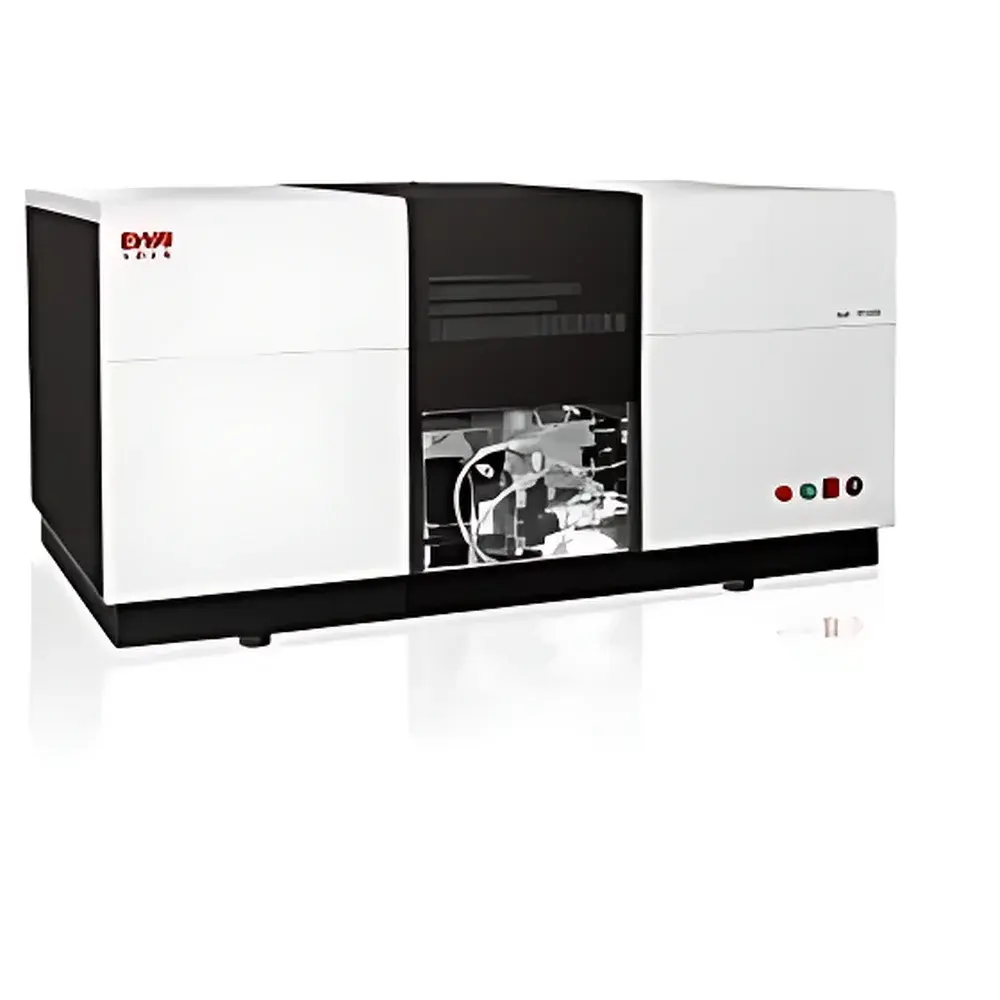
English Product Name
| Origin | Shandong, China |
|---|---|
| Manufacturer Type | Authorized Distributor |
| Origin Category | Domestic (PRC) |
| Model | AA-7020 |
| Price Range | USD 7,000–14,000 (FOB) |
| Instrument Type | Dual-Mode Flame/Graphite Furnace AAS |
| Monochromator | Plane Grating (1800 lines/mm) |
| Optical System | Single-Beam Czerny-Turner |
| Detector | Solid-State Photomultiplier Tube (Hamamatsu R928) |
| Background Correction | Deuterium Lamp + Self-Reversal (Auto-Adjusting) |
| Spectral Resolution | ≤0.3 nm |
| Cu Sensitivity (Flame) | ≥0.3 A at 5 ppm |
| Relative Standard Deviation (RSD) | ≤0.3% (Flame), ≤1% (Graphite Furnace) |
| Detection Limit (Flame) | ≤0.003 µg/mL (Cu) |
| (Graphite Furnace) | ≤0.5×10⁻¹³ g (Cd) |
Overview
The Shandong AA-7020 is a dual-mode atomic absorption spectrometer engineered for high-reproducibility elemental quantification across environmental, clinical, food safety, and public health laboratories. It operates on the fundamental principle of atomic absorption spectroscopy—measuring the attenuation of characteristic hollow cathode lamp radiation as ground-state atoms in a flame or graphite furnace absorb photons at element-specific wavelengths (190.0–900 nm). Its integrated flame and graphite furnace atomizers—mechanically pre-aligned on a single optical platform—enable sub-2-second mode switching without realignment, eliminating optical drift and mechanical wear associated with manual interchange. The instrument employs longitudinal graphite tube heating (up to 3000 °C), optimized gas flow control (dual Ar/O₂ atmosphere below 500 °C; pure Ar above), and optical power feedback during atomization to ensure precise thermal ramping and minimal matrix interference. Designed for compliance-critical workflows, it supports GLP/GMP-aligned data integrity via audit-trail-capable software and meets ISO/IEC 17025-relevant performance benchmarks for precision, detection limit, and background correction linearity.
Key Features
- Patented dual-atomizer platform (ZL 2006 2 0023297.4): Flame and graphite furnace modules are permanently aligned on a rigid base; automatic switching requires no recalibration.
- Longitudinal graphite furnace with optical temperature control: Achieves ±1% temperature accuracy and ≥2000 °C/s ramp rate; enables reliable analysis of high-boiling-point elements (Al, Ni, Pd, Sr) up to 3000 °C.
- Enhanced background correction: Simultaneous deuterium lamp and self-reversal (SR) correction; compensates for structured background up to 1.0 A with >50× correction factor—critical for high-salt matrices (e.g., soy sauce, biological digests).
- Full-titanium burner head and nebulizer chamber: Mold-cast construction resists corrosion from strong acids/bases; eliminates dimensional drift common in polypropylene-based雾化室 designs.
- Intelligent gas management: Water-seal float–actuated solenoid valve prevents acetylene leakage during flame ignition; real-time pressure monitoring triggers shutdown on air under-pressure or flame extinction.
- Optical system isolation: Entire monochromator and detector assembly mounted on a vibration- and thermally isolated base (ZL 2006 2 0023296.X), ensuring stability in non-climate-controlled labs.
- Automated wavelength setup: 40-second full sequence—wavelength scan, slit selection (0.1–2.0 nm), lamp current optimization, energy balancing, and baseline zeroing—all executed unattended.
Sample Compatibility & Compliance
The AA-7020 accommodates aqueous solutions, acid-digested environmental samples (soil, sludge), diluted biological fluids (serum, urine), and food extracts. Its graphite furnace accepts up to 70 µL sample volume—reducing need for pre-concentration while maintaining sub-pg detection limits. Flame mode handles higher-concentration samples (ppm-level) with robust tolerance to chloride and sulfate matrices. For regulatory compliance, the system supports trace metal analysis per EPA Method 7000B, ISO 11885, and GB/T 5009 series standards. Software logging meets FDA 21 CFR Part 11 requirements for electronic records (user authentication, audit trail, data immutability). All safety interlocks—including coolant flow monitoring, argon pressure verification, and furnace over-temperature cutoff—are documented in the instrument’s IEC 61010-1 certified electrical architecture.
Software & Data Management
Controlled via Windows XP–based application (backward-compatible with Windows 10 via virtualization), the software provides full parameter automation: lamp selection, slit width, gain, integration time (10 ms–300 s), and multi-step graphite furnace temperature programming (up to 20 segments). Data acquisition supports peak height, peak area, and integrated absorbance modes using a 24-bit dual-channel ADC. Calibration options include linear, quadratic, cubic, log-log, and spline fitting across up to 20 standards; standard addition and single-point slope re-calibration are supported. Reports export to CSV/PDF with embedded metadata (instrument ID, operator, date/time, method parameters). Audit logs record all user actions, method changes, and calibration events—essential for ISO/IEC 17025 accreditation and internal QA reviews.
Applications
The AA-7020 delivers validated performance in public health surveillance (Pb, Cd, As in drinking water per WHO guidelines), food safety testing (Cu, Zn, Fe in fortified cereals), environmental monitoring (Cr, Ni in industrial effluents), and clinical toxicology (Al in dialysis patients). Its extended temperature range and dual-background correction make it suitable for analyzing refractory elements in geological samples (e.g., rare earths in rock digests) and high-matrix clinical specimens (e.g., hemoglobin-rich blood lysates). The optional graphite furnace autosampler adds programmable dilution/concentration—enabling direct analysis of viscous or particulate-laden samples without manual pretreatment.
FAQ
Does the AA-7020 support regulatory-compliant data archiving?
Yes—the software generates timestamped, user-authenticated audit trails and stores raw signal data with full method parameters, satisfying 21 CFR Part 11 and ISO/IEC 17025 documentation requirements.
What is the maximum graphite furnace temperature and how is thermal stability ensured?
The furnace reaches 3000 °C using longitudinal heating; optical power feedback during atomization maintains ±1% temperature accuracy and ≤0.5% repeatability across cycles.
Can the instrument analyze high-salt samples like seawater or soy sauce without spectral interference?
Yes—dual deuterium lamp + self-reversal background correction corrects for structured background up to 1.0 A, enabling accurate quantification in samples with >10% total dissolved solids.
Is external graphite furnace power supply required?
No—the 4 kW graphite furnace power module is fully integrated into the main chassis (ZL 2006 2 0023298.9), reducing footprint and eliminating external cabling or cooling demands.
How does the water-seal safety system prevent acetylene hazards?
A float switch directly actuates the acetylene solenoid valve; if water level drops below threshold, ignition is blocked and audible/visual alarms activate—preventing unignited gas accumulation.
Related Products






