English Product Name
| Brand | TimePower |
|---|---|
| Origin | Beijing, China |
| Manufacturer Type | Direct Manufacturer |
| Country of Origin | China |
| Model | TP737 |
| Pricing | Upon Request |
| Measurement Range | 0.0 °C to 1372 °C |
| Temperature Resolution | 0.1 °C (0.0–999.9 °C), 1 °C (>999.9 °C) |
| Temperature Accuracy | ±0.2% of reading |
| Ambient Operating Temperature | ≤30 °C |
| Relative Humidity | 10–70% RH |
| Storage/Transport Temperature | −25 °C to +55 °C |
| Power Supply | AC 220 V ±10%, 50 Hz ±10% |
| Max. Power Consumption | ≤2 kW |
| Dimensions (H×W×D) | 500 mm × 400 mm × 360 mm (main unit) |
Overview
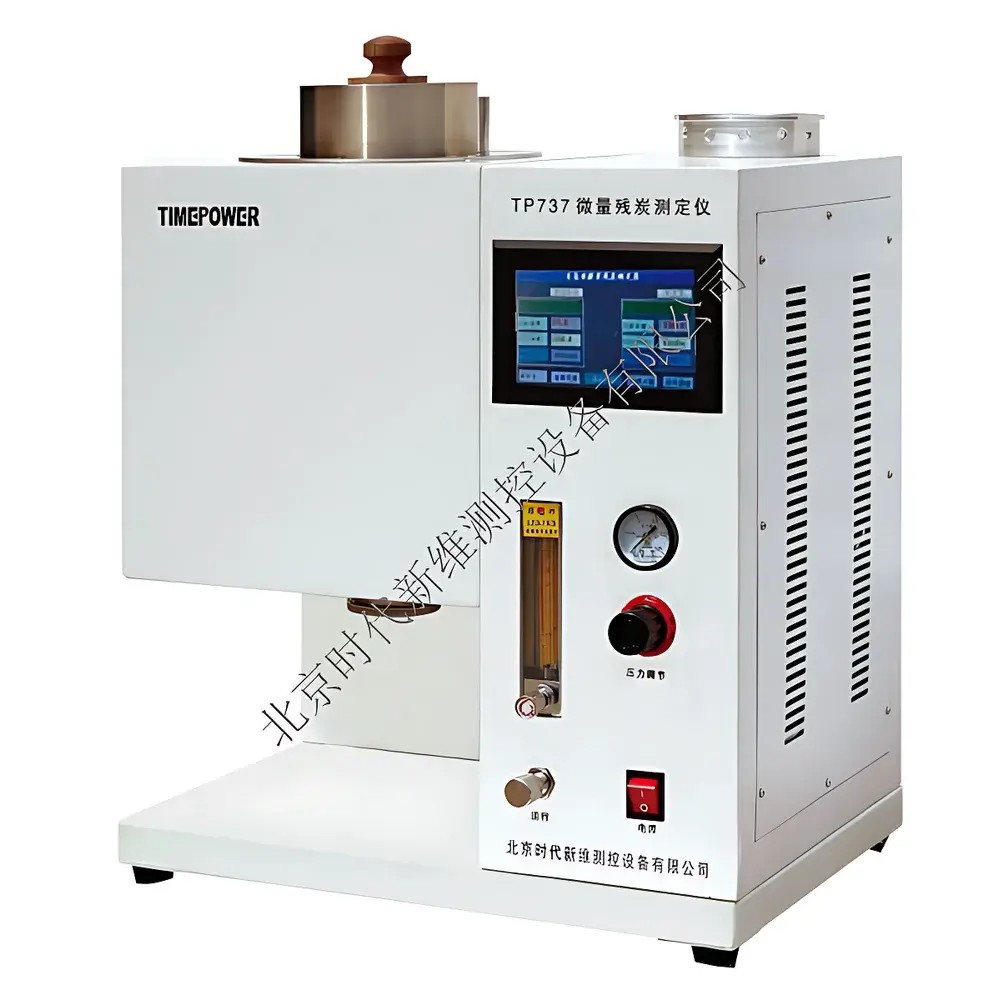
The TimePower TP737 Micro Carbon Residue Analyzer is a precision laboratory instrument engineered for the quantitative determination of carbon residue content in petroleum products according to ASTM D7042 (equivalent to GB/T 17144–1997). It employs the micro-method Conradson carbon residue (MCR) principle—based on controlled thermal decomposition under inert nitrogen atmosphere—to quantify the coke-forming tendency of lubricating oils, distillate fuels, residual fuels, and other hydrocarbon-based materials. Unlike traditional Ramsbottom or Conradson methods requiring large sample volumes (10 mL), the TP737 operates with 2–4 g samples, minimizing reagent consumption, waste generation, and operator exposure while maintaining full compliance with internationally recognized test protocols. Its design integrates thermogravimetric principles with programmable pyrolysis: samples are heated from ambient to 500 °C at defined ramp rates under continuous nitrogen purge (flow rate precisely regulated), volatiles swept away, and non-volatile carbonaceous residue gravimetrically expressed as mass percent of the original specimen.
Key Features
- 5-inch TFT color touchscreen interface with intuitive icon-driven navigation, real-time graphical display of temperature profile, nitrogen flow status, and elapsed time.
- Automated dual-parameter control: independent PID-regulated heating program and digitally stabilized nitrogen mass flow controller (0.08–0.2 MPa operational range, with low-pressure shutdown safeguard).
- Embedded real-time operating system ensuring deterministic response, zero runtime crashes, and uninterrupted data logging during extended 45–60 minute test cycles.
- Optimized high-temperature furnace architecture featuring multi-zone ceramic insulation, uniform radial heat distribution, and active lid-cooling geometry to prevent thermal runaway beyond 520 °C (audible alarm triggered upon exceedance).
- Integrated analytical workflow: manual entry of pre-weighed sample tube mass and specimen mass; automatic calculation of % carbon residue using ISO 10370-compliant formula: CR (%) = [(m₂ − m₁) / m₀] × 100, where m₀ = sample mass, m₁ = empty tube mass, m₂ = tube + residue mass.
- Onboard data storage supporting up to 100 test records with timestamp, operator ID field, and editable metadata; chronological retrieval by date range via calendar-based filter.
Sample Compatibility & Compliance
The TP737 accommodates both standard micro-carbon residue tubes (10 mm OD × 120 mm L) and optional large/small format variants for viscosity-stabilized heavy feedstocks. It supports analysis of crude oil fractions, diesel fuel, marine fuel oil (IFO 180/380), base oils, and synthetic lubricants per ASTM D4530, ISO 10370, and GB/T 17144–1997. All electronic controls, data handling, and audit trails align with GLP requirements: user-access logs, parameter change history, and immutable result export (CSV via USB port) facilitate FDA 21 CFR Part 11 readiness when paired with validated LIMS integration. The instrument’s mechanical safety interlocks, overtemperature cutoffs, and nitrogen pressure monitoring meet IEC 61010-1:2010 Class II electrical safety standards.
Software & Data Management
No proprietary PC software is required for basic operation—the embedded firmware handles all calibration, method execution, and reporting. For enterprise deployment, ASCII-formatted CSV output enables seamless ingestion into laboratory information management systems (LIMS) or statistical process control (SPC) platforms. Each record includes: test ID, start/end timestamps, peak temperature, nitrogen flow stability index (% deviation), raw mass entries, calculated CR value, and operator confirmation signature. Audit trail integrity is preserved through write-once memory allocation; historical entries cannot be edited or deleted without system-level administrative authentication.
Applications
- Refinery QC labs assessing thermal stability of vacuum gas oils prior to FCC feed blending.
- Marine engine oil condition monitoring to predict sludge formation potential in crosshead diesel engines.
- Aviation turbine fuel certification per DEF STAN 91-91 Annex G (carbon residue limit ≤0.05% wt).
- R&D evaluation of antioxidant package efficacy in transformer oils under accelerated aging protocols.
- Contract testing laboratories performing third-party verification for API RP 990 or ISO 8217 compliance reports.
FAQ
What safety precautions must be observed during operation?
Operators must wear heat-resistant gloves when handling the furnace lid or sample tubes post-test; surface temperatures exceed 300 °C. The instrument incorporates dual thermal fuses and an audible alarm for >520 °C excursions.
Is nitrogen purity critical for valid results?
Yes—minimum 99.995% pure N₂ is required to prevent oxidative side reactions; impurities such as O₂ or H₂O may artificially elevate residue values by promoting char oxidation or catalytic coking.
Can the TP737 be used for non-petroleum samples like biofuels?
It is validated only for hydrocarbon-based matrices per ASTM/ISO scope; biodiesel (FAME) or ethanol blends require method adaptation and independent validation per ASTM D7457.
How often does the furnace require recalibration?
Annual traceable calibration against NIST-traceable RTD standards is recommended; internal diagnostics verify thermocouple linearity before each test sequence.
Does the instrument support remote monitoring or network connectivity?
No Ethernet or Wi-Fi interface is provided; however, USB-host mode allows direct connection to Windows/Linux PCs for batch data export and firmware updates.