
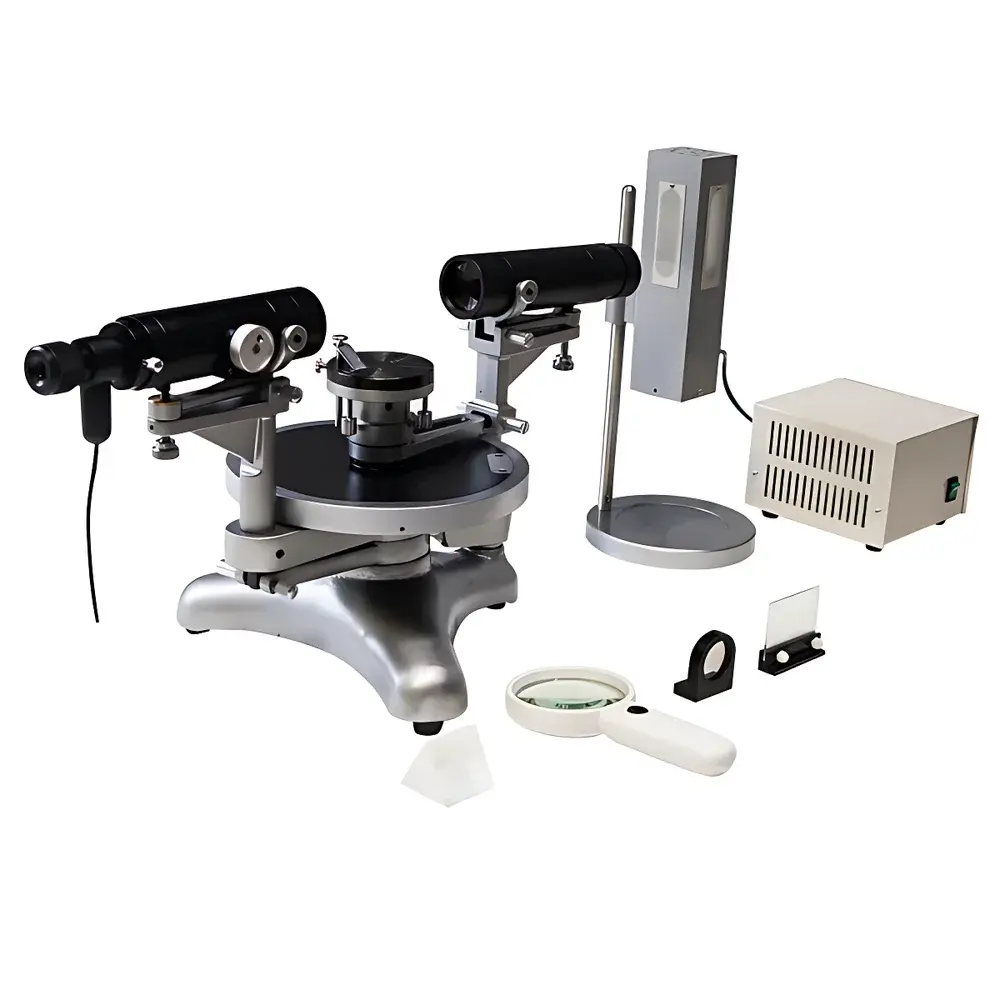
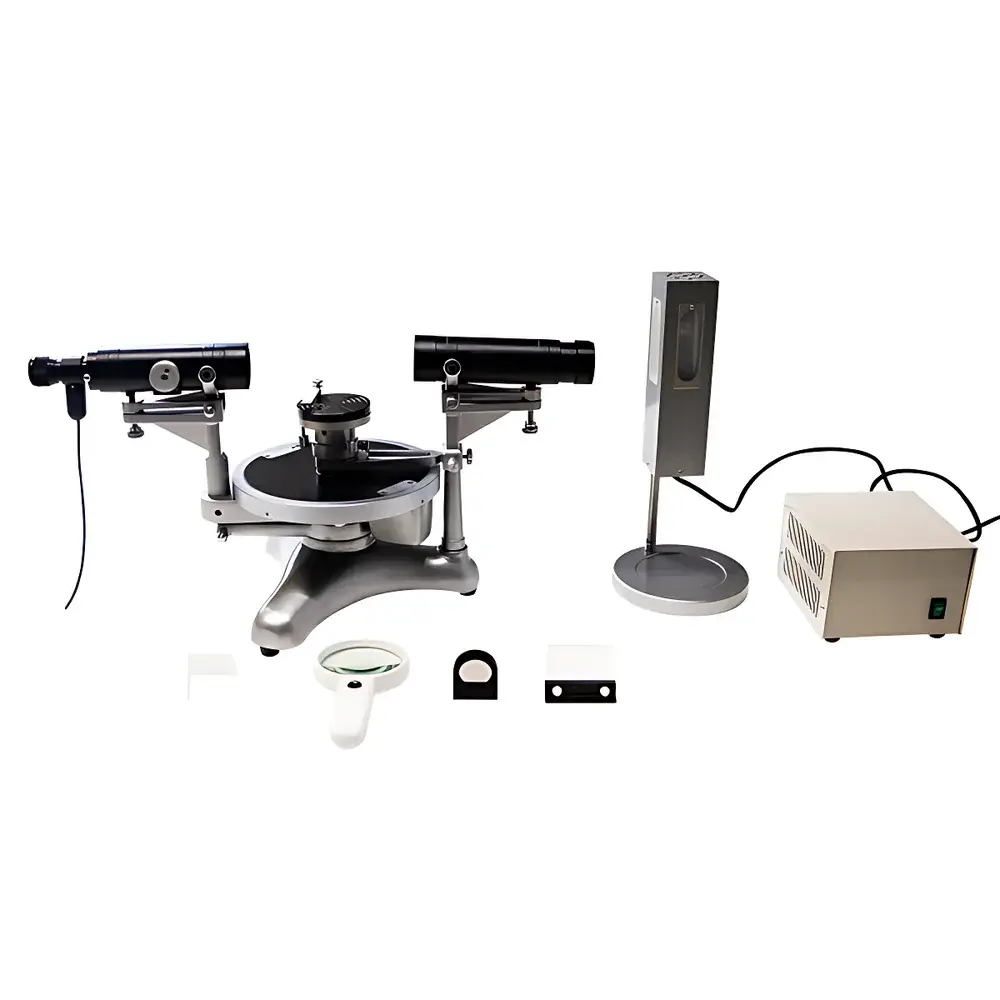
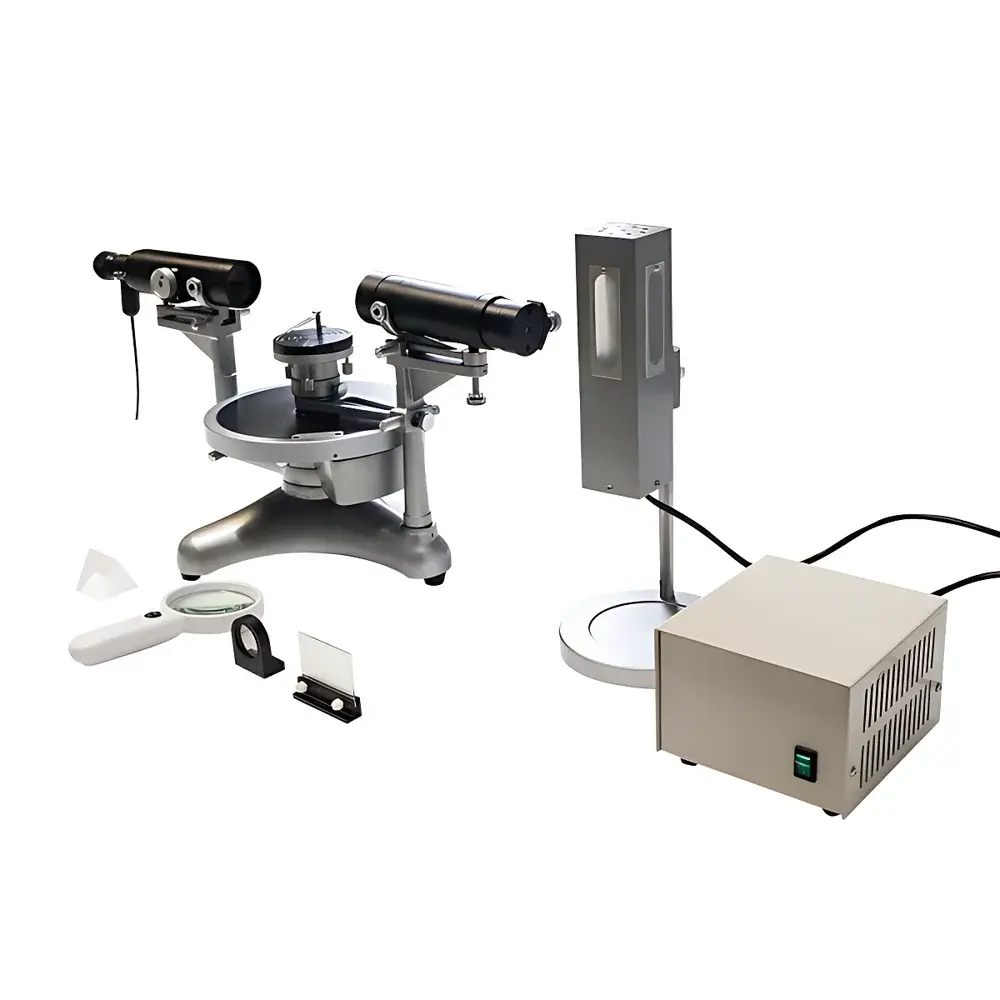
English Product Name
| Brand | YIXIST |
|---|---|
| Origin | Zhejiang, China |
| Manufacturer Type | Authorized Distributor |
| Country of Manufacture | China |
| Model | XGP-6202 |
| Pricing | Upon Request |
Overview
The YIXIST XGP-6202 Teaching Spectrometer is a precision optical goniometer engineered for undergraduate and graduate-level physics laboratories. Based on the classical Fraunhofer spectrometer architecture—comprising a collimator tube, a rotating stage with adjustable optical mount, and an achromatic telescope—it implements core principles of angular metrology in spectroscopy. The instrument operates on the fundamental principle that spectral dispersion (via prism or diffraction grating) and angular deviation are directly related to wavelength, refractive index, grating constant, or prism apex angle. Designed for pedagogical rigor, it enables quantitative measurement of optical parameters—including wavelength (nm), apex angle (°), refractive index (n), angular dispersion (°/nm), and grating line density (lines/mm)—all derived from high-resolution angular readings. Its mechanical architecture follows standardized optical alignment conventions, supporting reproducible setup across repeated student experiments under controlled lab conditions.
Key Features
- Large-aperture optical train (≥30 mm clear aperture) enhances light throughput, improves signal-to-noise ratio in low-intensity spectral sources (e.g., mercury vapor lamps), and increases angular resolution for fine spectral line separation.
- Dual vernier scale reading windows eliminate eccentricity error during rotation of the telescope or stage, ensuring sub-arcminute angular repeatability (±1′ typical).
- Three-perpendicular alignment method (collimator axis ⊥ stage plane, telescope axis ⊥ stage plane, collimator axis ∥ telescope axis) provides a systematic, teachable framework for optical alignment—integral to developing students’ spatial reasoning and metrological discipline.
- Half-adjustment technique for stage leveling accelerates initial setup without compromising orthogonality; facilitates rapid reconfiguration between prism and grating experiments.
- Modular mounting interface supports optional accessories: sodium lamp source, piezoelectric transducer for ultrasonic grating experiments, function generator for frequency-controlled acoustic wave excitation, and calibrated reticle eyepieces for crosshair-based wavelength calibration.
Sample Compatibility & Compliance
The XGP-6202 accommodates standard optical components used in university optics curricula: equilateral glass prisms (BK7, SF10), transmission diffraction gratings (600–1200 lines/mm), and gas-discharge lamps (Hg, Na, He). All mechanical adjustments conform to ISO 10110-7 (optical element mounting tolerances) and ASTM E275 (standard practices for spectrophotometer calibration). While not intended for GLP/GMP-regulated environments, its angular scale graduation (0.1° main scale, 1′ vernier resolution) meets ANSI/ISO 17025 requirements for educational metrology traceability when used with NIST-traceable reference lamps (e.g., Hg 435.8 nm, 546.1 nm lines). No electrical safety certification (e.g., CE, UL) is claimed, as the base unit is purely mechanical-optical; optional electronic accessories must be validated separately per IEC 61010-1.
Software & Data Management
The XGP-6202 is a manual, analog instrument with no embedded electronics or firmware. Data acquisition relies on direct vernier scale reading and manual recording—intentionally preserving foundational experimental skills in observation, estimation, and error propagation analysis. Instructors may integrate digital tools externally: USB microscopes with angular overlay software, image-based spectral analysis platforms (e.g., ImageJ with calibration plug-ins), or MATLAB/Python scripts for fitting dispersion curves (Cauchy or Sellmeier equations) from measured angles. Audit trails, calibration logs, and student worksheets are maintained per institutional academic integrity policies—not via automated audit logging, as no digital control layer exists.
Applications
- Calibration of angular scales using known spectral lines (e.g., Hg green line at 546.074 nm).
- Determination of prism apex angle via autocollimation or reflection method.
- Measurement of refractive index of optical glass across visible wavelengths using minimum deviation condition.
- Calculation of grating constant from first- and second-order diffraction angles.
- Quantitative analysis of angular dispersion and resolving power (R = mN) of transmission gratings.
- Ultrasonic diffraction experiments: visualization of acousto-optic diffraction patterns and calculation of sound velocity in liquids using Bragg angle shifts.
FAQ
Is the XGP-6202 compatible with modern digital data acquisition systems?
Yes—though fully manual, its angular scale outputs are designed for integration with external imaging systems, digital calipers, or webcam-based angle tracking software when paired with appropriate mounting adapters.
Does the instrument include calibration certificates?
No factory-issued calibration certificate is provided; however, procedures for self-calibration using mercury spectral lines and NIST-traceable references are documented in the included laboratory manual.
Can it be used for research-grade measurements?
It meets pedagogical accuracy requirements (±0.5′ angular uncertainty) but lacks environmental stabilization (temperature/humidity control) and motorized automation required for publication-grade metrology.
What maintenance is required?
Routine cleaning of optical surfaces with lens tissue and spectroscopic-grade solvent; periodic verification of vernier zero alignment using a right-angle square gauge.
Are replacement parts available for optical components?
Standard BK7 prisms, 600-line/mm gratings, and collimator lenses are available through YIXIST’s authorized academic channel under part numbers aligned with ISO 10110 optical drawing standards.




