
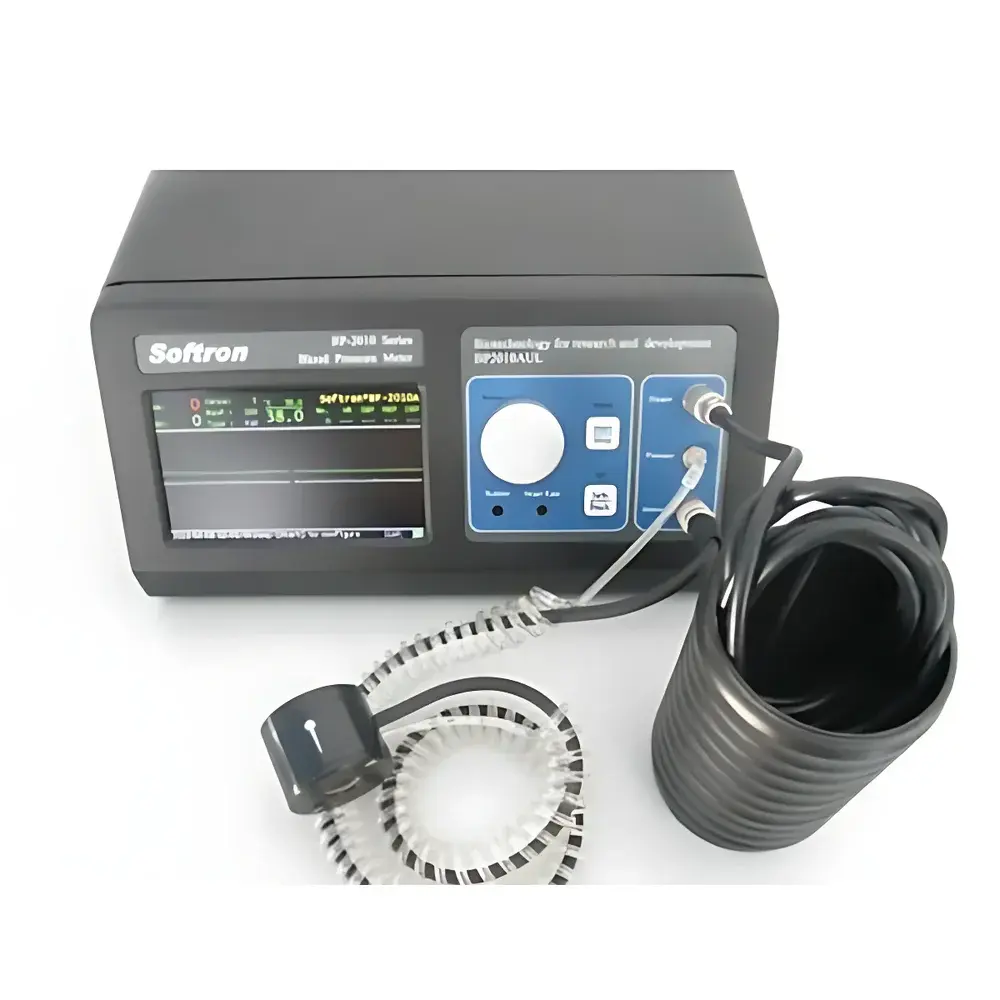
English Product Name
| Origin | Shenzhen, China |
|---|---|
| Manufacturer Type | Authorized Distributor |
| Regional Origin | Domestic (PRC) |
| Model | BP-2010A |
| Pricing | Available Upon Request |
| Display | 4.3-inch color LCD |
| Measurement Principle | Infrared photoplethysmography (PPG) |
| Method | Tail-cuff occlusion with automated inflation/deflation |
| Temperature Control Range | 30–40 °C (adjustable via host or software) |
| Blood Pressure Range | 0–350 mmHg |
| Pulse Rate Range | 0–1000 BPM |
| Measured Parameters | Systolic BP, Mean Arterial Pressure (MAP), Diastolic BP, Heart Rate |
| Data Storage | SD card and/or PC via USB 2.0 |
| Software Features | Automated measurement initiation, post-acquisition editing, averaging (6–7 cycles), scheduled measurements, report generation (PDF/CSV), GLP-compliant audit trail export |
| Throughput | Up to 3 rodents per session (sequential) |
| Measurement Duration | ≤15 min (rats), ≤5 min (mice) |
| Compliance | Designed for ISO 13485-aligned manufacturing environments |
Overview
The BP-2010A is a non-invasive, tail-cuff-based blood pressure monitoring system engineered for preclinical cardiovascular research in murine models. It employs infrared photoplethysmography (PPG) to detect volumetric pulsations in the tail artery during controlled cuff deflation, enabling precise derivation of systolic, diastolic, and mean arterial pressure—alongside heart rate—without surgical instrumentation or anesthesia-induced hemodynamic interference. The system integrates a thermoregulated restraint environment (30–40 °C) to promote peripheral vasodilation and stabilize autonomic tone, thereby improving signal-to-noise ratio and inter-session reproducibility. Its fully self-contained architecture—featuring a 4.3-inch color LCD, onboard waveform visualization, and real-time parameter display—allows operation independent of external computing hardware, while USB connectivity enables synchronized data acquisition and remote control in networked lab environments.
Key Features
- Automated tail-cuff occlusion and stepwise deflation using calibrated pneumatic actuation, optimized for murine tail anatomy and compliance characteristics.
- Integrated thermal chamber with PID-controlled heating (30–40 °C range), adjustable via front-panel interface or companion software—ensuring consistent peripheral perfusion across repeated measurements.
- Infrared PPG sensor with high-sensitivity optical detection circuitry, minimizing motion artifact and enabling reliable pulse waveform capture under low-stress, conscious restraint conditions.
- On-device averaging algorithm computes final systolic, diastolic, MAP, and HR values from 6–7 consecutive valid cycles—reducing intra-animal variability without requiring operator intervention.
- Dual-data-path storage: raw waveforms and derived metrics saved directly to removable SD card (FAT32 formatted) or streamed in real time to Windows-based host PC via USB 2.0.
- Programmable measurement schedules—including time-of-day triggers and multi-session protocols—support circadian rhythm studies and longitudinal hypertension modeling.
Sample Compatibility & Compliance
The BP-2010A is validated for use with C57BL/6, Sprague-Dawley, Wistar, and BALB/c mice (18–35 g) and rats (200–500 g). Interchangeable tail cuffs, thermal sleeves (φ60 mm), and size-graded restraint nets and bags (BP10-PK-S/M/L and BP10-PKM-S/M for mice; BP10-NT-S/M/L and BP10-NTM-S/M for rats) ensure anatomical fit and minimize stress-induced pressor responses. All consumables are manufactured from medical-grade, non-allergenic polymers compliant with ISO 10993-5 cytotoxicity standards. While the device itself is not CE-marked as an IVD or Class IIa medical device, its design aligns with OECD Test Guideline 407 (Repeated Dose 28-Day Oral Toxicity) and supports adherence to AAALAC International accreditation requirements for rodent cardiovascular phenotyping. When operated with version-controlled software and timestamped audit logs, the system meets foundational criteria for GLP-compliant data integrity per OECD Principles of Good Laboratory Practice.
Software & Data Management
The proprietary Windows-based application provides full instrument control, real-time waveform overlay, and post-hoc signal validation. Users may manually flag or exclude individual cycles prior to averaging, adjust baseline correction thresholds, and export datasets in CSV, Excel-compatible XLSX, or PDF report formats—including annotated pressure tracings, statistical summaries (mean ± SD), and cohort comparison charts. Audit trails record operator ID, session timestamp, environmental parameters (temperature, ambient light status), and all user-initiated edits—exportable as encrypted XML files for regulatory submission. The software supports batch processing of multi-animal datasets and integrates with LIMS via ODBC drivers. Optional API access enables synchronization with third-party acquisition platforms (e.g., LabChart, Spike2) for multimodal physiological correlation.
Applications
- Pharmacological evaluation of antihypertensive agents, vasodilators, and sympatholytic compounds in normotensive and genetically hypertensive rodent models (e.g., SHR, Dahl salt-sensitive).
- Longitudinal monitoring of blood pressure changes during chronic disease modeling—including diabetic nephropathy, metabolic syndrome, and aging-related vascular stiffness.
- Assessment of autonomic function via beat-to-beat variability analysis when combined with synchronized ECG or respiration signals.
- Non-invasive screening in transgenic and knockout lines where surgical implantation of telemetry devices is contraindicated or logistically prohibitive.
- Training and standardization of cardiovascular phenotyping protocols across multi-site collaborative studies, leveraging its high inter-operator reproducibility (CV < 4.2% for systolic BP in trained operators).
FAQ
Is the BP-2010A suitable for both conscious and anesthetized rodents?
Yes—the system is optimized for conscious, restrained animals. Anesthesia is not required and is generally discouraged, as it alters autonomic regulation and vascular resistance. However, measurements can be acquired under light sedation if ethically justified and protocol-approved.
What is the minimum interval between successive measurements on the same animal?
A minimum 5-minute recovery period is recommended to allow vascular normalization and minimize cumulative stress effects. For longitudinal studies, ≥24-hour intervals are advised to ensure physiological homeostasis.
Does the system support ISO/IEC 17025 or FDA 21 CFR Part 11 compliance?
The hardware and firmware meet foundational traceability and data integrity requirements. Full 21 CFR Part 11 compliance—including electronic signatures and role-based access control—is achievable through validated software deployment, documented SOPs, and periodic system verification per IQ/OQ/PQ protocols.
Can the BP-2010A be integrated into existing vivarium infrastructure with centralized temperature or lighting control?
Yes—via TTL-triggered I/O ports (optional module), the device can synchronize measurement onset with environmental cues such as dark-phase onset or HVAC setpoint changes, supporting chronobiological experimental designs.
Are calibration certificates and metrological traceability documentation available?
Factory calibration against NIST-traceable pressure standards is performed prior to shipment. Certificates of Conformance and calibration reports (including uncertainty budgets per ISO/IEC 17025 Annex A.4) are provided upon request for regulated research environments.




