
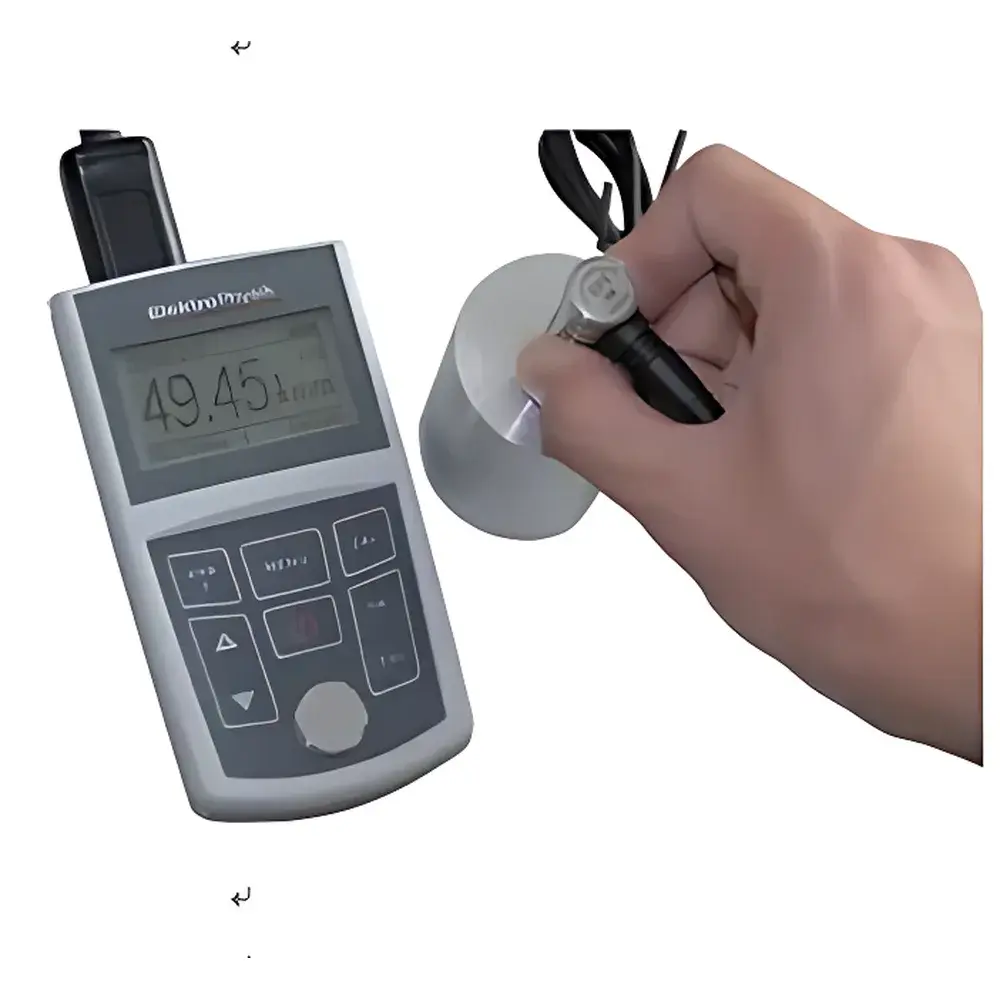
English Product Name
| Brand | EPK |
|---|---|
| Origin | Germany |
| Model | MiniTest 420 / 430 / 440 |
| Measurement Principle | Pulse-Echo & Echo-Echo (Coating-Compensated) |
| Thickness Range (Pulse-Echo) | 0.65–500 mm |
| Thickness Range (Echo-Echo) | 3–25 mm |
| Resolution | 0.01 mm (<99.99 mm), 0.1 mm (≥100 mm) |
| Sound Velocity Range | 1000–9999 m/s |
| Display | 128 × 64 backlit LCD |
| Dimensions | 130 × 73 × 24 mm (L×W×H) |
| Weight | ~190 g |
| Operating Temperature | –20 °C to +50 °C |
| Battery Life | ≥80 h continuous operation |
| Data Storage | Up to 5,000 readings across 10 user-defined groups |
| Interface | USB for data export and firmware update |
| Compliance | Designed for ISO 2400, ASTM E797, and EN 15317-compliant thickness verification workflows |
Overview
The EPK MiniTest 420, 430, and 440 series are precision-engineered ultrasonic thickness gauges developed in Germany for non-destructive evaluation of solid materials. Based on pulse-echo and echo-echo (coating-compensated) measurement principles, these instruments determine material thickness by analyzing the time-of-flight of high-frequency ultrasonic waves transmitted through the test specimen and reflected at its back surface. The MiniTest 440 uniquely supports dual-mode operation—standard pulse-echo for bare substrates and echo-echo mode for accurate base-metal thickness measurement through paint, enamel, or polymer coatings up to 2 mm thick—without requiring coating removal. All models feature automatic zero calibration at startup, temperature-stable transducer electronics, and a rugged, flame-retardant polymer housing rated for industrial environments. Their compact form factor (130 × 73 × 24 mm), low mass (~190 g), and 80+ hour battery life support extended field deployment in refinery inspection, shipyard QA, power plant maintenance, and laboratory-based material qualification.
Key Features
- Pulse-echo mode with 0.65–500 mm range and ±0.01 mm resolution for thin-walled tubing, plates, and castings.
- Echo-echo (E-E) mode (MiniTest 440 only) enables reliable substrate thickness measurement through non-metallic coatings—critical for corrosion monitoring under insulation or protective layers.
- Intelligent probe recognition automatically configures velocity settings, gain, and mode based on connected transducer type (e.g., U2.0 for coarse-grained cast iron, U5.0HT for hot-surface measurements up to 350 °C).
- Multi-function measurement modes: Min/Max tracking, differential (Δ), averaging (2–9 points), and upper/lower limit alarm for pass/fail screening per ASTM E797 Section 7.3.
- Onboard sound velocity determination for unknown materials; includes factory-preset velocities for 9 common alloys, plastics, and ceramics (e.g., aluminum: 6320 m/s, stainless steel: 5790 m/s, PVC: 2300 m/s).
- USB interface compliant with USB 2.0 full-speed specification; supports bidirectional data transfer via EPK’s proprietary PC software for traceable reporting and GLP/GMP audit trails.
Sample Compatibility & Compliance
The MiniTest series is validated for use on homogeneous, isotropic solids including carbon steel, stainless steel, aluminum, copper, titanium, glass, ceramic, and engineering plastics (e.g., PMMA, PTFE, ABS). It accommodates curved surfaces down to Ø10 mm (with U10.0 probe) and elevated temperatures up to 350 °C (U5.0HT probe, contact duration ≤5 s). Each instrument is calibrated per ISO 16949–traceable procedures and conforms to the metrological requirements of EN 15317 (Non-destructive testing — Ultrasonic thickness measurement — Equipment characterization and verification) and ASTM E797/E1065 (Standard Practices for Measuring Thickness by Manual Ultrasonic Pulse-Echo Contact Method). For regulated environments, data logging supports 21 CFR Part 11–compliant electronic records when used with EPK’s validated software suite and secure user authentication.
Software & Data Management
The MiniTest 430 and 440 models include a Windows-compatible USB communication cable and EPK Thickness Manager v3.x software. This application enables structured data import, statistical analysis (mean, SD, min/max, Cp/Cpk), customizable report generation (PDF/CSV), and hierarchical data archiving aligned with ISO/IEC 17025 documentation requirements. All stored readings retain metadata: timestamp, probe ID, sound velocity setting, measurement mode, and battery status. Audit logs record configuration changes, calibrations, and user logins—essential for FDA-regulated quality systems and third-party accreditation audits.
Applications
- Corrosion mapping of piping networks, pressure vessels, and storage tanks in petrochemical and nuclear facilities.
- In-process wall-thickness verification during pipe bending, extrusion, and forging operations.
- Quality control of coated automotive body panels, aerospace composites, and marine hull plating.
- Research-grade thickness profiling of thin-film substrates, battery electrode foils, and optical glass wafers.
- Field validation of thermal spray coatings and weld overlay integrity per AWS D1.1 and ASME BPVC Section V.
FAQ
What is the difference between pulse-echo and echo-echo measurement modes?
Pulse-echo measures total material thickness from front-surface entry to back-wall reflection. Echo-echo eliminates coating interference by measuring the time interval between the first and second back-wall echoes—yielding base-metal thickness independent of coating thickness or acoustic impedance mismatch.
Can the MiniTest measure through rust or scale?
No. Surface contamination such as loose rust, mill scale, or heavy pitting must be removed prior to measurement. The instrument requires consistent acoustic coupling and an intact, parallel back surface for valid results.
Is probe calibration required before each use?
Automatic zero calibration occurs at power-on using the built-in delay line. However, velocity calibration using a reference standard of known thickness and composition is recommended before critical measurements or after ambient temperature shifts >5 °C.
How is data traceability ensured for ISO 17025 compliance?
Each stored reading includes embedded device serial number, probe ID, calibration timestamp, and operator ID (when configured). Exported datasets contain SHA-256 checksums and digital signatures when generated via validated software, satisfying clause 7.7.1 of ISO/IEC 17025:2017.
Which probe is recommended for measuring thin-walled stainless steel tubing (Ø15 mm, 0.8 mm wall)?
The U7.5 (6 mm diameter, 7.5 MHz) probe provides optimal near-field resolution and curvature compensation for tubes with diameters ≥15 mm and wall thicknesses <1.5 mm.



