
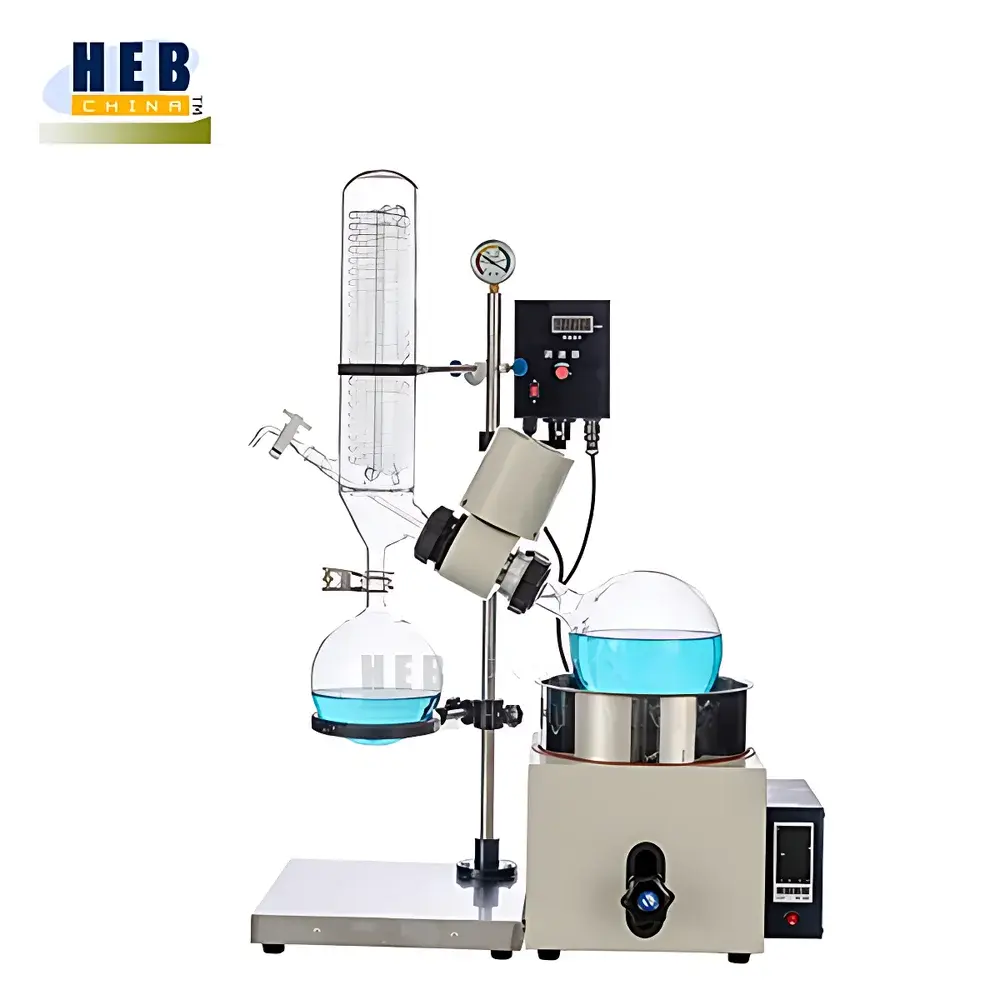
English Product Name
| Brand | Jihepu |
|---|---|
| Origin | Shandong, China |
| Model | R206D |
| Capacity | 2 L |
| Ultimate Vacuum | −0.098 MPa |
| Rotation Speed | 4–200 rpm |
| Heating Temperature Range | Ambient to 180 °C |
| Temperature Control Accuracy | ±1 °C |
| Condenser Cooling Area | 0.11 m² |
| Water Bath Power | 1.5 kW |
| Motor Power | 40 W |
| Voltage/Frequency | 220 V / 50 Hz |
| Dimensions (W×D×H) | 650 × 360 × 950 mm |
Overview
The Jihepu R206D Rotary Evaporator is a precision-engineered laboratory instrument designed for efficient solvent removal, concentration, and recovery under reduced pressure. It operates on the principle of thin-film evaporation: a sample-containing flask rotates in a heated water or oil bath while subjected to controlled vacuum, generating a large surface area for rapid, gentle volatilization. The system integrates a vertical condenser with 0.11 m² cooling area, enabling high-efficiency vapor condensation and solvent recovery—critical for preserving thermolabile compounds in pharmaceutical synthesis, natural product isolation, and analytical sample preparation. Its modular architecture supports seamless integration into multi-step purification workflows, and its robust construction ensures long-term stability in demanding QC/QA and R&D environments.
Key Features
- High-integrity vacuum sealing system using fluororubber gaskets and precision-ground GG17 borosilicate glass joints, maintaining stable vacuum down to −0.098 MPa for reproducible low-boiling-point solvent removal.
- Stepless electronic speed control (4–200 rpm) via front-panel rotary knob, enabling precise optimization of film thickness and evaporation kinetics across diverse viscosities.
- Dual-mode heating capability: water bath (ambient to 99 °C) and optional oil bath (ambient to 299 °C), with digital PID temperature controller offering ±1 °C accuracy and real-time display.
- Ergonomic mechanical design featuring stainless steel base, aluminum alloy support column and shaft, and corrosion-resistant surface finish—engineered for durability and ease of cleaning in regulated labs.
- Quick-release rotating flask mechanism with threaded retaining collar: clockwise rotation secures the 2 L evaporation flask (24/29 standard taper), counterclockwise release enables tool-free flask exchange.
- Integrated bath lift function for safe, repeatable immersion depth adjustment—minimizing thermal shock and improving process consistency during batch transitions.
- Standard fittings include 10 mm inner-diameter vacuum inlet and dual 12 × 8 mm ports for recirculating chiller or vacuum pump connection, compatible with common laboratory fluid handling infrastructure.
Sample Compatibility & Compliance
The R206D accommodates a broad range of solvents—including acetone, ethanol, ethyl acetate, dichloromethane, and toluene—as well as heat-sensitive organic extracts, peptide solutions, and polymer precursors. Its GG17 glass components meet ISO 3585 standards for hydrolytic resistance and thermal shock tolerance. While not certified to ISO/IEC 17025 or FDA 21 CFR Part 11 out-of-the-box, the instrument’s digital temperature and speed readouts support audit-ready documentation when paired with validated lab notebooks or LIMS-integrated data capture protocols. All electrical components comply with IEC 61010-1 safety requirements for laboratory equipment.
Software & Data Management
The R206D operates as a standalone analog-digital hybrid system with no embedded firmware or network connectivity. Temperature setpoint, actual bath temperature, and rotational speed are displayed continuously on dedicated LED modules. For GLP/GMP-aligned operations, users may log parameters manually or interface the unit with external data acquisition systems via analog output signals (if retrofitted) or time-stamped video recording of operational displays. The absence of proprietary software eliminates cybersecurity risks associated with cloud-connected instruments while ensuring full user control over data ownership and retention policies.
Applications
- Solvent recovery and reuse in synthetic chemistry scale-up (e.g., post-reaction workup of Grignard or Suzuki couplings).
- Concentration of crude natural product extracts without degradation—common in phytochemical profiling and nutraceutical development.
- Removal of residual solvents from APIs prior to lyophilization or crystallization, supporting ICH Q3C compliance.
- Preparative chromatography fraction concentration in academic and industrial analytical labs.
- Drying and solvent exchange steps in nanomaterial synthesis (e.g., quantum dot ligand exchange or MOF activation).
- Teaching applications in undergraduate organic chemistry laboratories, where reliability, visibility, and hands-on operability are pedagogically essential.
FAQ
What is the maximum recommended operating vacuum level?
The system is engineered to sustain and maintain −0.098 MPa (≈20 mbar absolute) under typical ambient conditions with properly maintained seals and an appropriately sized vacuum pump.
Can the R206D be used with corrosive solvents such as concentrated HCl or HF?
No. While fluororubber seals offer broad chemical compatibility, exposure to strong mineral acids or hydrofluoric acid will rapidly degrade gasket integrity and compromise vacuum performance. Use only with solvents listed in ASTM D471 compatibility tables.
Is the water bath temperature calibration traceable to NIST standards?
The built-in digital controller is factory-calibrated; however, end-users must perform periodic verification using a NIST-traceable thermometer immersed at the bath center, per ISO/IEC 17025 Clause 6.5.
Does the unit support automatic distillation endpoint detection?
No. The R206D does not include pressure-sensing, temperature gradient, or conductivity-based endpoint logic. Endpoint determination remains operator-dependent based on visual condensate rate or timed operation.
What maintenance intervals are recommended for optimal vacuum performance?
Inspect and replace fluororubber seals every 6–12 months depending on usage frequency and solvent type; clean glass joints weekly with isopropanol; verify vacuum hose integrity before each use.
Related Products



