
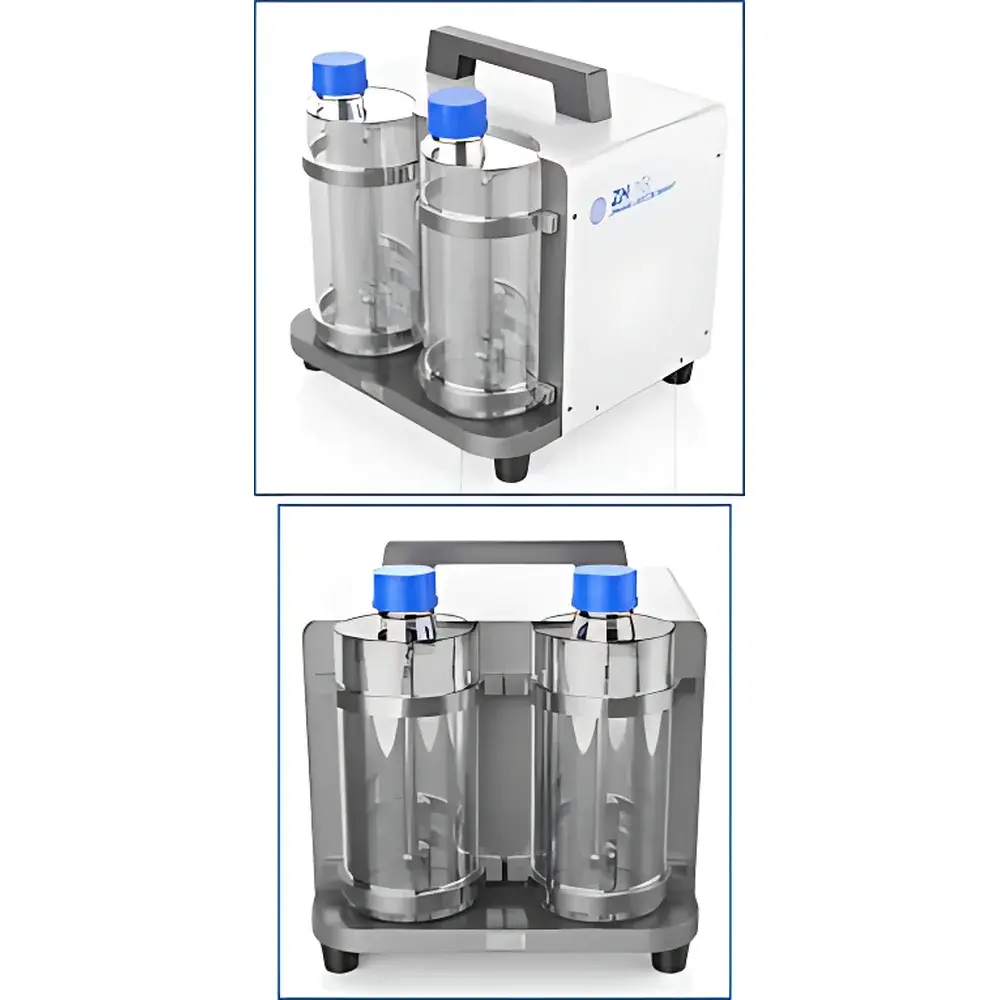
English Product Name
| Brand | HePu (Jihepu) |
|---|---|
| Origin | Shandong, China |
| Manufacturer Type | Authorized Distributor |
| Country of Origin | China |
| Model | ZH-1B |
| Price Range | USD 1,400 – 7,000 |
| Sample Processing | Acid Mist / Corrosive Exhaust Gas Treatment |
| Inlet Configuration | Dual-Channel Inlet |
| Airflow Capacity | 2 × 30 L/min |
| Neutralizing Solution Volume | 1 L (10–25% NaOH or KOH) |
| Distilled Water Volume | 1 L |
| Activated Carbon Filter | External, Replaceable Cartridge |
| Power Supply | AC 220 V / 50 Hz |
| Power Consumption | 120 W |
| Net Weight | 7 kg |
| Gross Weight | 10 kg |
| Dimensions (W×D×H) | 300 × 300 × 500 mm |
Overview
The HePu ZH-1B Integrated Acid-Base Neutralization and Exhaust Treatment System is an engineered solution for the safe, continuous abatement of acidic vapors—primarily HCl, HNO₃, HF, and H₂SO₄ fumes—generated during laboratory sample digestion, wet ashing, and acid reflux procedures. Unlike passive scrubbers or open-ventilation setups, the ZH-1B employs a three-stage counter-current absorption architecture grounded in fundamental principles of gas–liquid mass transfer and neutralization kinetics. Its integrated design eliminates reliance on external vacuum sources, delivering consistent negative pressure across dual inlet ports to ensure stable draw from digestion hoods, block digesters, or fume cabinets. The system operates on stoichiometric neutralization: gaseous acids dissolve into alkaline aqueous phase (Stage 1), followed by water-soluble residual trace gases captured via dissolution and dilution (Stage 2), with final adsorption of organic volatiles and residual odorous compounds on granular activated carbon (Stage 3). This multi-barrier approach ensures compliant exhaust emissions meeting local occupational exposure limits (e.g., OSHA PELs) and ambient air quality guidelines (e.g., EPA Method 26A for acid gas quantification).
Key Features
- Integrated high-efficiency diaphragm vacuum pump (120 W, continuous-duty rated) providing stable 2 × 30 L/min dual-channel suction—no external pump required.
- Three-tier sequential treatment: (1) Alkaline scrubbing (10–25% NaOH/KOH, 1 L capacity), (2) Deionized water rinse (1 L capacity), and (3) Modular external activated carbon cartridge for selective VOC and odor adsorption.
- Optimized gas–liquid contact geometry—including baffle plates and porous dispersion media—maximizes interfacial area and residence time, achieving >98% neutralization efficiency for common mineral acid mists under standard operating conditions.
- Tool-free, front-access design enables rapid replacement of neutralizing solution, distilled water reservoir, and activated carbon cartridges without system disassembly.
- Leak-tight polypropylene (PP) and polyvinyl chloride (PVC) wetted components ensure long-term chemical resistance against concentrated acids and caustics.
- Low thermal load (120 W total power) and silent operation (<55 dB(A)) support integration into shared laboratory environments without HVAC interference.
Sample Compatibility & Compliance
The ZH-1B is validated for use with standard laboratory digestion systems—including block digesters (e.g., SCP Science DigiPREP MS, Milestone Start D), microwave-assisted digestion units (e.g., CEM MARS 6), and hot plate reflux stations. It accommodates variable exhaust flow profiles typical of batch digestion cycles (transient peak flows up to 60 L/min, sustained average ~30 L/min). All wetted materials comply with ISO 15223-1 labeling standards and meet UL 94 HB flammability requirements. While not certified to CE or UL as a standalone appliance, the unit conforms to general safety provisions of IEC 61010-1 (Laboratory Equipment Safety) when operated within specified voltage (AC 220 V ±10%) and ambient temperature (10–40 °C) ranges. Waste effluent from Stage 1 and Stage 2 is classified as hazardous aqueous waste per EPA 40 CFR Part 261 and must be disposed of in accordance with institutional EH&S protocols.
Software & Data Management
The ZH-1B is a hardware-only, analog-operated system with no embedded microcontroller, display, or digital interface. It requires no firmware updates, driver installation, or network connectivity—ensuring operational continuity, electromagnetic compatibility (EMC) robustness, and compliance with GLP/GMP environments where software validation burdens are prohibitive. Pump runtime may be logged manually or via external timer relays. For laboratories requiring audit-trail capability, integration with building management systems (BMS) is achievable through dry-contact relay outputs (optional accessory kit available upon request). No data storage, encryption, or FDA 21 CFR Part 11 functionality is implemented—consistent with its classification as ancillary exhaust treatment infrastructure rather than analytical instrumentation.
Applications
- Neutralization of HCl/HNO₃ fumes during aqua regia digestion of geological samples prior to ICP-MS analysis.
- HF vapor capture in silicate matrix dissolution workflows for XRF and ICP-OES sample preparation.
- Continuous acid mist control in QA/QC labs performing AOAC 985.27 or ASTM D5176 digestion protocols.
- Supplemental exhaust polishing for fume hoods handling perchloric acid or mixed-acid digestions (used only after primary perchloric acid scrubbers).
- On-site mitigation of corrosive emissions from wastewater pretreatment labs conducting EPA Method 300.0 or 300.1 analyses.
FAQ
Does the ZH-1B require calibration or periodic verification?
No. As a passive chemical scrubber relying on stoichiometric reaction and physical adsorption, it does not incorporate sensors or transducers requiring calibration. Routine verification consists of visual inspection of liquid levels, pH testing of Stage 1 effluent (target pH >12), and scheduled carbon replacement per manufacturer guidance (typically every 200–300 hours of operation).
Can the ZH-1B handle hydrofluoric acid (HF) fumes?
Yes—provided the alkaline stage uses calcium hydroxide (Ca(OH)₂) slurry or sodium hydroxide at ≥20% concentration. HF neutralization generates CaF₂ precipitate; users must monitor Stage 1 reservoir for sediment accumulation and perform quarterly cleaning.
Is the activated carbon filter included with the base unit?
No. The external activated carbon cartridge is sold separately and configurable by adsorption profile (e.g., coconut-shell base for organics, impregnated carbon for H₂S/Cl₂). Standard part number: AC-ZH1B-STD.
What maintenance intervals are recommended?
Alkaline solution: replace every 4–6 weeks under continuous use (or after 50 digestion cycles); distilled water: replenish weekly; activated carbon: replace every 200–300 operational hours; pump diaphragm: inspect annually; all wetted seals: replace biannually.
Can the ZH-1B be connected to multiple digestion units simultaneously?
Yes—via Y-branch manifold with individual inline flow regulators (sold separately). Total combined airflow must not exceed 60 L/min to maintain optimal contact time and neutralization efficiency.



