
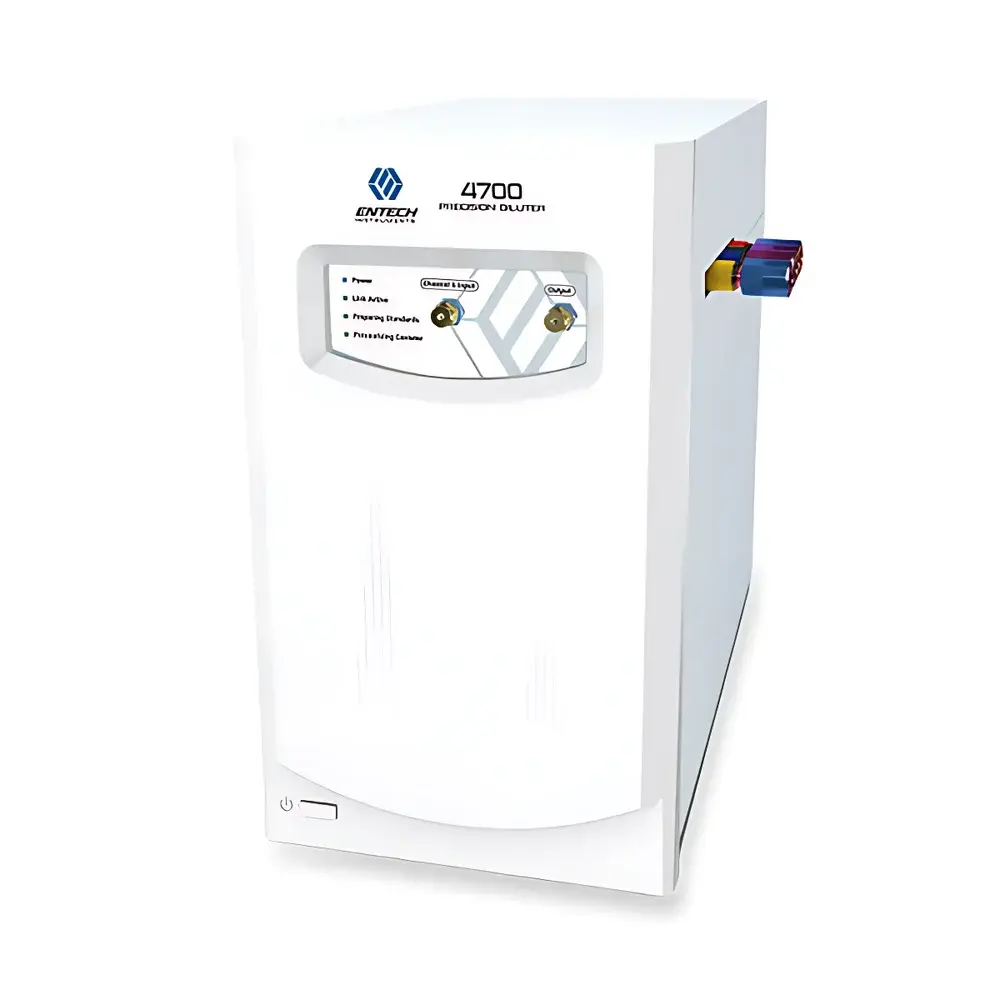
ENTECH 4700 High-Precision Gas Dilution System
| Brand | ENTECH |
|---|---|
| Origin | USA |
| Model | 4700 |
| Dilution Range | ppb to sub-ppt |
| Maximum Total Dilution Factor | 10,000× |
| Pressure Sensor Accuracy | ±0.05% FS |
| Standard Configuration | 6-Channel Dilution |
| Calibration Method | Gravimetric (NIST-traceable) |
| Regulatory Compliance | EPA TO-15, ASTM D6420, ISO 16017-1 |
| System Pathway | Ultra-Inert (SilcoNert®/Sulfinert®-treated stainless steel) |
Overview
The ENTECH 4700 High-Precision Gas Dilution System is an engineered solution for trace-level calibration gas preparation in environmental air analysis, emissions monitoring, and laboratory reference standard generation. Unlike conventional dilution systems relying on mass flow controllers (MFCs), the 4700 employs differential pressure-based flow measurement — a principle grounded in laminar flow physics and Hagen–Poiseuille law validation — to eliminate MFC-related nonlinearity, thermal drift, gas-specific calibration dependencies, and particulate-induced hysteresis. This architecture ensures metrological traceability directly to NIST-certified pressure standards, supporting rigorous adherence to EPA Method TO-15 requirements for VOC analysis by canister-based sampling and GC–MS detection. The system operates under controlled temperature-stabilized conditions and integrates real-time pressure feedback loops to maintain dynamic flow stability across wide concentration spans — from high-concentration stock gases down to sub-pictogram-per-liter (sub-pptv) working standards.
Key Features
- Differential pressure transduction technology replaces traditional MFCs, delivering gas-independent accuracy and long-term repeatability without recalibration per analyte.
- Ultra-inert fluidic pathway constructed from SilcoNert®- and Sulfinert®-passivated 316 stainless steel, minimizing adsorption, catalytic decomposition, and memory effects for reactive VOCs (e.g., aldehydes, terpenes, sulfur compounds).
- Six independently programmable dilution channels enable parallel preparation of multiple calibration levels or multi-component standards with synchronized timing and pressure-balanced delivery.
- Integrated high-resolution pressure sensors (±0.05% full scale) with temperature compensation provide direct traceable quantification of dilution ratios — eliminating reliance on secondary flowmeter verification.
- Gravimetric calibration capability supports ISO/IEC 17025-compliant lab validation; optional integration with certified analytical balances enables on-site uncertainty budgeting per EURACHEM/CITAC guidelines.
- Modular design accommodates future expansion with auxiliary modules including cryogenic trapping, automated valve sequencing, and integrated humidity control for humidified standard generation.
Sample Compatibility & Compliance
The 4700 is validated for use with compressed gas cylinders (He, N₂, air), permeation tubes, diffusion sources, and liquid standard spiking systems. It maintains compatibility with EPA TO-15 target compounds (C₂–C₁₂ hydrocarbons, halocarbons, oxygenates, and carbonyls), as well as extended lists defined in ASTM D6420 and ISO 16017-1. All wetted materials comply with USP Class VI biocompatibility testing, and surface inertness is verified via dynamic breakthrough testing per EPA SW-846 Method 8260D. System documentation includes full traceability records for sensor certifications, material test reports (MTRs), and factory acceptance test (FAT) data — supporting GLP/GMP audit readiness and FDA 21 CFR Part 11 compliance when paired with validated LIMS interfaces.
Software & Data Management
The ENTECH 4700 is operated via the ENTECH ControlSuite™ software platform — a Windows-based application compliant with IEC 62443-3-3 cybersecurity standards. It provides full electronic recordkeeping with ALCOA+ principles (Attributable, Legible, Contemporaneous, Original, Accurate, Complete, Consistent, Enduring, Available), including user authentication, role-based access control, and immutable audit trails for all dilution events, parameter changes, and calibration logs. Data export formats include CSV, XML, and PDF reports compatible with LIMS and ELN systems. Optional 21 CFR Part 11 add-on enables digital signatures, electronic approval workflows, and secure archive retention aligned with pharmaceutical and regulatory laboratory requirements.
Applications
- Preparation of EPA TO-15 calibration standards for ambient air monitoring networks (e.g., CASTNet, SEARCH, IMPROVE).
- Generation of tiered calibration curves for GC–MS, GC–FID, and PTR–TOF instruments in environmental and industrial hygiene labs.
- Dynamic dilution of high-concentration reference materials for method validation, instrument linearity assessment, and detection limit studies (MDL/IDL).
- Support of ISO 17025 accreditation through documented uncertainty budgets incorporating pressure sensor error, temperature drift, and gravimetric weighing contributions.
- On-demand synthesis of humidified or oxidant-stabilized standards for ozone-sensitive compounds (e.g., isoprene, α-pinene) in atmospheric chemistry research.
FAQ
Does the 4700 require routine recalibration of its pressure sensors?
No — factory-calibrated pressure transducers are NIST-traceable and rated for 12-month stability; annual verification against primary standards is recommended but not mandatory under EPA TO-15.
Can the system be used with reactive gases such as chlorine or hydrogen sulfide?
Yes, provided the ultra-inert pathway option is specified; SilcoNert®/Sulfinert® treatment has been validated for ≤100 ppbv H₂S and Cl₂ exposure over 72-hour dynamic testing.
Is remote operation supported?
Yes — ControlSuite™ supports secure remote desktop access and RESTful API integration for automated workflow orchestration within enterprise lab informatics environments.
What documentation is supplied for regulatory audits?
Full FAT report, material certifications, pressure sensor calibration certificates, software validation summary (IQ/OQ), and TO-15 compliance statement are included in the delivery package.
How is dilution accuracy verified during routine use?
Via built-in gravimetric check mode using certified analytical balances; optional integration with ENTECH’s TraceCal™ verification kit enables independent ratio confirmation without external instrumentation.



