
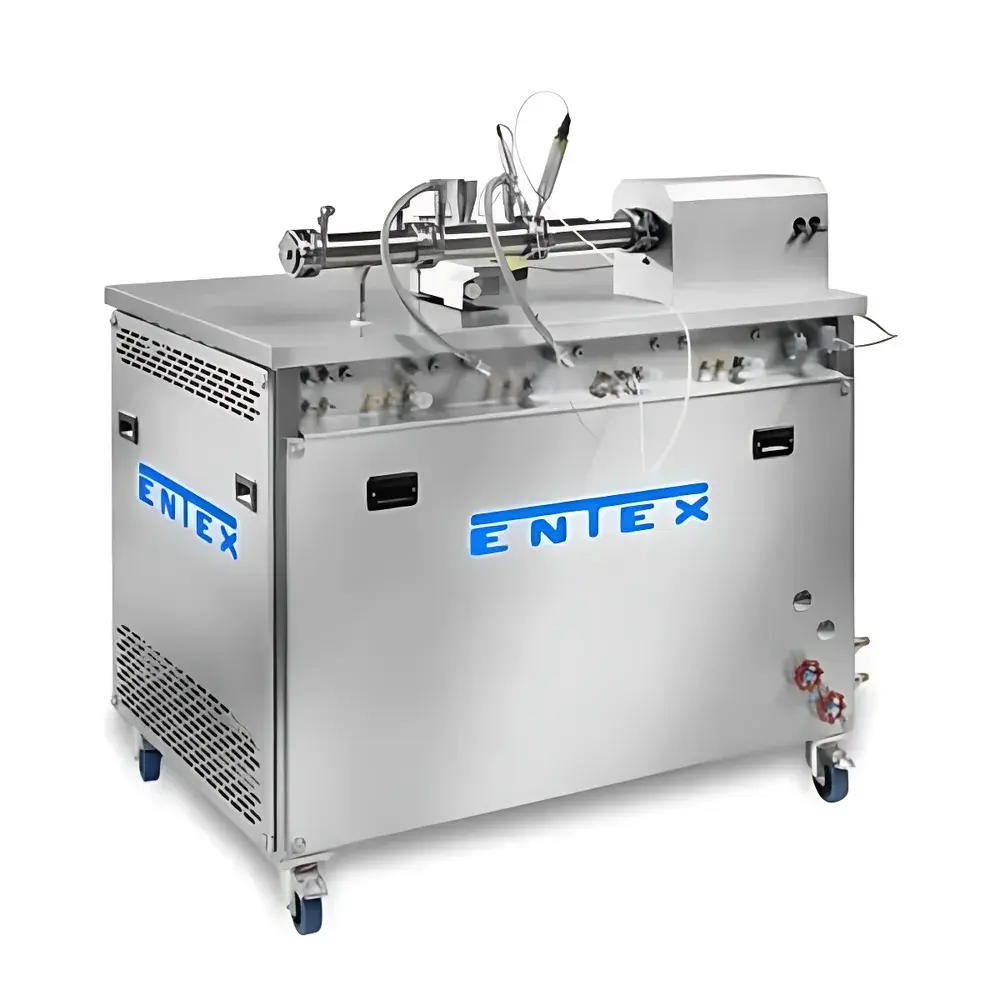
ENTEX L-WE30 Laboratory Planetary Twin-Screw Extruder
| Brand | ENTEX |
|---|---|
| Origin | Germany |
| Model | L-WE30 |
| Type | Planetary Twin-Screw Configuration |
| Drive System | Servo-Motor Controlled |
| Modular Architecture | Yes |
| Integrated Sensors | Torque, Melt Pressure, Zone Temperature (Multiple Zones) |
| Data Acquisition | Real-time Energy Input & Thermal Profile Logging |
| Peripheral Compatibility | Gravimetric Feeders, Side Feeders, Vacuum Venting Units, Strand Pelletizers |
| Compliance Framework | Designed for R&D-scale GLP-aligned process development |
Overview
The ENTEX L-WE30 Laboratory Planetary Twin-Screw Extruder is an engineered platform for precision compound development, formulation screening, and small-batch process validation in polymer science and advanced materials research. Unlike conventional co-rotating or counter-rotating twin-screw extruders, the L-WE30 employs a planetary gear-driven screw configuration—where multiple satellite screws rotate around a central sun shaft while simultaneously revolving on their own axes. This architecture generates exceptionally high shear homogenization, superior distributive mixing, and controlled residence time distribution within compact barrel volumes. Its 30 mm nominal screw diameter and modular 12–24 L/D barrel length enable scalable translation from lab-scale trials to pilot-line parameter mapping. The system operates under fully instrumented conditions: real-time torque monitoring reflects specific mechanical energy (SME) input; multi-zone melt pressure transducers track flow resistance across die interfaces; and calibrated thermocouples (±0.5 °C accuracy) record axial thermal gradients critical for thermal history-sensitive polymers such as PEEK, TPU, or reactive blends.
Key Features
- Planetary twin-screw kinematics delivering >3× higher specific energy input per unit volume compared to standard corotating systems—ideal for high-viscosity masterbatch dispersion and nanocomposite deagglomeration.
- Modular barrel assembly with quick-release flanges and interchangeable screw elements (conveying, kneading, reverse-pitch, and barrier sections), enabling rapid reconfiguration for melt compounding, devolatilization, or reactive extrusion.
- Integrated sensor suite: high-resolution torque transducer (0.1% FS), flush-mount melt pressure sensors (up to 350 bar range), and 6-point axial temperature profiling with PID-controlled heating/cooling zones.
- Open-architecture control interface supporting deterministic sampling at 100 Hz for synchronized acquisition of rpm, torque, pressure, temperature, and feeder mass-flow rates.
- Compliance-ready data structure: timestamped binary logs exportable in HDF5 or CSV formats, compatible with LIMS integration and audit-trail generation per FDA 21 CFR Part 11 requirements for regulated R&D environments.
Sample Compatibility & Compliance
The L-WE30 accommodates thermoplastics (PP, PA6, PC, ABS), elastomers (EPDM, TPE), filled systems (CaCO₃, glass fiber, carbon black), and reactive formulations (peroxide-cured EPDM, silane-grafted PE). Its low minimum batch size (as low as 50 g) supports DOE-based formulation optimization without material waste. All wetted components meet ISO 80369-7-compliant surface finish standards (Ra ≤ 0.8 µm) for cleanability. Mechanical design adheres to CE Machinery Directive 2006/42/EC, while electrical safety conforms to IEC 61000-6-2/6-4. Optional ATEX-certified variants are available for solvent-based processing.
Software & Data Management
ENTEX ControlSuite v4.2 provides deterministic process supervision via deterministic real-time OS (QNX-based). Users define multi-stage recipes with interlocked setpoints (e.g., ramp torque limit upon reaching target melt temperature), automatic safety shutdowns (overpressure >95% full scale), and adaptive feed-forward control based on historical SME correlations. Raw data streams are stored with SHA-256 checksums; metadata includes operator ID, environmental ambient logs, and calibration certificate traceability (NIST-traceable pressure/torque calibrations performed annually). Export modules support ASTM D3835-compliant reporting templates for rheological performance summaries.
Applications
- Formulation development for conductive polymer composites (CNT, graphene-loaded systems)
- Thermal stability assessment of flame-retardant additives under shear-thermal stress coupling
- Residence time distribution (RTD) studies using tracer compounds (e.g., fluorescent dyes) for kinetic modeling of grafting reactions
- Viscoelastic property mapping via inline capillary rheometry coupling
- GLP-compliant batch records generation for regulatory submissions (e.g., FDA 510(k) dossiers for medical-grade polymer devices)
FAQ
What distinguishes planetary screw kinematics from conventional twin-screw designs?
Planetary motion introduces three-dimensional velocity gradients—radial, tangential, and axial—enabling simultaneous dispersive and distributive mixing without requiring high L/D ratios or excessive shear degradation.
Can the L-WE30 be validated for GMP-relevant process parameters?
Yes—its deterministic control architecture, electronic signature capability, and audit-trail-enabled data logging comply with Annex 11 and USP analytical instrument qualification frameworks.
Is vacuum venting integrated or optional?
Vacuum degassing is implemented as an optional module with dual-stage liquid ring pump (ultimate vacuum ≤ 5 mbar) and condensate trap, configurable at any barrel port location.
What feeder compatibility does the system support?
Gravimetric loss-in-weight feeders (±0.25% repeatability) and volumetric side feeders (for fillers or liquids) are supported via EtherCAT-synchronized I/O with dynamic rate compensation algorithms.
Are screw element geometries standardized or customizable?
ENTEX supplies ISO-standardized screw elements (DIN 70000), but custom geometries—including asymmetric kneading blocks and variable pitch conveyors—can be manufactured per client specifications with NDA-protected IP handling.





