
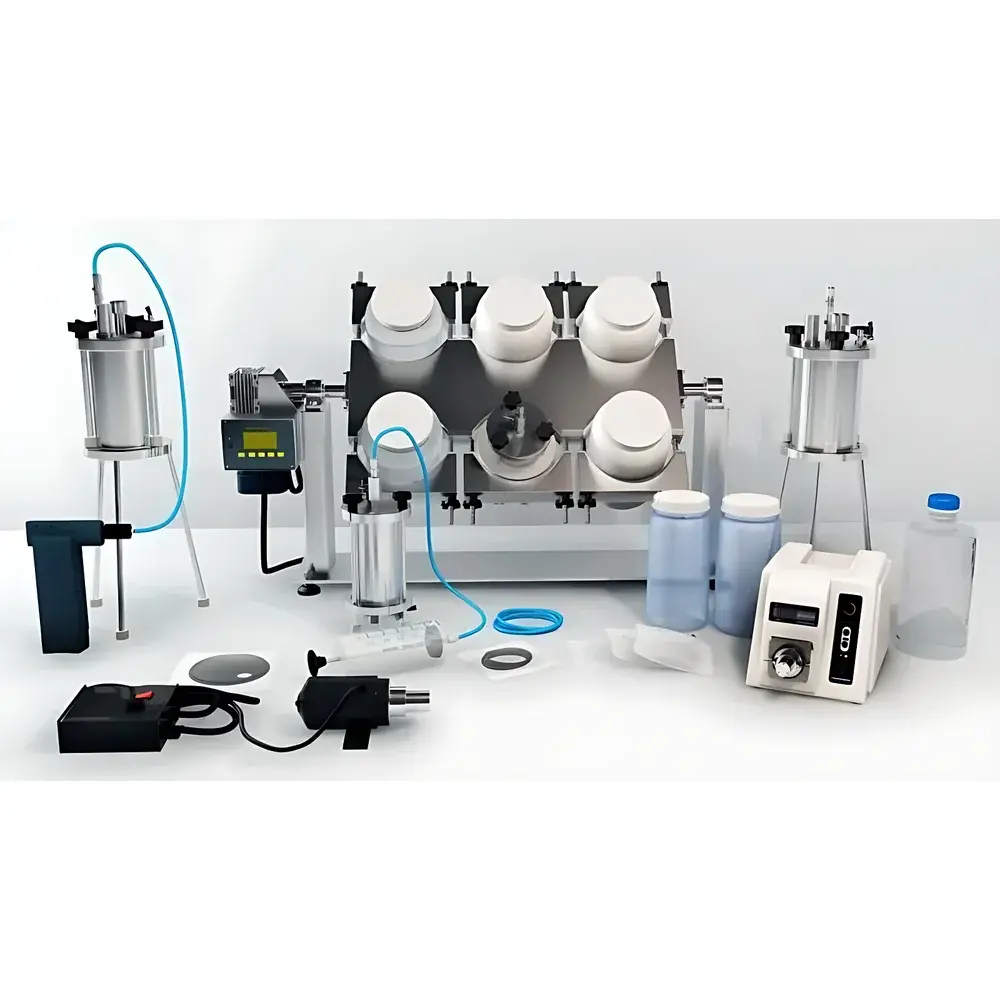
Environ Lab TCLP Solid Waste Toxicity Leaching System
| Brand | Environ Lab |
|---|---|
| Origin | USA |
| Model | TCLP |
| Agitator Speed | 30 ± 2 rpm |
| Vessel Capacity | 2.0 L (non-volatile) / 550 mL (volatile, zero-headspace) |
| Filtration Pressure Rating | ≥50 psi |
| Filter Disc Diameter | 142 mm (non-volatile) / 90 mm (volatile) |
| Filter Pore Size | 0.7 µm (glass fiber) / 0.5 µm (stainless steel) |
| Construction Materials | 316 stainless steel (filtration unit), borosilicate glass & PE & PTFE-compatible vessels |
| pH Adjustment | Manual in-situ capability |
| Safety | Overload protection, low-noise rotary drive, aluminum frame architecture |
| Compliance | Designed for EPA Method 1311 (TCLP), ASTM D5233, ISO 11372 |
Overview
The Environ Lab TCLP Solid Waste Toxicity Leaching System is a purpose-engineered laboratory platform for conducting standardized toxicity characteristic leaching procedure (TCLP) tests in accordance with U.S. Environmental Protection Agency (EPA) Method 1311 and complementary international standards including ASTM D5233 and ISO 11372. The system replicates the geochemical conditions under which hazardous constituents—such as heavy metals (e.g., Pb, Cd, Cr, Hg), semi-volatile organic compounds (SVOCs), and volatile organic compounds (VOCs)—may mobilize from solid waste matrices during landfill disposal or environmental exposure. By subjecting homogenized waste samples to controlled acidic extraction (pH 4.93 ± 0.05, using acetic acid/sodium acetate buffer), the system quantifies the concentration of leachable contaminants in the resulting extract, enabling regulatory classification of waste as hazardous or non-hazardous per RCRA Subtitle C criteria.
Key Features
- Rotary agitator engineered for continuous, high-duty-cycle TCLP operation: precision-controlled at 30 ± 2 rpm with mechanical stability over 18–24 hour rotation cycles; low-vibration aluminum alloy chassis ensures consistent torque transmission and acoustic isolation in shared lab environments.
- Dual-path configuration supporting both non-volatile and volatile leaching protocols: includes a 2.0 L borosilicate glass or polyethylene extraction vessel set for standard TCLP, plus a dedicated zero-headspace extraction (ZHE) module rated to ≥50 psi and operable at 4 °C for VOC preservation.
- Integrated high-pressure filtration unit constructed entirely from electropolished 316 stainless steel (ASME BPVC Section VIII compliant); accommodates 142 mm or 90 mm filter discs and maintains pressure integrity during vacuum-assisted or gravity-driven filtration.
- Chemically inert fluid handling components: PTFE-lined metering pump, fluoropolymer tubing, and ZHE piston assembly with SLO/FLO-coated surface ensure minimal analyte adsorption, carryover, or degradation—critical for trace-level VOC recovery.
- Modular accessory ecosystem: supports interchangeable filter media (0.7 µm glass fiber and 0.5 µm stainless steel discs), TEFLON-sealed caps, TEDLAR sampling bags, and stainless-steel gas-tight syringes—all traceable to NIST-traceable calibration protocols.
Sample Compatibility & Compliance
The system accommodates heterogeneous solid waste matrices—including municipal solid waste ash, industrial sludge, foundry sand, mining tailings, and construction debris—after size reduction to ≤9.5 mm (per EPA 1311). Sample-to-extractant ratio is maintained at 1:20 (w/v) with strict adherence to buffering, agitation, centrifugation (if required), and filtration sequence. All hardware meets EPA-recommended material compatibility guidelines: no copper, brass, or zinc-containing components contact leachates; all wetted surfaces are either 316 SS, borosilicate glass, or FDA-compliant polymers. The design supports full auditability for GLP-compliant laboratories and satisfies documentation requirements for USP /, FDA 21 CFR Part 11 (when paired with validated LIMS), and ISO/IEC 17025 accreditation.
Software & Data Management
This is a hardware-dedicated, non-instrumented platform—no embedded microcontroller or proprietary software is included. However, it is fully compatible with third-party laboratory information management systems (LIMS) and electronic lab notebooks (ELN) via standardized SOP templates and metadata tagging (e.g., sample ID, batch date, operator, vessel lot number, filter type, pH log). Each ZHE unit includes a calibrated 0–60 psi oil-filled pressure gauge with NIST-traceable certificate. Optional digital RPM logging modules and temperature-stamped agitation timers are available as add-ons for 21 CFR Part 11-compliant environments requiring electronic audit trails.
Applications
- Hazardous waste characterization for RCRA compliance and landfill acceptance testing
- Leachate risk assessment in brownfield redevelopment and site remediation projects
- Validation of stabilization/solidification treatment efficacy for metal-laden soils
- Regulatory submission support for TSCA Section 8(d) and REACH Annex XIII data requirements
- Research on contaminant speciation and pH-dependent solubility thresholds in geotechnical and hydrogeological modeling
FAQ
What regulatory methods does this system support?
EPA Method 1311 (TCLP), ASTM D5233 (Standard Guide for Leaching Tests), ISO 11372 (Soil quality — Leaching procedures), and SW-846 Chapter 7 (Extraction Procedures).
Can the system be used for SPLP or WET testing?
Yes—the agitator’s speed and tilt-angle adjustability, combined with interchangeable vessel geometry, allow adaptation to Synthetic Precipitation Leaching Procedure (SPLP) and Waste Extraction Test (WET) protocols with minor procedural modifications.
Is method validation documentation provided?
Environ Lab supplies a comprehensive User Qualification Package (UQP) including installation qualification (IQ), operational qualification (OQ), and performance verification data against certified reference materials (CRMs) such as NIST SRM 2710a and 2711a.
What maintenance is required for long-term reliability?
Routine inspection of drive belt tension, filter disc seating integrity, ZHE O-ring compression, and pressure gauge calibration every 6 months—full service intervals recommended annually by certified field engineers.
Are replacement parts and consumables stocked internationally?
Yes—glass fiber filters (142 mm/90 mm), stainless steel filter discs, ZHE piston seals, and PTFE pump heads are distributed through Environ Lab’s global network of authorized service centers in EU, APAC, and LATAM regions.
Related Products







