
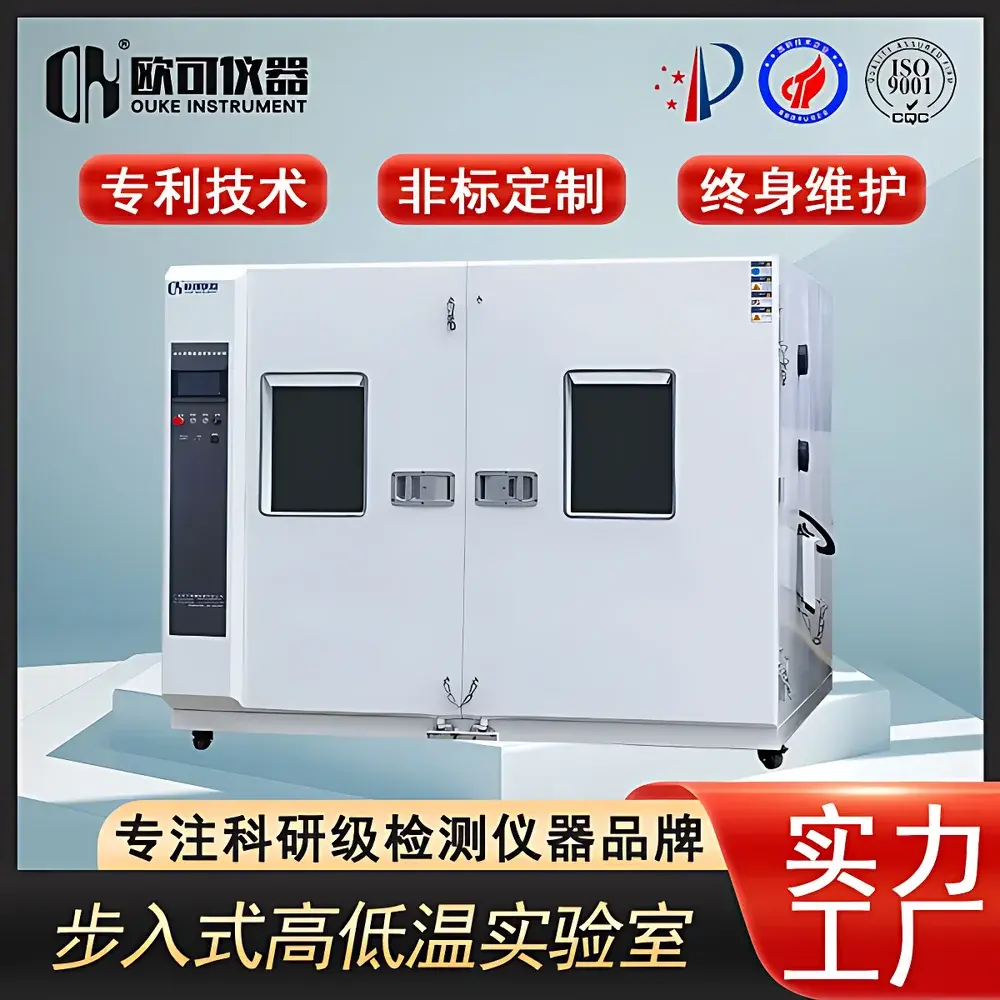
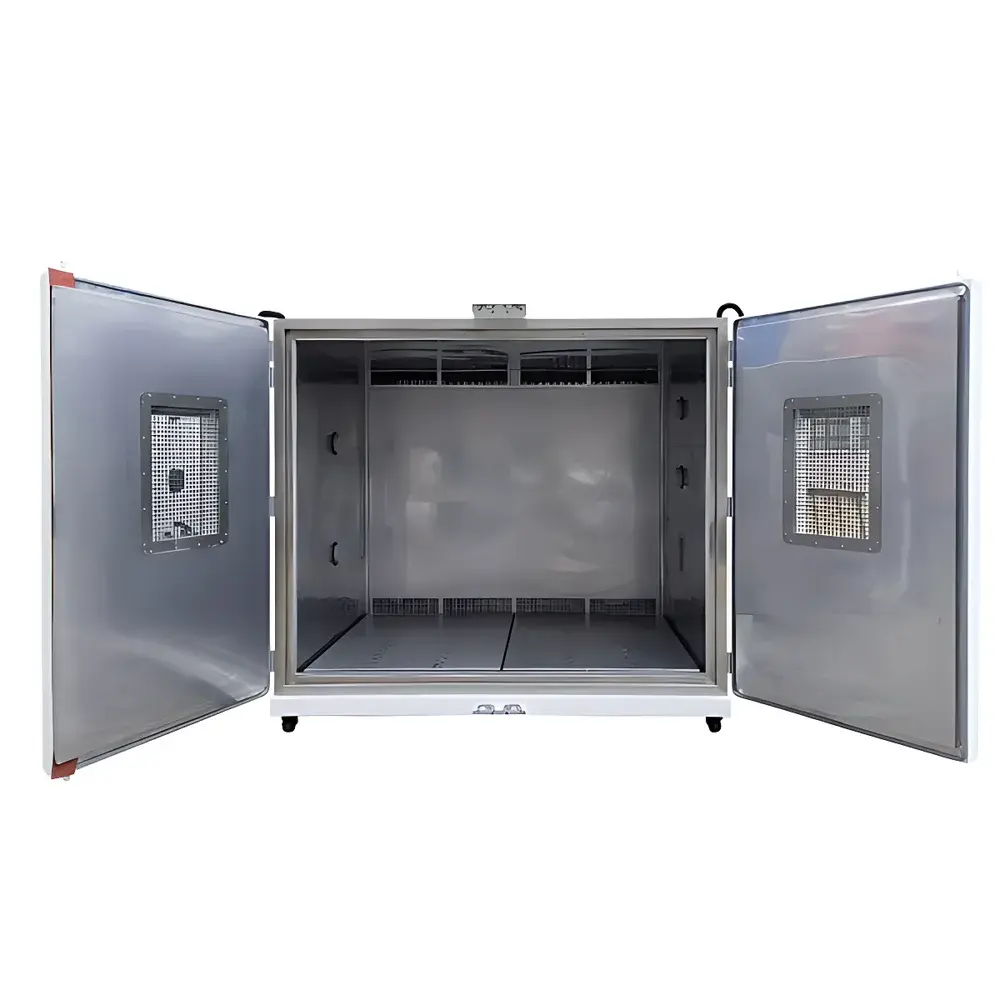
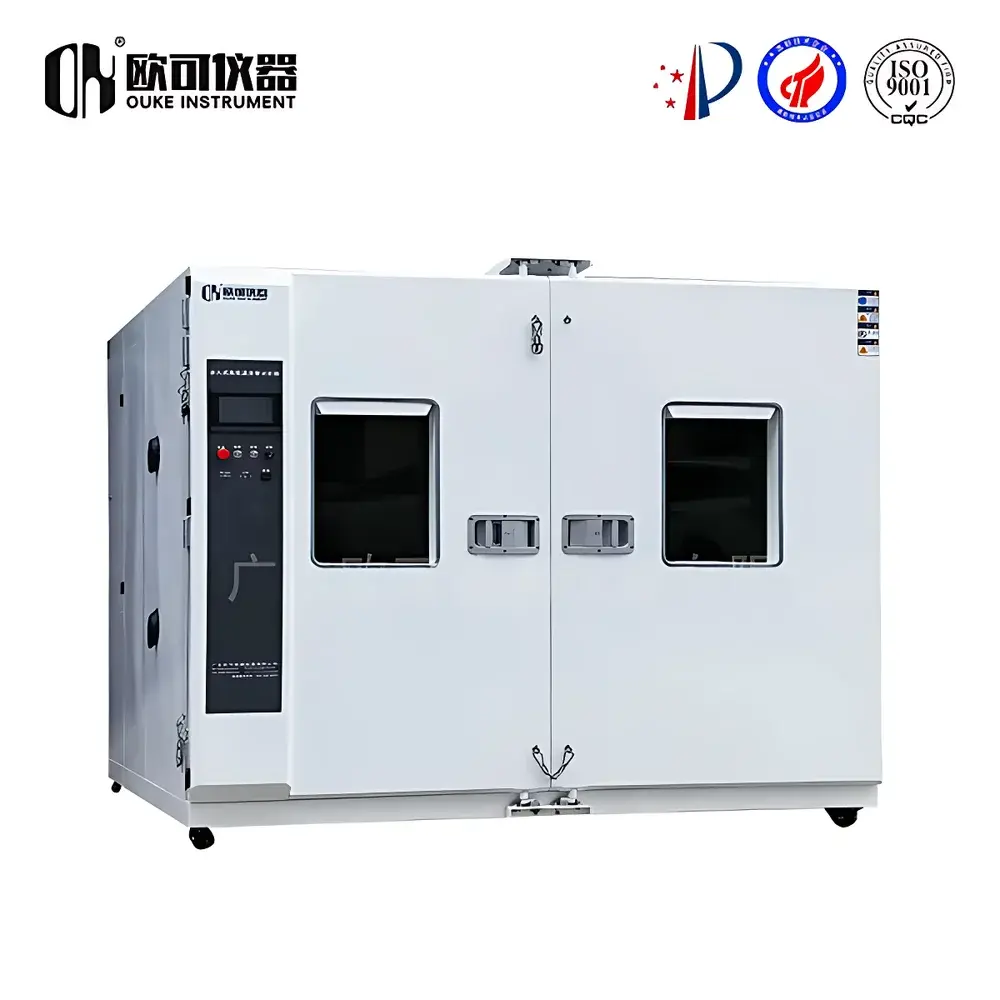
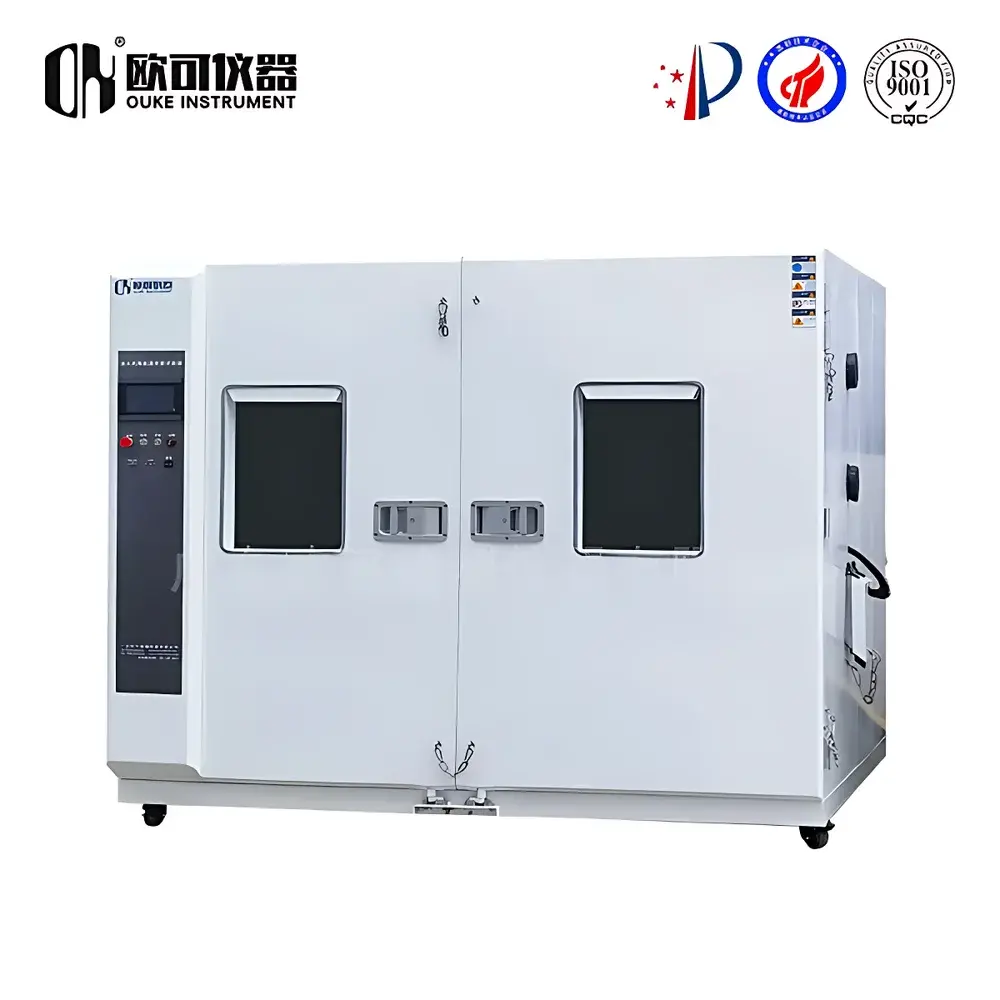
OK Environmental Systems OK-STH-88 Walk-in Temperature & Humidity Chamber
| Brand | OK Environmental Systems |
|---|---|
| Origin | Guangdong, China |
| Manufacturer Type | Direct Manufacturer |
| Product Origin | Domestic (China) |
| Model | OK-STH-88 |
| Internal Volume | Custom-engineered (starting from 1 m³, scalable to ≥100 m³) |
| Temperature Range Options | A: 0°C to +85°C |
| B | −20°C to +85°C |
| C | −40°C to +85°C |
| D | −60°C to +85°C |
| E | −70°C to +85°C |
| Temperature Uniformity | ±3°C (per IEC 60068-3-5 & ASTM E145) |
| Temperature Control Stability | ±1°C |
| Heating Rate | 1.0–4.0°C/min (linear, load-dependent) |
| Humidity Range | 20–98% RH (at applicable temperature bands) |
| Humidity Control Accuracy | ±3% RH |
| Refrigeration System | Dual-stage cascade refrigeration (R404A/R23 or R507A, optional LN₂ assist for rapid cooldown) |
| Air Circulation | High-capacity centrifugal blower with optimized ducted airflow and multi-point return design |
| Structural Insulation | 100–200 mm thick PU/rockwool sandwich panels (thermal conductivity ≤0.022 W/m·K) |
| Door | Reinforced insulated swing door with double-glazed observation window, anti-frost heater, safety interlock, and emergency egress release |
| Electrical Interface | 3-phase 380 VAC ±10%, 50 Hz (customizable for 400 V / 60 Hz) |
| Compliance | Designed per ISO 17025 laboratory infrastructure requirements |
Overview
The OK Environmental Systems OK-STH-88 is a fully engineered walk-in temperature and humidity chamber designed for system-level environmental validation of large-scale, high-value assets. Unlike benchtop or upright environmental chambers, the OK-STH-88 functions as a controlled climatic room—capable of accommodating full vehicles, battery energy storage systems (BESS), avionics racks, server cabinets, or multi-unit production batches. Its operational principle relies on precision-coupled thermodynamic control: dual-stage cascade refrigeration ensures stable sub-zero performance down to −70°C, while PID-regulated electric heating elements and steam/humidifier-based moisture delivery enable simultaneous, independent control of temperature (±1°C stability) and relative humidity (20–98% RH). Air distribution is governed by a high-CFM centrifugal circulation system with calibrated inlet/outlet manifolds, ensuring spatial uniformity within ±3°C across the entire working volume—validated per IEC 60068-3-5 and ASTM E145 test methods. The chamber’s structural architecture integrates reinforced steel framing, modular polyurethane-insulated panels (100–200 mm thickness), and hermetic sealing to minimize thermal leakage and support long-duration steady-state or dynamic profile testing.
Key Features
- Modular, field-assembled construction enabling custom internal dimensions—from 1 m³ to over 100 m³—tailored to user-defined payload geometry and airflow clearance requirements.
- Dual-stage cascade refrigeration system with redundant compressors, oil management, and low-GWP refrigerants (R404A/R23 or R507A); optional liquid nitrogen (LN₂) injection port for accelerated cooldown profiles (≤10 min from +25°C to −70°C under no-load conditions).
- Integrated steam-based humidification and dehumidification subsystems with condensate recovery, supporting reproducible wet-bulb/dry-bulb control across the full operating envelope.
- Reinforced insulated access door featuring heated double-glazed viewport, mechanical safety lock, emergency interior release, and automatic seal compression upon closure.
- Multi-point sensor network (≥6 PT100 Class A sensors + ≥3 capacitive RH probes) with real-time spatial mapping and auto-compensation algorithms for load-induced thermal gradients.
- Industrial-grade PLC controller (Siemens S7-1200 or equivalent) with 10.4″ HMI touchscreen, preloaded test templates (ISO 16750-4, GB/T 2423, MIL-STD-810H), and configurable alarm hierarchy (audible/visual/email/SMS).
Sample Compatibility & Compliance
The OK-STH-88 accommodates physically heterogeneous test articles—including assembled electric vehicles, 40-foot containerized BESS units, aircraft fuselage sections, telecom base station cabinets, and multi-tier material aging racks. Its open-floor layout, reinforced floor loading capacity (≥1,000 kg/m²), and standardized cable/port interfaces (up to 12 × 100 mm diameter sealed feedthroughs) ensure compatibility with live-power, data-acquisition, and real-time telemetry setups. From a regulatory standpoint, the chamber is engineered to serve as an ISO/IEC 17025-accredited test environment when paired with traceable calibration protocols. It supports GxP-aligned operation via optional OK-Logix™ software integration, delivering 21 CFR Part 11-compliant electronic records—including user authentication, audit trail, version-controlled test scripts, and immutable data export (CSV, PDF, XML). All electrical and refrigerant components comply with CE, UL 61010-1, and RoHS directives; structural design adheres to ASME BPVC Section VIII and local industrial building codes.
Software & Data Management
Control and documentation are unified under OK-Logix™—a Windows-based platform supporting multi-chamber coordination, remote supervision (via TLS-secured web interface), and synchronized data logging at up to 1 Hz resolution across all monitored parameters (T, RH, dew point, power consumption, compressor status, door cycle count). The software enables creation of nested test sequences (e.g., 500-cycle thermal shock with dwell, ramp, and soak segments), automatic pass/fail evaluation against user-defined tolerances, and automated report generation compliant with AIAG CQI-9, VDA 2, and IATF 16949 requirements. Raw datasets are stored in encrypted SQLite databases with SHA-256 hashing; backup archives can be scheduled to NAS, cloud storage (AWS S3, Azure Blob), or removable media. Optional API integration (RESTful JSON) allows bi-directional synchronization with MES, PLM, and LIMS platforms.
Applications
- Automotive: Full-vehicle cold-start validation (-40°C), HVAC performance mapping, ADAS sensor drift assessment under thermal cycling, and battery pack thermal runaway propagation studies.
- Energy Storage: Accelerated life testing of lithium-ion BESS cabinets per UL 9540A and IEEE 1679.2, including charge/discharge cycling under variable ambient conditions.
- Aerospace & Defense: Environmental stress screening (ESS) of flight-critical avionics per DO-160G Section 4/5, ground-support equipment qualification, and satellite component outgassing preconditioning.
- Data Center Infrastructure: Thermal load simulation of rack-level IT equipment under ASHRAE TC 90.4 boundary conditions, including hot/cold aisle containment verification.
- Electronics Manufacturing: High-acceleration stress screening (HASS) of PCBAs, burn-in of power converters, and humidity-induced corrosion testing per IPC-J-STD-002/003.
FAQ
What is the minimum recommended clear air space around test articles to ensure uniform exposure?
A minimum 15% free volume margin (relative to total chamber capacity) is required—e.g., for a 20 m³ chamber, maximum payload volume should not exceed 17 m³—to maintain specified airflow velocity (>1.5 m/s at sample surface) and thermal uniformity.
Can the chamber operate continuously at −70°C with 95% RH?
No. At temperatures below −40°C, humidity control is physically constrained by frost formation; RH specification is only guaranteed above −40°C. Sub-zero operation defaults to dry-cold mode unless dehumidified air injection is implemented.
Is on-site commissioning and IQ/OQ/PQ validation included?
Yes—OK Environmental Systems provides full FAT/SAT documentation, third-party accredited calibration certificates (NIST-traceable), and optional GMP-compliant qualification packages (IQ/OQ/PQ) executed by certified metrologists.
How is heat dissipation from powered test articles handled in thermal budget calculations?
Users must supply worst-case wattage and thermal mass data during engineering review; OK’s thermal load modeling software then determines required refrigeration oversizing (typically 1.3–1.8× nominal capacity) and airflow recalibration.
What maintenance intervals are recommended for the cascade refrigeration system?
Compressor oil analysis every 2,000 operating hours; refrigerant leak check quarterly; desiccant cartridge replacement annually; full system performance verification per ISO 5171 every 12 months.
Related Products



