
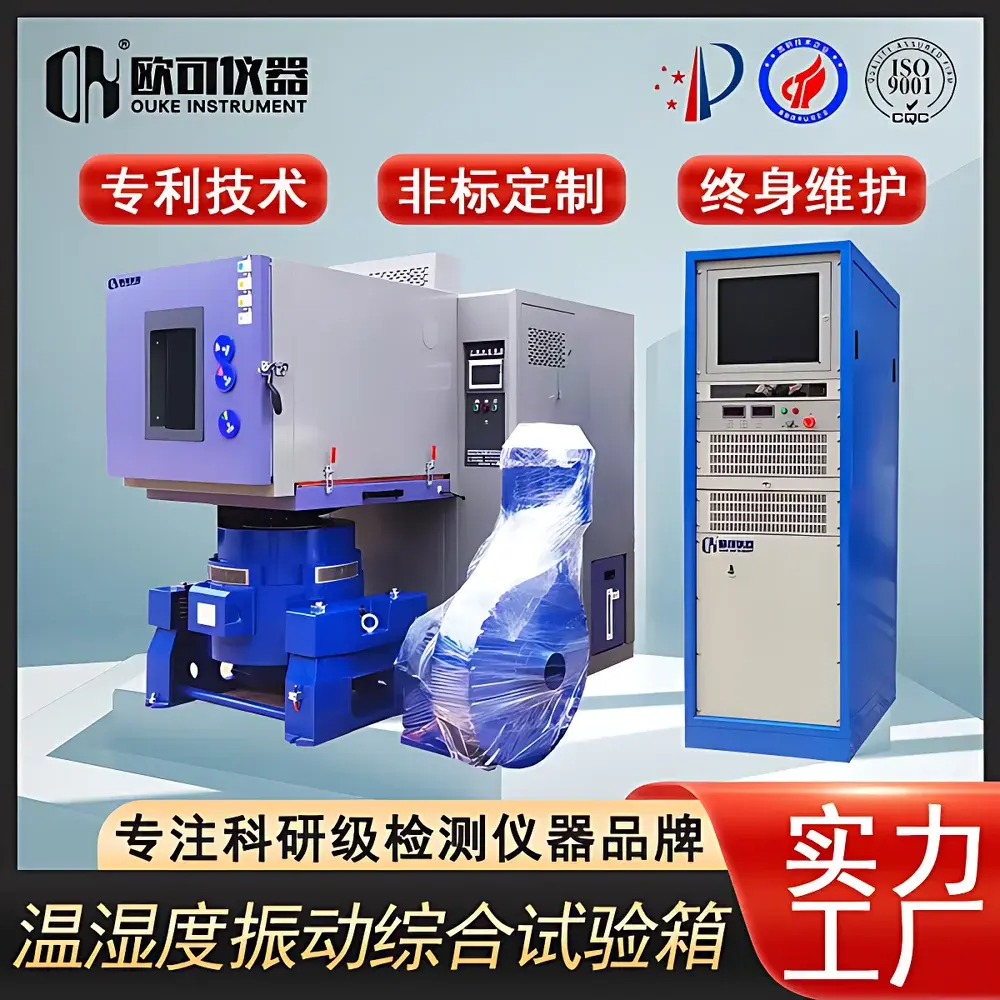
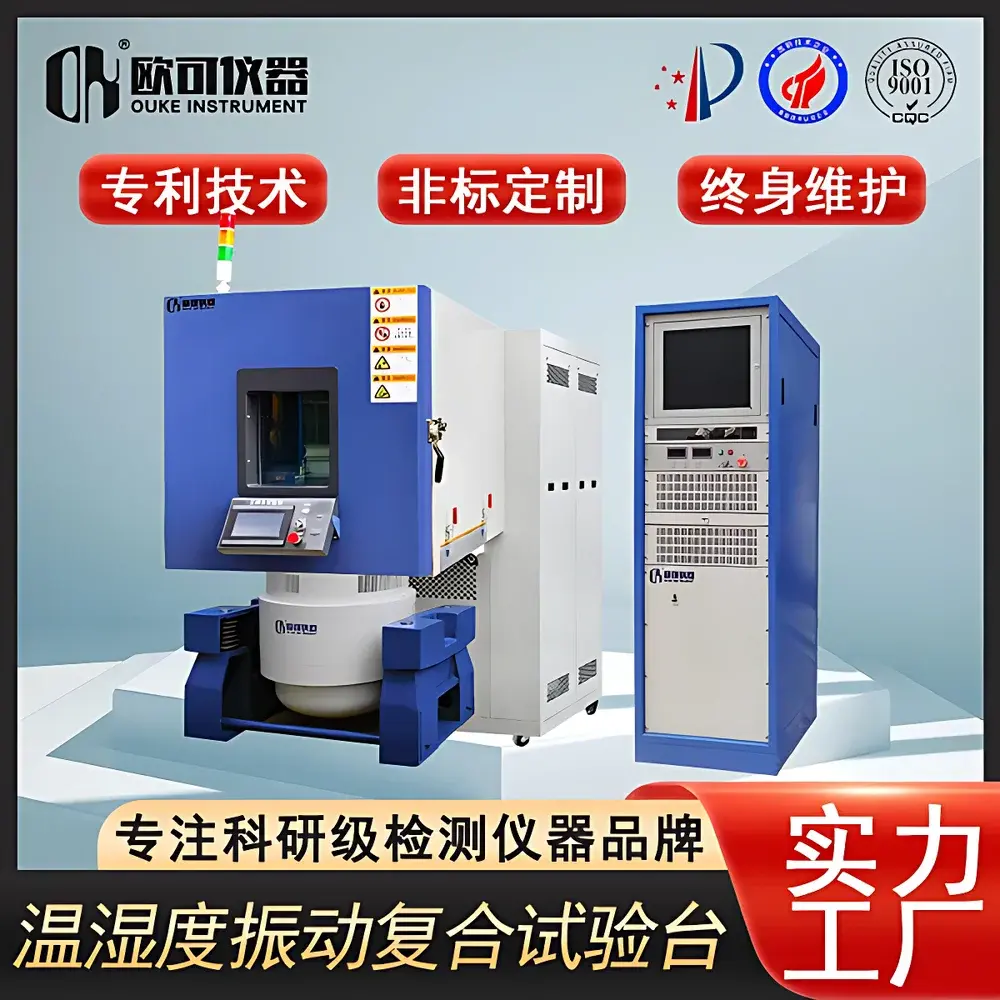
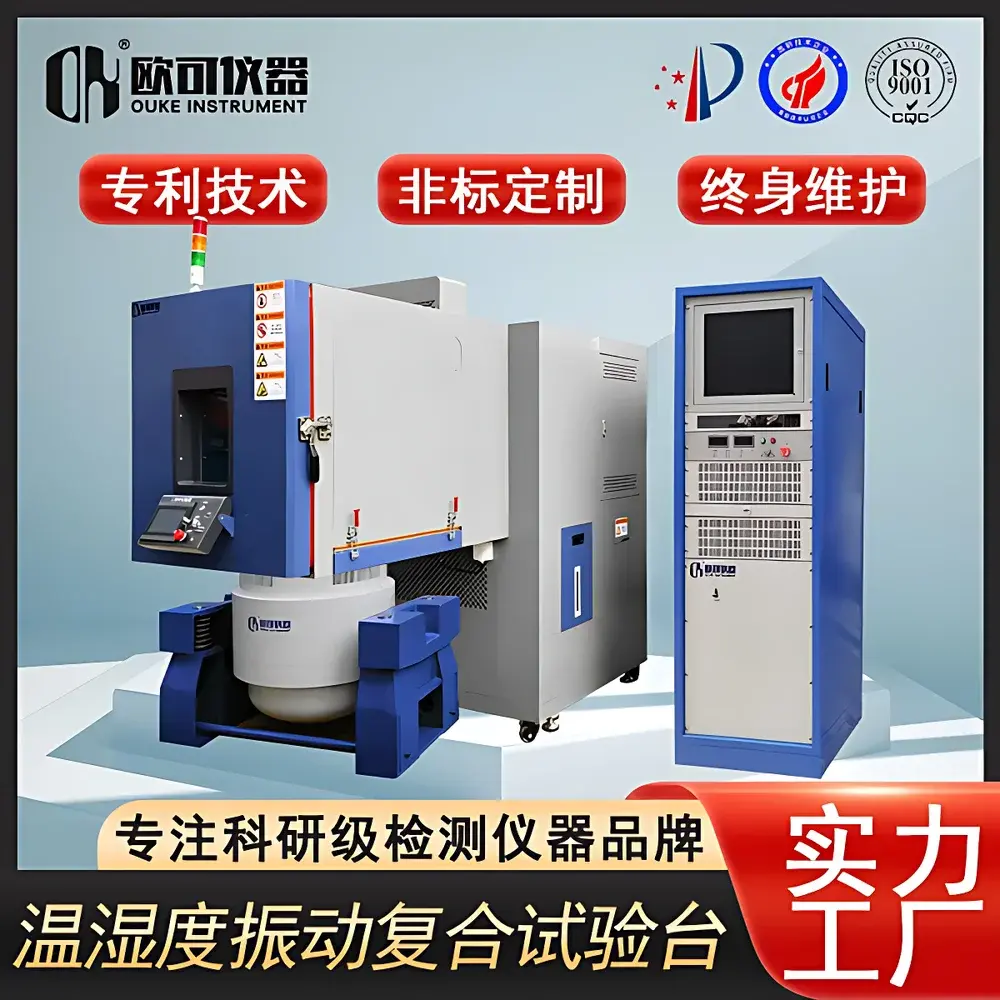
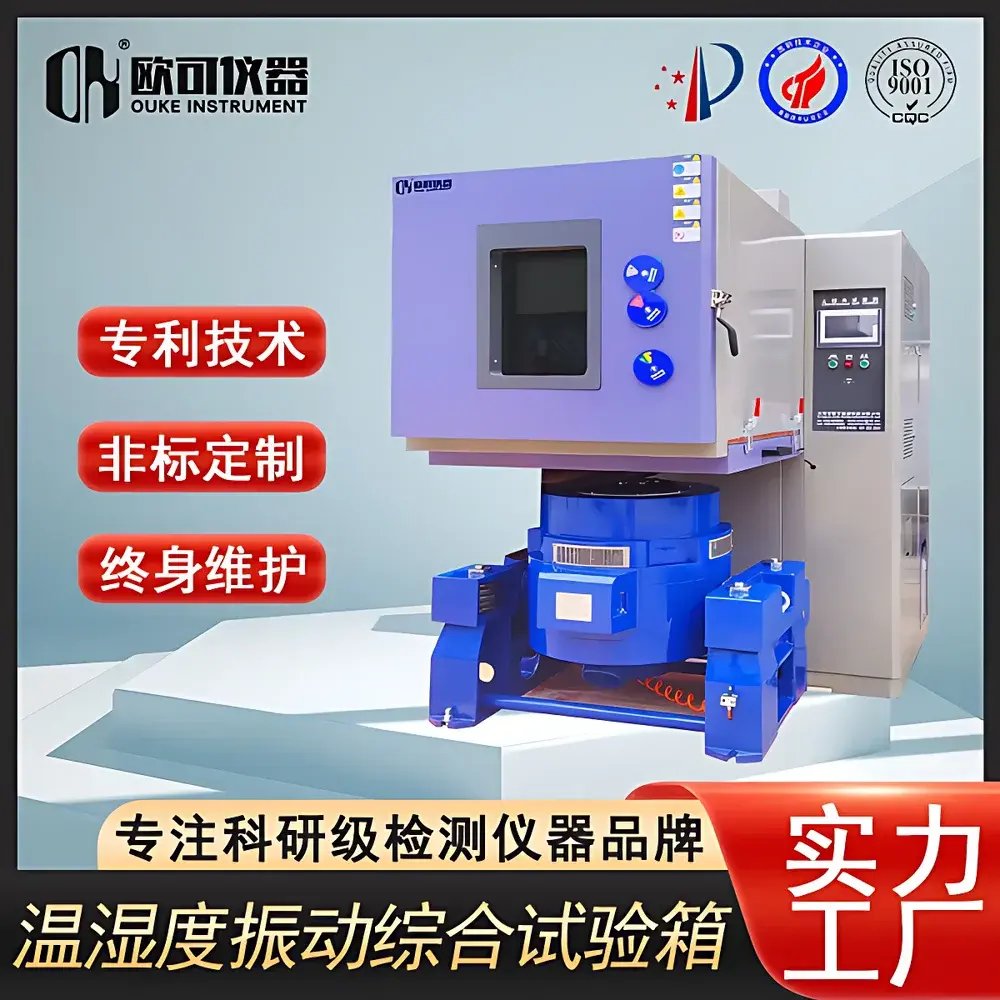
OK Environmental Test Systems OK-ZTH-390.000 Combined Temperature-Humidity-Vibration Test Chamber
| Brand | OK |
|---|---|
| Origin | Guangdong, China |
| Manufacturer Type | Direct Manufacturer |
| Product Category | Domestic |
| Model | OK-ZTH-390.000 |
| Temperature Range | −70 °C to +150 °C |
| Humidity Range | 20–98 %RH at 20–85 °C |
| Temperature Uniformity | ≤ ±0.5 °C |
| Standard Load Capacity | 15 kg aluminum mass (350 W thermal dissipation) |
| Control Interface | 7-inch LCD color touchscreen controller with RS-232 communication port |
| Refrigeration System | Twin-stage or cascade low-temperature circuit with hermetic compressors (Tecumseh or Bitzer equivalent) |
| Internal Chamber Material | Mirror-finished SUS304 stainless steel |
| External Casing | Zinc-coated steel with powder coating |
| Vibration Integration | Modular electrodynamic shaker coupling with dynamic load transfer optimization |
Overview
The OK Environmental Test Systems OK-ZTH-390.000 is a fully integrated combined environmental test chamber engineered for simultaneous and synchronized application of temperature cycling, humidity conditioning, and mechanical vibration—enabling accelerated reliability assessment under multi-stress operational profiles. This system operates on the principle of synergistic stress interaction, where thermal expansion/contraction, moisture ingress, and dynamic mechanical loading collectively accelerate failure mechanisms such as solder joint fatigue, polymer creep, interfacial delamination, and contact resistance degradation. Designed in accordance with IEC 60068-2-64 (vibration), IEC 60068-2-30 (damp heat cyclic), and MIL-STD-810H Method 514.8 (vibration) and Method 502.7 (temperature/humidity), the OK-ZTH-390.000 supports qualification testing for aerospace avionics, automotive ECUs, military electronics, telecommunications infrastructure, and high-reliability consumer devices.
Key Features
- Triple-stress synchronization: Real-time coordinated control of temperature (−70 °C to +150 °C), relative humidity (20–98 %RH within 20–85 °C operating envelope), and vibration (programmable sine, random, swept-sine, and transient shock profiles)
- Mirror-polished SUS304 stainless steel inner chamber ensures corrosion resistance, non-outgassing performance, and long-term dimensional stability under repeated thermal-hygric cycling
- Cascade refrigeration architecture with dual-stage compression enables rapid cooling ramp rates and stable sub-zero operation without liquid nitrogen dependency
- Modular vibration interface accommodates optional electrodynamic shakers (e.g., LDS V875, TIRA TV 51120) with optimized force transmission paths and vacuum-tight feedthroughs for sealed chamber integrity
- 7-inch industrial-grade color touchscreen HMI with embedded PID algorithms, programmable step-and-hold sequences, and real-time trend logging of all three stress domains
- RS-232 serial interface compliant with SCPI command set for integration into automated test systems and LabVIEW-based validation platforms
Sample Compatibility & Compliance
The OK-ZTH-390.000 accommodates test specimens up to 15 kg mounted on standardized aluminum test plates (350 W maximum internal power dissipation). Its chamber geometry (390 L net volume) permits full-unit testing of automotive control modules, PCB assemblies, sensor housings, and small enclosures. All thermal and humidity control functions meet ISO 16750-4 (road vehicles), JEDEC JESD22-A108 (environmental stress screening), and ASTM D4332 (conditioning containers for testing). The system supports GLP-compliant audit trails when paired with OK’s optional data acquisition module (OK-DAQ-300), which records timestamped sensor values with NIST-traceable calibration metadata.
Software & Data Management
The embedded controller firmware implements deterministic real-time scheduling for concurrent stress execution, with independent loop tuning for temperature, humidity, and vibration axes. Optional PC-based OK-TestSuite software provides Gantt-style test sequencing, statistical process monitoring (SPC), and export to CSV, XML, and PDF formats compliant with FDA 21 CFR Part 11 requirements (electronic signatures, audit trail, user role management). Raw vibration spectral data (PSD, FFT, kurtosis) can be exported for post-test analysis in MATLAB or SigLab environments.
Applications
- Environmental Stress Screening (ESS) of electronic assemblies prior to burn-in or field deployment
- Design verification testing of automotive ADAS sensors subjected to thermal shock and road-induced vibration
- Reliability growth testing of avionics boxes per DO-160G Section 25 (vibration) and Section 10 (temperature/humidity)
- Failure mode identification in battery management systems (BMS) under coupled thermal cycling and mechanical resonance
- Qualification of medical device enclosures to IEC 60601-1 Clause 11 (environmental conditions) and Clause 9 (mechanical hazards)
FAQ
What vibration standards does the OK-ZTH-390.000 support?
It natively executes IEC 60068-2-6 (sine vibration), IEC 60068-2-64 (random vibration), and MIL-STD-810H Method 514.8 via programmable waveform synthesis.
Can the chamber operate continuously for extended HALT/HASS profiles?
Yes—the system has been validated for unattended 720-hour continuous operation with monitored compressor duty cycles, refrigerant pressure stability, and humidity sensor drift < ±1.5 %RH/year.
Is third-party calibration documentation available?
OK provides factory calibration certificates traceable to CNAS-accredited laboratories (ISO/IEC 17025), including temperature uniformity mapping, humidity accuracy verification, and shaker force linearity reports.
How is thermal leakage minimized at the vibration interface?
A dual-labyrinth dynamic seal design isolates the cold chamber from the shaker baseplate, maintaining thermal gradient integrity while preserving mechanical impedance matching across 5–2000 Hz.
Does the system support remote monitoring via Ethernet?
The standard RS-232 interface may be extended using OK’s optional RS-232-to-Ethernet gateway (OK-ETH-100), enabling Modbus TCP readout of chamber status and alarm logs.



