
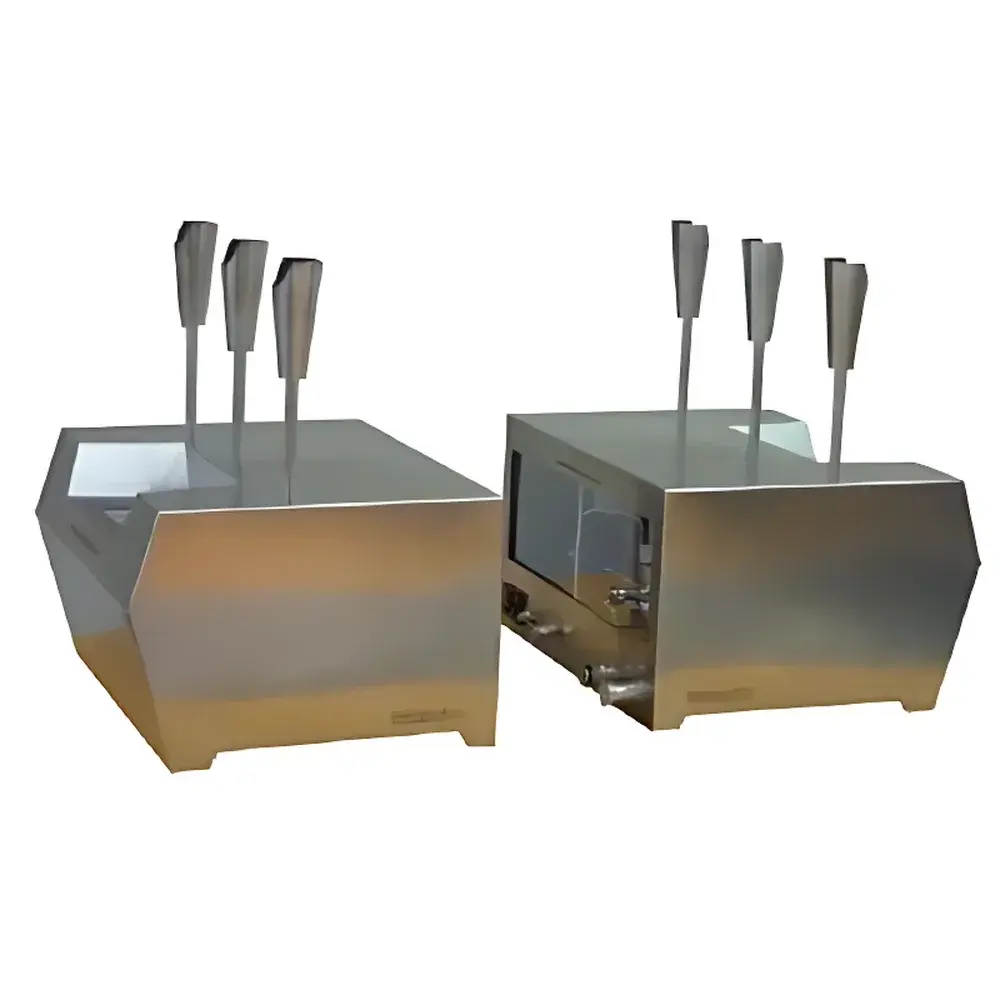
Environodour Dynamic Olfactometry Analyzer
| Origin | Australia |
|---|---|
| Manufacturer Type | Authorized Distributor |
| Origin Category | Imported |
| Model | Environodour |
| Pricing | Available Upon Request |
Overview
The Environodour Dynamic Olfactometry Analyzer is a precision-engineered instrument designed for standardized, human-panel-based odor concentration measurement in compliance with internationally recognized olfactometric protocols. It operates on the principle of dynamic dilution olfactometry—where ambient or source-emitted air samples are progressively diluted with odor-free air until the odor threshold is reached by a trained panel of human assessors. This method quantifies odor concentration in European Odour Units per cubic meter (ouE/m³), as defined in EN 13725:2022 and aligned with the Chinese national standard GB/T 14675–2023 (replacing GB 14675). Unlike sensor-based gas detectors, the Environodour system leverages biological detection sensitivity—capable of identifying complex odor mixtures at sub-ppb perception thresholds—making it indispensable for regulatory odor impact assessments, nuisance investigations, and environmental permitting.
Key Features
- Triple-olfactometer cup configuration enabling simultaneous presentation to three panelists, ensuring statistical robustness and inter-panelist consistency per EN 13725 requirements.
- Integrated dynamic dilution system with mass flow controllers (MFCs) calibrated to ±1.5% full scale, supporting dilution ratios from 1:1 to 1:100,000 with pneumatic actuation and real-time feedback control.
- Remote Rapid Sampling Module (RRSM) compatible with stainless-steel canisters and Tedlar® bags; enables time-resolved, field-deployable grab sampling under ambient pressure and temperature conditions—critical for capturing transient odor events during complaint investigations.
- Panel management interface compliant with ISO 8586:2014 for assessor selection, training records, and performance validation (e.g., n-butanol threshold testing).
- Modular airflow architecture with HEPA/activated carbon filtration for zero-air supply, meeting EN 13725’s requirement for background odor concentration < 0.1 ouE/m³.
Sample Compatibility & Compliance
The Environodour system accommodates gaseous samples collected via direct line connection, evacuated canisters (SUMMA, SilcoCan), or flexible polymer bags (Tedlar®, FlexFoil®). It supports analysis of complex odorants—including sulfur compounds (H2S, mercaptans), volatile fatty acids (butyric, valeric acid), aromatic hydrocarbons (toluene, styrene), and nitrogenous bases (trimethylamine)—without chemical bias. The instrument conforms to EN 13725:2022 for laboratory olfactometry, GB/T 14675–2023 for three-point comparative testing, and ISO 16000-28:2012 for indoor odor assessment methodology. All operational procedures support GLP-compliant audit trails, including sample ID logging, panelist assignment timestamps, and dilution sequence verification.
Software & Data Management
The Environodour Control Suite (v4.2+) provides a validated Windows-based platform for test protocol definition, real-time panel response capture, automatic calculation of odor concentration (CouE), and uncertainty estimation per GUM (JCGM 100:2008). Data export formats include CSV, PDF reports with digital signatures, and XML for LIMS integration. Audit trail functionality complies with FDA 21 CFR Part 11 requirements, featuring role-based access control, electronic signature authentication, and immutable record retention. Calibration logs, MFC verification certificates, and panelist proficiency records are stored with time-stamped metadata.
Applications
- Regulatory odor impact assessment for wastewater treatment plants, composting facilities, rendering operations, and livestock farms.
- Source identification and fingerprinting via triangular odor comparison tests—determining whether two samples share perceptual similarity (odor quality matching) using forced-choice discrimination protocols.
- Odor dispersion modeling input generation, including emission rate derivation (ouE/s) from stack or surface flux measurements.
- Complaint-driven field investigations supported by RRSM time-synchronized sampling and lab-based olfactometric reanalysis.
- Research on odorant interaction effects (masking, synergy, adaptation) under controlled dilution gradients.
FAQ
Does the Environodour system require certified odor assessors?
Yes—EN 13725 and GB/T 14675 mandate use of panels comprising 4–8 trained assessors certified per ISO 8586. The system includes tools for assessor qualification tracking and threshold validation.
Can it be used for continuous monitoring?
No—it is a batch-mode analytical instrument for discrete sample evaluation. Continuous odor monitoring requires complementary electronic nose systems or sensor networks; Environodour provides reference-grade validation for such technologies.
Is the Remote Rapid Sampling Module weather-resistant?
The RRSM housing meets IP54 ingress protection standards and operates within −10 °C to +50 °C ambient range, suitable for outdoor deployment during odor complaint response.
What maintenance is required for long-term accuracy?
Quarterly MFC recalibration against NIST-traceable flow standards, semiannual filter replacement (HEPA + carbon), and annual third-party verification of dilution ratio linearity are recommended per EN 13725 Annex C.
How is data integrity ensured during multi-lab collaborative studies?
The software enforces standardized test templates, embeds instrument serial numbers and calibration IDs in all reports, and supports encrypted data exchange via SFTP—enabling cross-laboratory reproducibility studies compliant with ISO/IEC 17025.







