
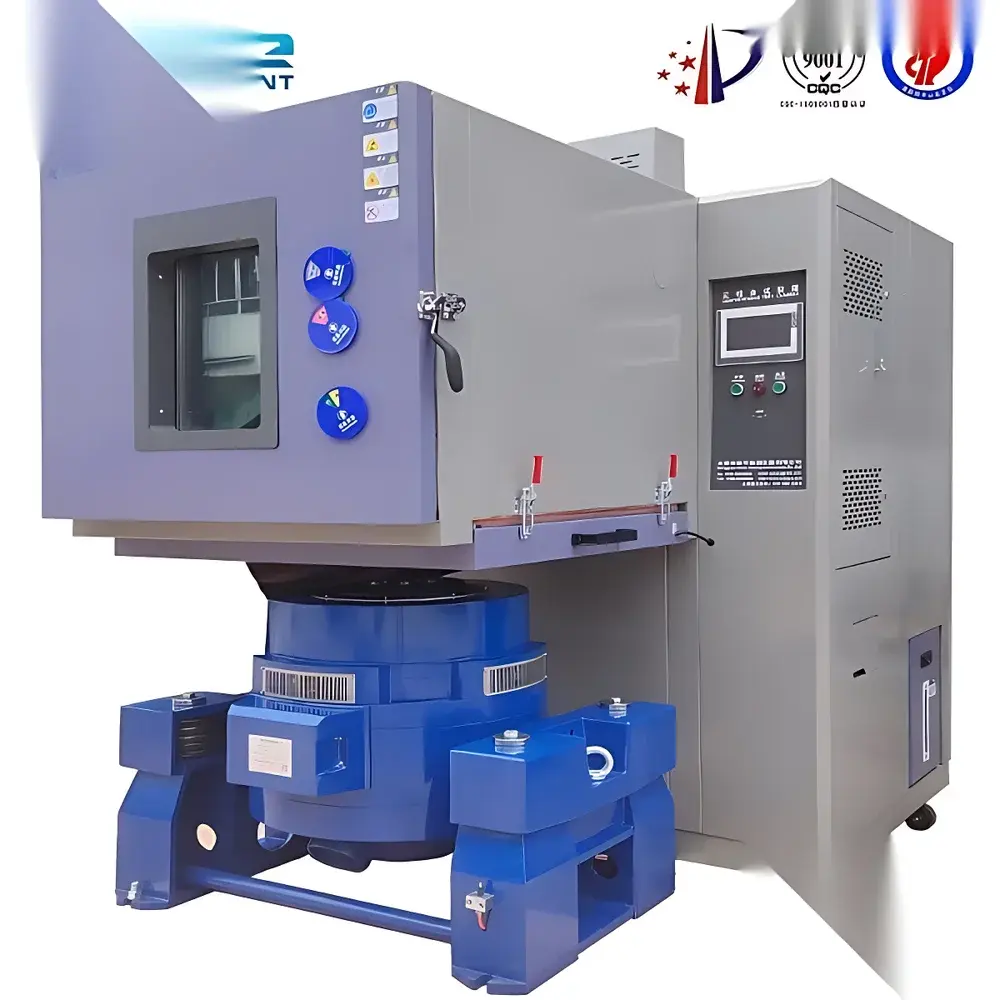
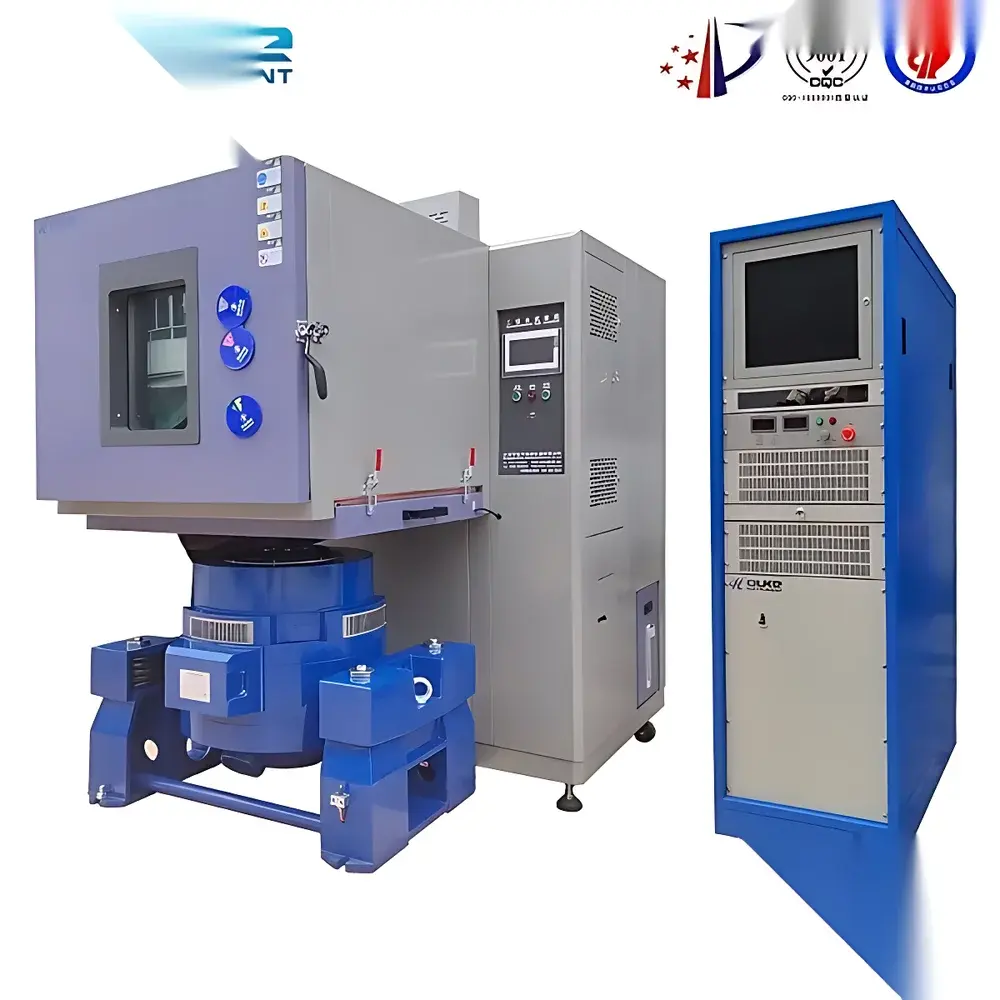
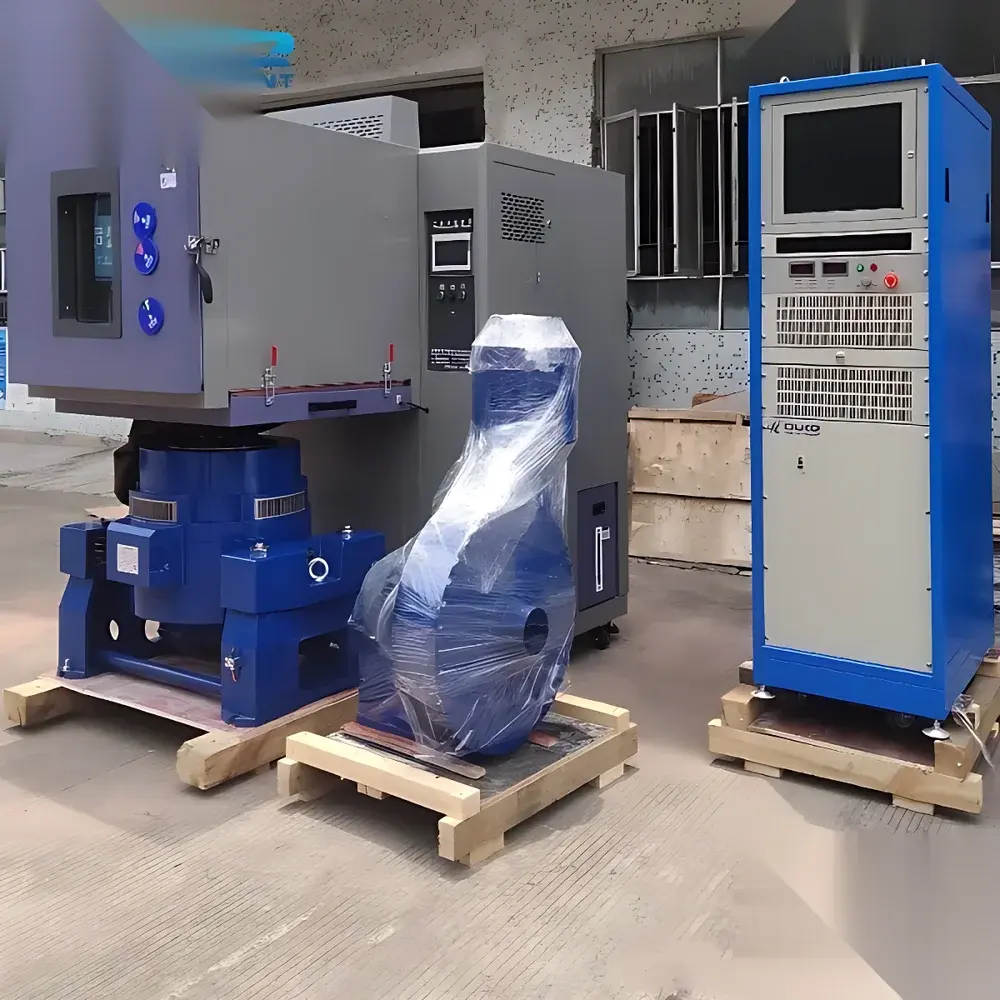
EOC Combined Temperature-Humidity-Vibration Environmental Test System
| Brand | Other Brands |
|---|---|
| Origin | Imported |
| Manufacturer Type | Authorized Distributor |
| Temperature Range | -70 °C to +200 °C |
| Humidity Range | 20–98% RH |
| Vibration Force | 300–5000 kgf (peak) |
| Frequency Range | 2–2000 Hz |
| Maximum Displacement | 25.4–51 mm (peak-to-peak) |
| Control Architecture | Independent Multi-Mode Control System (Standalone Temp/Humidity/Vibration or Fully Integrated Combined Operation) |
Overview
The EOC Combined Temperature-Humidity-Vibration Environmental Test System is an integrated reliability validation platform engineered for rigorous physical stress testing of automotive components under synchronized climatic and mechanical loading conditions. It combines a high-performance environmental chamber—capable of precise temperature and humidity control—with a high-fidelity electrodynamic or servo-hydraulic shaker system, enabling concurrent application of thermal cycling, moisture exposure, and mechanical vibration (sinusoidal or random profiles) in accordance with internationally recognized test standards including ISO 16750-4, SAE J2380, GMW 14872, and Ford CETP 00.00-L-467. Unlike sequential single-stress testing, this tri-combined approach replicates real-world operational environments where thermal expansion, condensation-induced corrosion, and resonant fatigue occur simultaneously—critical for validating electronic control units (ECUs), sensors, connectors, lighting assemblies, and structural subassemblies prior to production release.
Key Features
- Modular dual-control architecture: fully independent operation of temperature/humidity conditioning and vibration excitation, or seamless synchronization via master-slave interface logic.
- Movable rail-mounted shaker integration: allows rapid reconfiguration between standalone vibration testing and combined chamber-in-shaker configurations without mechanical disassembly.
- Wide dynamic range performance: vibration force capacity from 300 kgf to 5000 kgf (peak), frequency coverage from 2 Hz to 2000 Hz, and peak-to-peak displacement up to 51 mm—suitable for both low-frequency road-simulation spectra and high-frequency component resonance screening.
- Chamber specifications compliant with IEC 60068-2-1, IEC 60068-2-2, and IEC 60068-2-30: temperature stability ±0.5 °C, humidity uniformity ±3% RH, and ramp rates programmable up to 10 °C/min (heating) and 5 °C/min (cooling).
- Robust mechanical coupling design: reinforced chamber baseplate with seismic-grade anchoring, low-resonance support frame, and dynamic isolation mounts to prevent cross-talk between thermal and vibrational subsystems.
Sample Compatibility & Compliance
The system accommodates automotive parts ranging from compact ECUs (<5 kg) to large chassis modules (up to 200 kg), with customizable fixture interfaces (ISO 13076-compliant mounting plates, T-slot rails, and inertial mass adapters). All operational modes support traceable calibration per ISO/IEC 17025 requirements. Test protocols may be configured to meet functional safety validation needs under ISO 26262 ASIL-B/C workflows. The system’s environmental control subsystem complies with EN 60068-3-5 (humidity control accuracy), while vibration profiles adhere to ISO 10816-1 (vibration severity classification) and MIL-STD-810H Method 514.7 (vibration testing procedures). Full audit trails—including setpoint logs, sensor readings, and actuator feedback—are retained for GLP/GMP-regulated development programs.
Software & Data Management
Control and data acquisition are managed through a deterministic real-time OS-based platform supporting IEEE 1588 PTP time synchronization. The software suite provides: (i) multi-parameter profile scripting with conditional branching (e.g., “hold at –40 °C / 95% RH until dew point stabilization, then initiate 10–500 Hz swept sine at 1.5 g RMS”); (ii) live spectral monitoring with FFT-based real-time PSD estimation; (iii) automated report generation compliant with ASTM E2709 for statistical confidence in pass/fail criteria; and (iv) optional 21 CFR Part 11-compliant electronic signature and audit trail modules for regulated industries. Raw data export supports HDF5, CSV, and UFF58 formats for post-processing in MATLAB, Python (SciPy), or commercial FEA tools.
Applications
- Accelerated life testing of infotainment head units under thermal shock + broadband vibration.
- Validation of battery management system (BMS) housings against condensation-induced leakage during cold-start cycling.
- Corrosion resistance assessment of aluminum suspension links exposed to salt fog + thermal cycling + road-load vibration.
- EMC pre-compliance screening: detecting vibration-induced micro-disconnects in high-speed CAN FD harnesses under humid conditions.
- Development of ADAS radar enclosures subjected to combined thermal gradient stress and resonant modal excitation.
FAQ
Can the system perform vibration-only tests without temperature or humidity activation?
Yes—the control architecture permits full decoupling of subsystems, allowing standalone mechanical vibration testing with no environmental conditioning active.
Is third-party calibration certification available?
Yes—NIST-traceable calibration certificates for temperature, humidity, and acceleration transducers can be provided upon request, aligned with ISO/IEC 17025 scope.
What level of customization is supported for non-standard sample fixtures?
Custom mounting solutions—including inertial mass compensation plates, thermal shunts, and RF-transparent composite load frames—can be designed and validated in collaboration with EOC’s application engineering team.
Does the system support remote monitoring and alarm notification?
Standard Ethernet/IP and Modbus TCP interfaces enable integration into facility SCADA systems; email/SMS alerts are configurable for critical fault conditions (e.g., chamber overtemperature, shaker coil overcurrent, humidity sensor drift).
Are test method templates available for common automotive OEM specifications?
Preloaded protocol libraries include GMW 14872 Rev. G, Ford WSS-M99P1111-A, and VW 80101, with editable parameters and compliance checklists embedded in the test sequence editor.



