
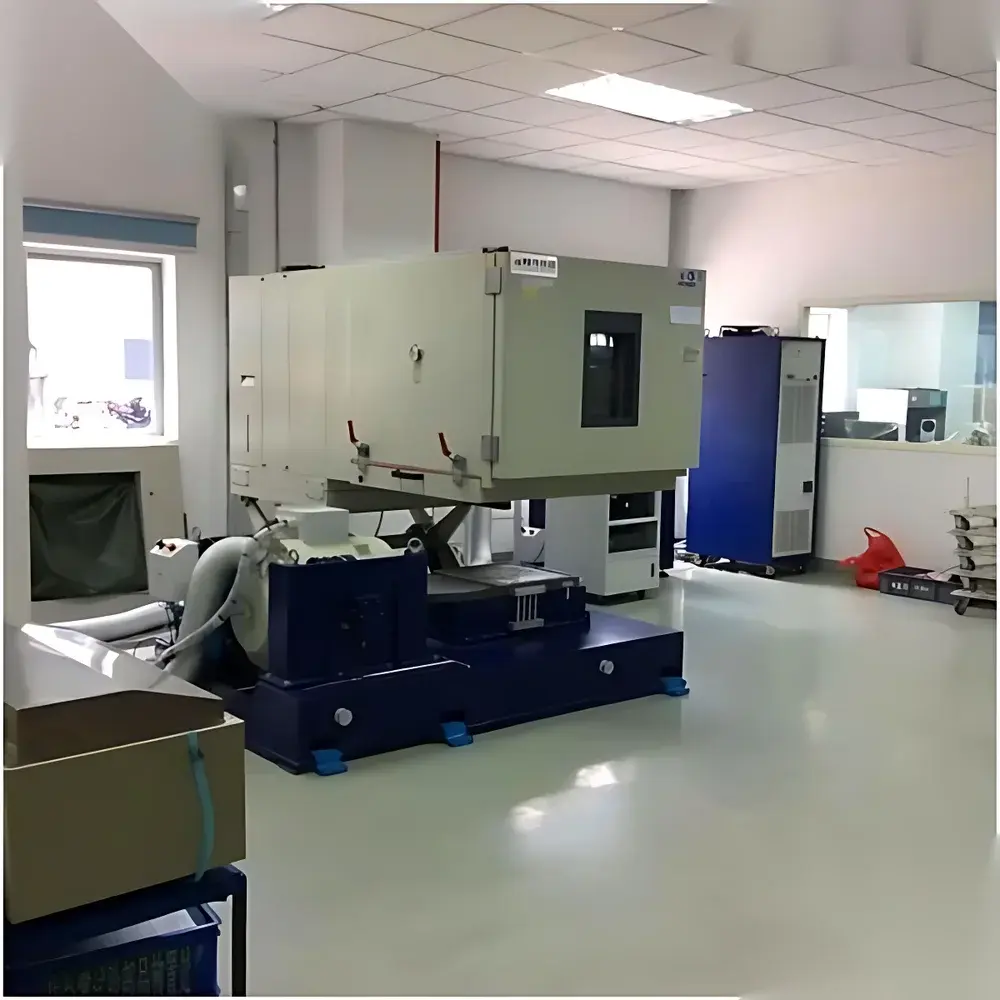
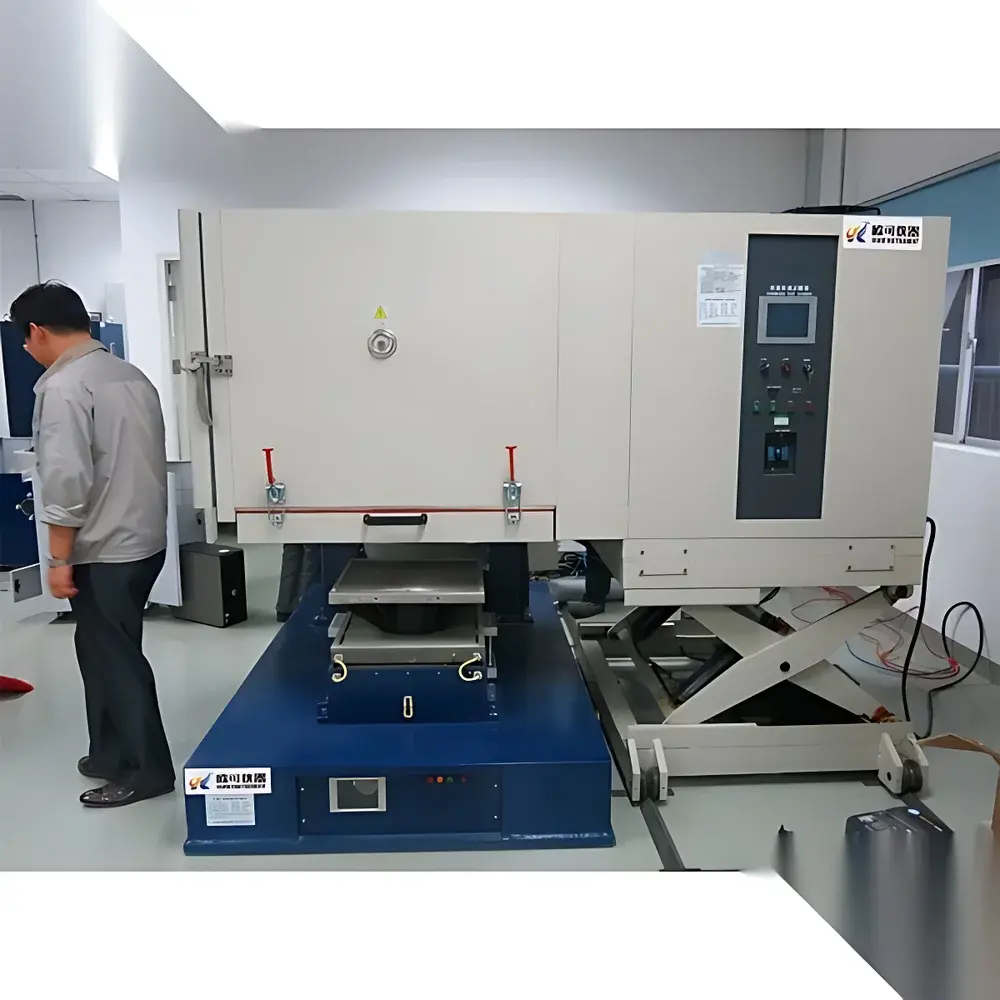
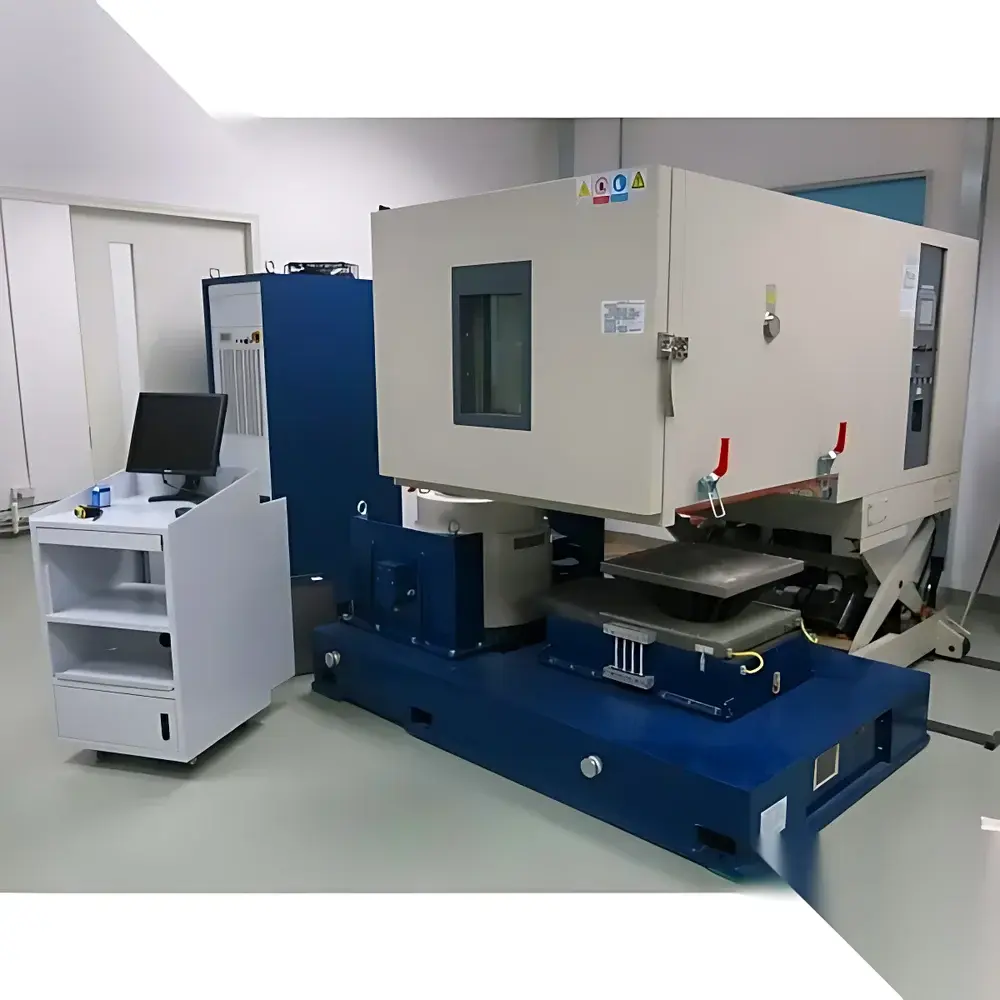
EOKE Combined Temperature-Humidity-Vibration Environmental Test System
| Brand | Other Brands |
|---|---|
| Origin | Imported |
| Manufacturer Type | Authorized Distributor |
| Price | USD 21,500 (FOB) |
| Vibration Axis | Vertical (with Auto-Centering Mechanism) |
| Vibration Waveforms | Sine, Random, Shock |
| Viewing Window | Multi-layer Tempered Glass with Conductive Coating |
| Feedthrough Port | Ø50 mm (Left Side) |
| Heating System | Finned Stainless Steel Heaters with Infrared Nickel-Chromium Alloy Elements |
| Insulation | Ultra-Fine Glass Wool |
| Interior Material | SUS304 Mirror-Finish Stainless Steel |
| Exterior Material | A3 Steel with Powder-Coated Finish |
| Air Circulation | Top-Mounted Low-Noise Xiangming Motor + Multi-Blade Centrifugal Impeller, Single-Circuit Forced Convection |
Overview
The EOKE Combined Temperature-Humidity-Vibration Environmental Test System is an integrated reliability testing platform engineered for simultaneous or sequential exposure of electronic components, automotive modules, aerospace subassemblies, and industrial PCBs to controlled thermal, hygrothermal, and dynamic mechanical stress conditions. Based on the principle of accelerated environmental stress screening (ESS), this system enables precise replication of real-world operational and transport-induced degradation mechanisms—including solder joint fatigue, material creep, condensation-induced corrosion, and resonance-triggered structural failure. Unlike standalone chambers or shaker tables, the EOKE tri-combined system maintains strict cross-coupling control: temperature and humidity profiles remain stable within ±0.5 °C and ±2 % RH during active vibration, verified per IEC 60068-2-64 and MIL-STD-810H methodology. The chamber’s structural architecture isolates thermal-hygric and vibrational subsystems via independent PID-controlled loops and physically decoupled mounting interfaces—ensuring metrological integrity across all three domains.
Key Features
- Independent dual-control architecture: Separate microprocessor-based controllers for climate (temperature/humidity) and vibration subsystems, eliminating signal interference and enabling synchronized or staggered test sequencing.
- Vertical-axis electrodynamic vibration system with auto-centering mechanism: Equipped with precision linear guides and height gauge for repeatable specimen alignment; supports sine sweep, random PSD (power spectral density), and classical shock pulse testing per ISO 10326-1 and ASTM D999.
- High-fidelity observation and monitoring: Triple-layer tempered viewing window with embedded conductive film prevents fogging and electrostatic buildup, ensuring unobstructed optical access during high-humidity cycling.
- Thermal management optimized for stability: Stainless steel finned heaters with far-infrared Ni-Cr alloy cores provide uniform heat distribution; ultra-fine glass wool insulation achieves ≤0.8 K/m thermal gradient across the working volume.
- Modular vibration stage integration: Removable vibration table slides on stainless steel rails beneath the test chamber floor—allowing full isolation when only thermal-hygric testing is required, minimizing maintenance downtime.
- Electrical interface flexibility: One Ø50 mm feedthrough port (left-side mounted) accommodates external power, sensor leads, or data acquisition cables without compromising chamber seal integrity.
Sample Compatibility & Compliance
The system accommodates specimens up to 500 mm × 500 mm × 500 mm (W×D×H) and 30 kg maximum mass. Compatible with standard test fixtures, thermocouple harnesses, and non-contact displacement sensors. Designed and validated in accordance with IEC 60068-3-3 (environmental testing guidance), IEC 60068-2-6 (vibration), IEC 60068-2-30 (damp heat cyclic), and ISO 16750-4 (road vehicles—electrical loads). Supports audit-ready documentation for GLP and GMP environments through optional calibration traceability to NIST or PTB standards. All safety interlocks comply with EN 61000-6-2 (EMC immunity) and EN 61000-6-4 (EMC emissions).
Software & Data Management
The system operates via a Windows-based control interface supporting real-time waveform visualization (FFT, time-domain, PSD plots), profile programming (step, ramp, dwell, loop), and event-triggered logging. Data export conforms to CSV and XML formats compatible with MATLAB, LabVIEW, and JMP. Optional FDA 21 CFR Part 11 compliance package includes electronic signatures, audit trail logging, user role-based access control, and encrypted database storage. Remote monitoring via Ethernet (TCP/IP) enables integration into enterprise MES or PLM platforms.
Applications
- Qualification testing of avionics enclosures under combined thermal cycling and ground vibration spectra.
- Accelerated life testing of battery packs subjected to humid tropical conditions and road-induced vertical excitation.
- Failure mode analysis of MEMS sensors exposed to condensation cycles followed by resonant frequency sweeps.
- Reliability validation of medical device housings per ISO 14971 risk management requirements.
- Design verification of 5G base station RF modules operating at elevated ambient temperatures with mechanical shock inputs.
FAQ
Can the system perform simultaneous temperature-humidity-vibration testing?
Yes—the climate and vibration subsystems operate concurrently with real-time compensation algorithms to maintain specified tolerances per IEC 60068-2-64 Annex B.
What is the maximum allowable specimen weight for vertical vibration?
The rated payload is 30 kg at frequencies up to 2000 Hz; derating applies above 1000 Hz per manufacturer’s dynamic load curve.
Is third-party calibration certification available?
Yes—NIST-traceable calibration reports for temperature, humidity, and acceleration sensors are provided upon request.
Does the system support custom test profile scripting?
Yes—via built-in script editor supporting conditional logic, variable assignment, and external trigger inputs.
How is condensation managed during rapid cooling/humidification transitions?
Integrated dew point monitoring and adaptive defrost logic minimize moisture accumulation on internal surfaces and specimen interfaces.



