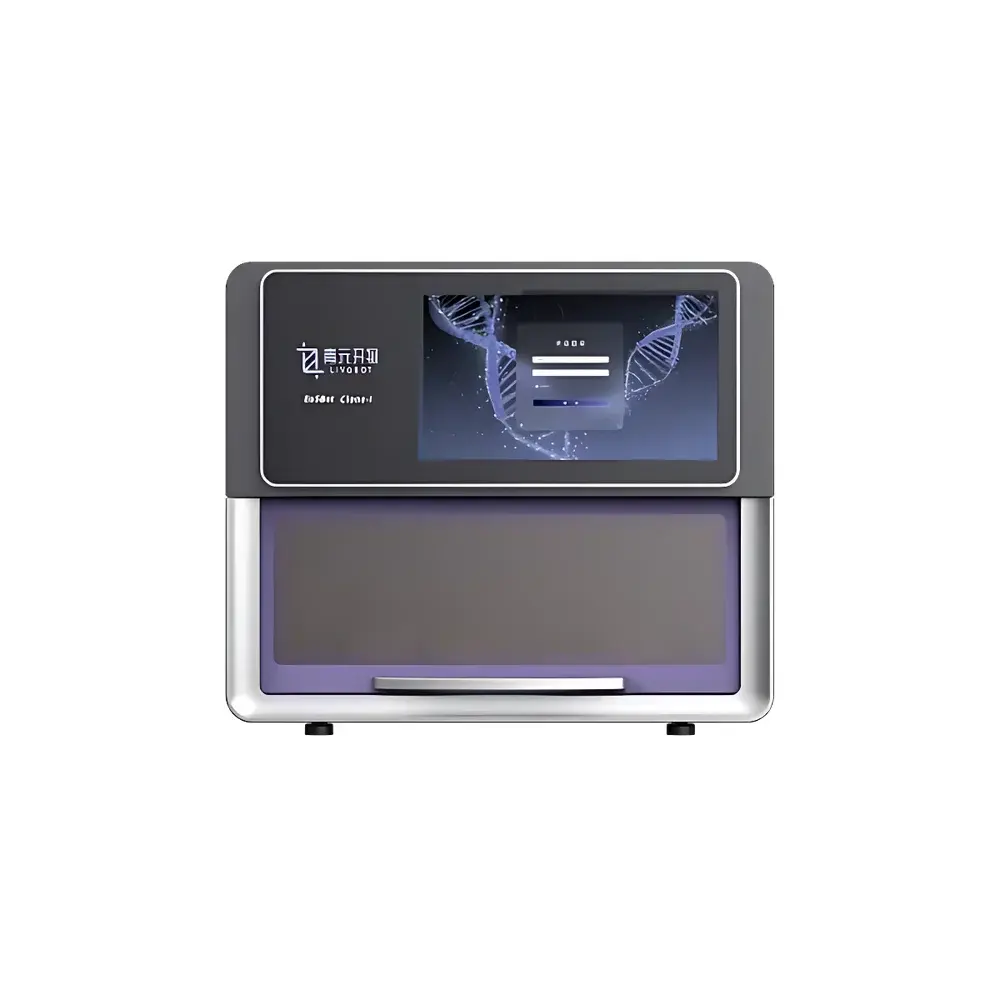
EosBot® Clone-I Intelligent Colony Recognition and Automated Clone Picking Workstation
| Brand | LIVOBOT |
|---|---|
| Origin | Beijing, China |
| Manufacturer Type | Direct Manufacturer |
| Regional Classification | Domestic (China) |
| Model | EosBot® Clone-I |
| Instrument Type | Single-Needle Colony Picking Workstation |
| Compatible Microorganism | Escherichia coli |
| Inoculation Modes | Solid-to-Liquid, Liquid-to-Solid |
| Picking Speed | ≥320 colonies/hour |
| Picking Accuracy | 98% |
| Target Plate Formats | Disposable tips |
| Dimensions (D×W×H) | 632 mm × 490 mm × 550 mm |
Overview
The EosBot® Clone-I Intelligent Colony Recognition and Automated Clone Picking Workstation is an integrated benchtop platform engineered for high-fidelity, reproducible colony isolation in molecular microbiology and synthetic biology workflows. It operates on a dual-principle architecture: high-resolution digital imaging coupled with precision robotic actuation under controlled environmental conditions. The system captures multi-spectral images of agar plates using a calibrated CMOS sensor with adjustable illumination, then applies machine learning–enhanced segmentation algorithms to distinguish individual colonies based on morphological features—including size, circularity, edge gradient, and optical density—enabling robust discrimination even in high-density (>1000 CFU/plate) or overlapping growth scenarios. Following identification, the workstation executes contact-based colony picking using a sterile, single-use disposable tip mounted on a Z-axis–controlled linear stage, ensuring minimal cross-contamination and mechanical consistency across pick cycles. Its design aligns with core laboratory automation principles: traceability, repeatability, and operator-independent execution.
Key Features
- High-accuracy colony recognition engine trained on diverse E. coli strain morphologies, achieving ≥98% picking fidelity under validated conditions (ISO/IEC 17025–aligned verification protocol)
- Single-needle robotic arm with sub-millimeter positional repeatability (±0.15 mm), compatible with standard SBS-format petri dishes and microplates (48-, 96-, 384-well)
- Automated plate handling sequence: image acquisition → colony detection → priority-based selection → tip sterilization (UV + ethanol wipe) → targeted picking → liquid or solid-phase inoculation
- Benchtop footprint (632 × 490 × 550 mm) optimized for placement inside Class II biological safety cabinets without airflow disruption
- Open API architecture supporting integration with LIMS (e.g., LabVantage, STARLIMS), ELN systems, and upstream colony scanners via RESTful endpoints and TCP/IP command protocols
Sample Compatibility & Compliance
The EosBot® Clone-I is validated for use with Escherichia coli strains grown on standard LB, SOB, or TB agar media. While optimized for this host organism, its image analysis pipeline supports user-defined training for additional bacterial species upon submission of representative annotated datasets. All fluidic pathways and tip-contact surfaces are constructed from USP Class VI-certified polymers. The workstation complies with IEC 61000-6-2 (EMC immunity) and IEC 61000-6-3 (EMC emissions) standards. Software operation adheres to ALCOA+ data integrity principles, with full audit trail logging (user actions, timestamps, image hashes, pick coordinates) meeting FDA 21 CFR Part 11 requirements when deployed with qualified electronic signature modules.
Software & Data Management
The proprietary EosControl™ software provides a modular GUI with three operational modes: Guided Workflow (for novice users), Protocol Editor (for defining custom pick logic, z-height offsets, and dwell times), and Batch Scheduler (for unattended overnight runs). All acquired images, pick maps, and log files are stored in vendor-neutral TIFF and CSV formats, with optional encryption-at-rest and role-based access control. Metadata embedding follows MIAME-compliant schema, enabling direct ingestion into Galaxy, BaseSpace, or internal bioinformatics pipelines. Version-controlled firmware updates are delivered via secure HTTPS channels with SHA-256 hash verification.
Applications
- Drug Discovery: High-throughput screening of mutant libraries for target engagement assays; hit validation through colony arraying prior to MIC testing
- Synthetic Biology: Assembly verification of Golden Gate or Gibson constructs; functional screening of promoter-RBS variants in standardized plate formats
- Enzyme Engineering: Rapid isolation of expression clones post-transformation; preparation of uniform glycerol stocks for activity profiling across temperature/pH gradients
- Quality Control: Strain archiving with digital provenance; generation of reference colony grids for ISO 11133–compliant culture purity assessment
FAQ
What colony density range is supported for reliable detection?
The system achieves ≥95% detection sensitivity at densities up to 1,200 CFU per 100 mm Petri dish under optimal contrast conditions (e.g., white opaque agar, 24 h incubation at 37 °C).
Can the workstation handle non-E. coli species such as Bacillus or Streptomyces?
Yes—custom morphology models can be trained using user-supplied annotated image sets; validation data must be submitted for protocol qualification.
Is tip sterilization fully automated between picks?
Yes—each cycle includes UV-C irradiation (254 nm, 30 s) followed by ethanol vapor purge and air-dry phase before tip ejection.
Does the system support integration with third-party liquid handlers?
Yes—via industry-standard SLIM (Standard Laboratory Integration Method) messaging over Ethernet, with documented command syntax for Hamilton, Tecan, and Opentrons platforms.
What regulatory documentation is provided for GMP environments?
IQ/OQ protocols, risk assessments (FMEA), and raw test data packages are available upon request; software qualifies under Annex 11 and GAMP5 Category 3 classification.