
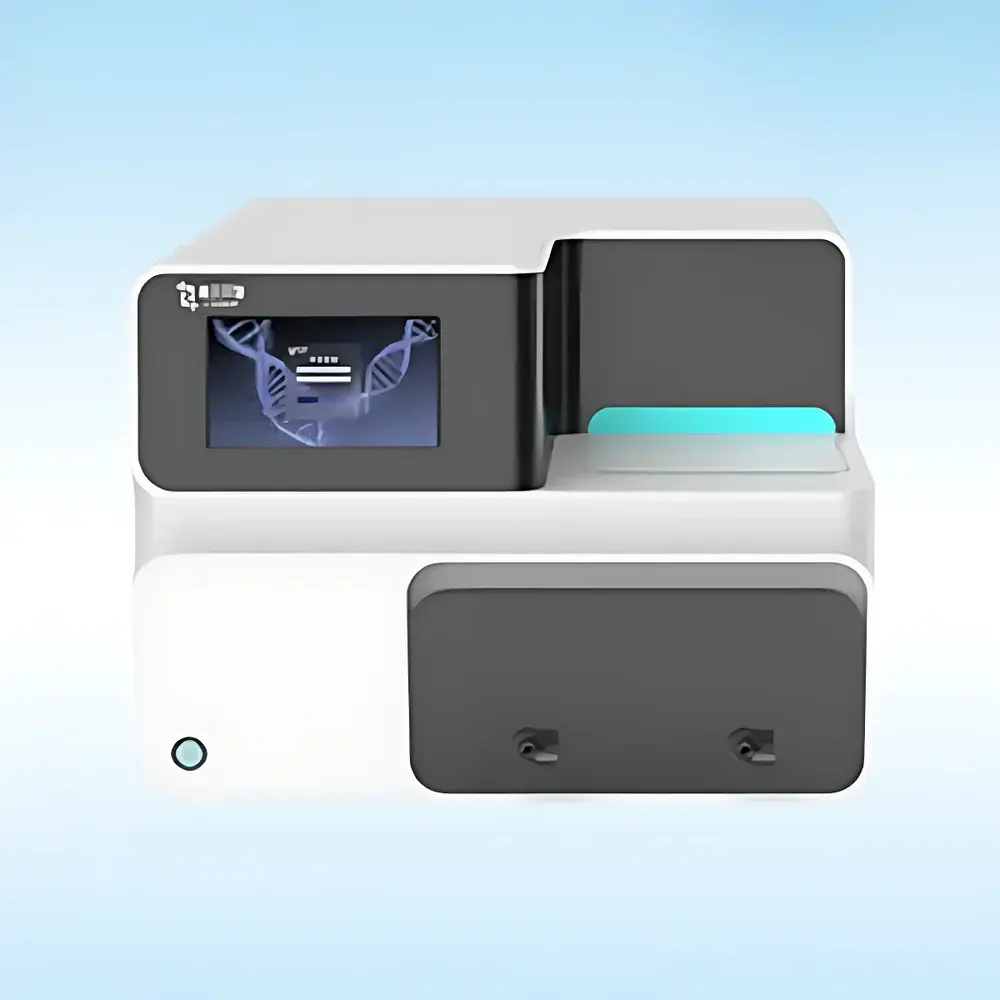
EoSonics® FRAG96 High-Throughput Focused Ultrasonic DNA Shearer
| Brand | LIVOBOT |
|---|---|
| Model | EoSonics® FRAG96 |
| Origin | Beijing, China |
| Manufacturer | LIVOBOT (OEM/ODM Producer) |
| Regulatory Status | NMPA Class I Medical Device Registration, CB & CE Certified |
| Nucleic Acid Fragment Size Range | 100 bp – 5 kb |
| Sample Throughput | 1–96 samples per run |
| Operating Ambient Temperature | 20–30 °C |
| Rated Power Input | 450 VA |
| Compatible Vessel Format | Standard 96-well PCR plates, cell culture plates (open-tube format, no proprietary consumables required) |
| Independent Parameter Zones | Up to 12 rows (each row configurable with unique sonication intensity/duration) |
Overview
The EoSonics® FRAG96 is a benchtop high-throughput focused ultrasonic shearing system engineered for reproducible, sequence-agnostic fragmentation of genomic DNA, RNA, chromatin, and intact cells. It operates on the principle of adaptive cylindrical ultrasonic (ACU™) transduction—generating highly localized, controllable cavitation fields within standard open-format microplates without requiring sealed or proprietary consumables. Unlike enzymatic digestion, which introduces sequence bias and variable fragment size distributions, ACU™-based mechanical shearing delivers narrow, tunable fragment size profiles across diverse sample types—including FFPE-derived nucleic acids, crosslinked chromatin, and suspension or adherent cells—making it suitable for next-generation sequencing (NGS), ChIP-seq, ATAC-seq, and targeted library preparation workflows.
Key Features
- Adaptive Cylindrical Ultrasonic (ACU™) technology enables precise spatial focusing of acoustic energy directly into wells of standard 96-well plates—eliminating cross-contamination risk and eliminating need for specialized tubes or cartridges.
- Row-wise parameter independence: Each of up to 12 rows can be assigned distinct sonication amplitude, pulse duration, and duty cycle settings—enabling simultaneous optimization of fragmentation across multiple sample conditions or input concentrations in a single run.
- Open-format compatibility: Fully supports ANSI/SBS-compliant 96-well PCR plates, deep-well plates, and cell culture plates—reducing consumables cost and enabling seamless integration with liquid handlers and robotic workstations.
- Thermally stable operation: Designed for ambient lab environments (20–30 °C); integrated thermal monitoring ensures consistent acoustic coupling and prevents sample overheating during extended runs.
- NMPA Class I medical device registration and dual CB + CE certification confirm compliance with essential safety and electromagnetic compatibility requirements for clinical and regulated research environments.
Sample Compatibility & Compliance
The EoSonics® FRAG96 processes a broad range of biological matrices without chemical modification or pre-treatment: double-stranded DNA (genomic or FFPE-derived), single-stranded RNA, formaldehyde-crosslinked chromatin, cultured mammalian cells (suspension or adherent), and fresh/frozen tissue homogenates. Its physical shearing mechanism avoids sequence-dependent cleavage artifacts inherent to restriction enzymes or tagmentation-based methods. The system meets ISO 13485-aligned manufacturing controls and complies with IEC 61000-6-3 (EMI) and IEC 61000-6-2 (immunity) standards. For GLP/GMP-aligned labs, audit-ready operation logs (timestamped parameter sets, run IDs, operator tags) are exportable via USB or network interface.
Software & Data Management
The embedded control software provides intuitive GUI-based method setup, real-time acoustic power monitoring, and automated calibration routines for plate alignment and transducer coupling validation. All protocol parameters—including row-specific amplitude (% of max), burst duration (ms), duty cycle (%), and total sonication time—are stored with full versioning and user attribution. Export formats include CSV and XML for integration with LIMS or ELN systems. While not FDA 21 CFR Part 11-compliant out-of-the-box, the system supports third-party electronic signature and audit trail modules compatible with validated laboratory IT infrastructures.
Applications
- Library preparation for whole-genome sequencing (WGS), exome capture, and targeted panels—particularly where FFPE-derived DNA requires tight fragment size control (e.g., TSO-based assays).
- Chromatin immunoprecipitation sequencing (ChIP-seq): reproducible fragmentation of crosslinked chromatin to ~200–600 bp fragments, critical for antibody binding efficiency and mapping resolution.
- ATAC-seq and DNase-seq: controlled nuclear membrane permeabilization and chromatin accessibility profiling without enzymatic bias.
- Cell lysis and tissue homogenization: scalable disruption of mammalian cells or soft tissues prior to nucleic acid or protein extraction—avoiding protease inhibitors or harsh detergents.
- Fragmentation of long-read sequencing templates (e.g., Oxford Nanopore or PacBio libraries) where ultra-low-input, uniform sizing is required.
FAQ
Does the EoSonics® FRAG96 require proprietary consumables?
No. It operates exclusively with standard ANSI/SBS-compliant 96-well plates—no dedicated tubes, cartridges, or disposable transducers are needed.
Can it process FFPE-derived DNA with consistent 200 bp target fragments?
Yes. Empirical validation shows reproducible 180–220 bp median fragment size from FFPE DNA using optimized ACU™ parameters; results are compatible with TSO-based targeted panel workflows.
Is row-level parameter customization available during runtime?
Yes. Parameters are configured per row prior to run initiation; changes cannot be made mid-run, but full row independence allows multiplexed optimization across sample batches.
What maintenance is required for long-term acoustic performance?
Annual transducer coupling verification and firmware updates are recommended; no routine fluid replacement or consumable wear parts are involved.
How does it compare to conventional bath or probe sonicators in terms of reproducibility?
Unlike bulk sonication methods, ACU™ delivers spatially confined energy delivery with <±5% inter-well CV in fragment size distribution under controlled ambient conditions—significantly improving inter-run and inter-lab comparability.




