
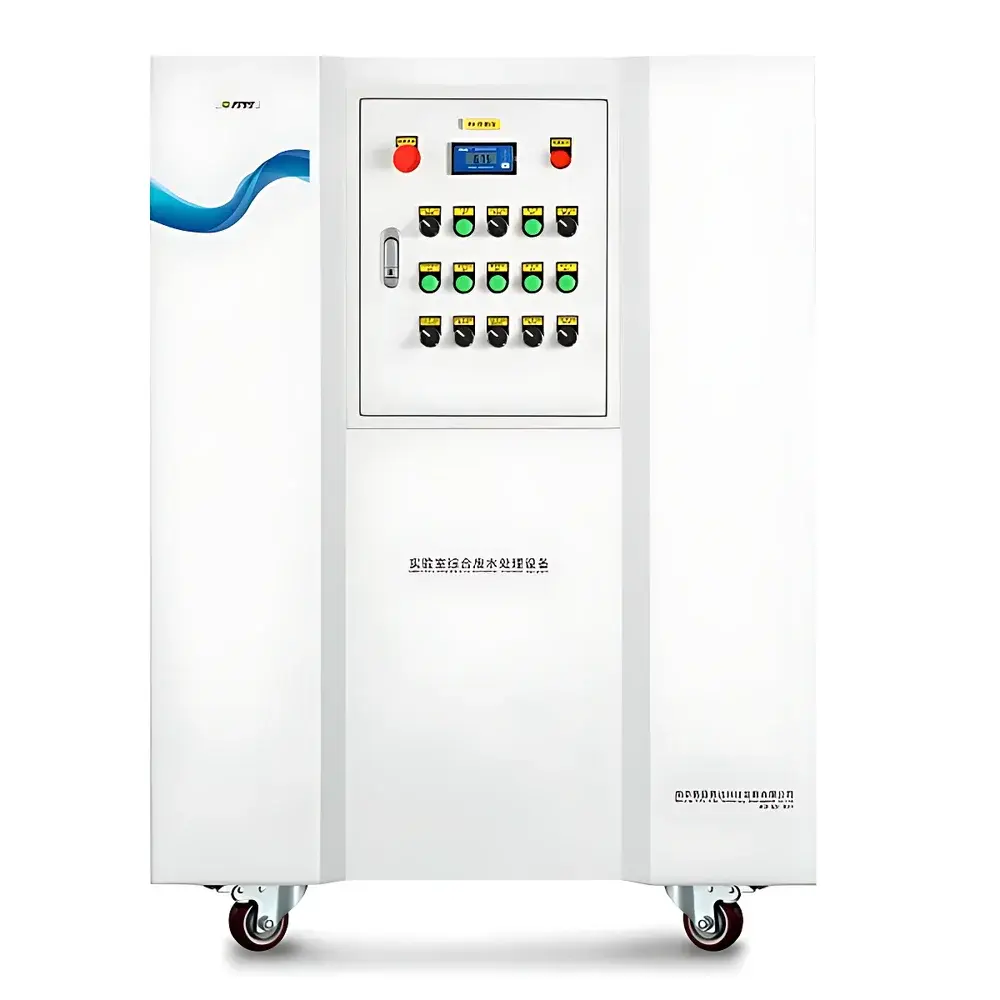
EPED EPED-CL-50 Integrated Laboratory Wastewater Treatment System
| Brand | EPED |
|---|---|
| Origin | Jiangsu, China |
| Model | EPED-CL-50 |
| Capacity | 50 L/day |
| Dimensions (Main Unit) | 960 × 600 × 1300 mm |
| Dimensions (Auxiliary Unit) | 1200 × 600 × 1100 mm |
| Compliance | GB 8978–1996 (Class III), CJ 343–2010 |
| Control System | PLC-based automation with HMI interface |
| Optional | Remote monitoring & data logging via dedicated software |
| Treatment Targets | Heavy metals, organic solvents, cyanides, fluorides, acids/bases, suspended solids (SS), COD/BOD, pathogens, and recalcitrant organics |
| Process Units | pH adjustment, coagulation-flocculation, dissolved air flotation (DAF), sedimentation, solid-liquid separation, heavy metal chelation, activated carbon adsorption, optional micro-electrolysis & photocatalytic oxidation |
| Output Quality | Meets municipal sewer discharge standards or enables reuse after tertiary polishing |
| Certification Context | Designed for GLP-compliant laboratories |
Overview
The EPED EPED-CL-50 Integrated Laboratory Wastewater Treatment System is an engineered solution for the on-site treatment of heterogeneous aqueous effluents generated in research, analytical, and quality control laboratories. Unlike generic industrial wastewater systems, the EPED-CL-50 is purpose-built to address the chemical complexity and low-volume, high-variability nature of laboratory discharges—including intermittent flows, wide pH excursions (pH 1–12), transient spikes in heavy metal concentration (e.g., Cr(VI), Hg²⁺, Cd²⁺, Pb²⁺), cyanide complexes, halogenated organics, phenolics, aldehydes, and biohazardous agents. Its modular process architecture integrates sequential physicochemical unit operations grounded in established environmental engineering principles: acid-base neutralization governed by stoichiometric titration logic, coagulation-flocculation using polyaluminum chloride (PAC) and cationic polymers, dissolved air flotation for lipid and colloidal removal, lamella-type sedimentation for enhanced solid-settling efficiency, chelating resin-based heavy metal capture, and granular activated carbon (GAC) adsorption for residual organics and color abatement. Optional advanced oxidation modules—micro-electrolysis (Fe/C galvanic cells) and UV/TiO₂ photocatalysis—are available for refractory compound degradation (e.g., nitrobenzenes, chlorophenols). All reaction kinetics, retention times, and tank volumes are empirically validated per ASTM D1129 and ISO 11733 methodologies to ensure consistent hydraulic residence time (HRT) ≥ 4 hours across critical treatment stages.
Key Features
- PLC-driven closed-loop control system with real-time pH, ORP, conductivity, and turbidity feedback—enabling dynamic reagent dosing without manual intervention
- Automated multi-stage chemical metering: independent pumps for acid, alkali, coagulant, flocculant, chelating agent, and oxidant solutions, calibrated to ±2% volumetric accuracy
- Integrated safety interlocks: dry-run protection, overflow sensing, low-level tank alarms, thermal cutoffs on pump motors, and emergency stop circuitry compliant with IEC 60204-1
- Corrosion-resistant construction: all wetted parts fabricated from PP-H, PVDF, or 316L stainless steel; non-metallic piping to prevent galvanic corrosion in acidic/oxidizing environments
- Compact footprint (≤1.2 m² total floor area) optimized for retrofit installation in basement utility rooms or dedicated lab mechanical spaces
- Modular scalability: identical control architecture supports seamless upgrade to EPED-CL-100/200 configurations via auxiliary skid integration
Sample Compatibility & Compliance
The EPED-CL-50 treats composite influent streams containing mixed inorganic, organic, and biological contaminants typical of university teaching labs, pharmaceutical QC suites, environmental testing facilities, and clinical diagnostics centers. It accommodates variable feed compositions—including strong mineral acids (HNO₃, H₂SO₄), alkaline cleaners (NaOH, Na₂CO₃), transition metal salts (CuSO₄, NiCl₂), complexed species (e.g., [Au(CN)₂]⁻, [Cr₂O₇]²⁻), halogenated solvents (CHCl₃, CCl₄), aromatic hydrocarbons (benzene, phenol), and pathogen-laden wash waters (BSL-2 compatible when paired with UV disinfection add-on). Effluent consistently meets GB 8978–1996 Class III limits (e.g., COD ≤ 500 mg/L, SS ≤ 400 mg/L, total Cr ≤ 1.5 mg/L, Pb ≤ 1.0 mg/L, CN⁻ ≤ 0.5 mg/L) and CJ 343–2010 requirements for sewer discharge. System documentation supports regulatory alignment with ISO 14001 environmental management systems and facilitates preparation for GLP audits through timestamped, user-annotated operational logs.
Software & Data Management
The embedded HMI provides a 7-inch LCD touchscreen with multilingual UI (English default), configurable alarm thresholds, historical trend graphs (7-day buffer), and password-protected parameter editing. All process events—including pump actuations, sensor readings, dosing cycles, and fault codes—are logged with ISO 8601 timestamps. When equipped with the optional remote monitoring module, data is transmitted via Ethernet or 4G LTE to a secure cloud dashboard accessible via browser or mobile app. This configuration satisfies traceability requirements under FDA 21 CFR Part 11 (electronic records/signatures) when combined with role-based access controls, audit trail activation, and encrypted data-at-rest policies. Export functions support CSV and PDF report generation for internal QA reviews or regulatory submissions.
Applications
This system serves laboratories where centralized municipal pretreatment is unavailable or insufficient—including academic institutions operating chemistry, biology, and materials science departments; contract testing laboratories accredited to ISO/IEC 17025; pharmaceutical R&D sites managing solvent recovery loops; environmental monitoring agencies handling soil leachate and water sample extracts; and public health laboratories processing clinical specimens. It is particularly suited for facilities subject to local discharge ordinances prohibiting direct release of heavy metals or persistent organics into combined sewers. Integration with rainwater harvesting or cooling tower makeup systems enables treated effluent reuse for non-potable applications, reducing freshwater demand by up to 60% in high-throughput labs.
FAQ
What types of laboratories is the EPED-CL-50 specifically designed for?
It targets mid-sized research, teaching, and analytical laboratories generating ≤50 L/day of mixed wastewater—such as university departmental labs, regional environmental testing centers, and pharmaceutical QC units.
Does the system require external chemical storage or dedicated ventilation?
No bulk chemical storage is needed; reagents are supplied in sealed, stackable 20-L HDPE carboys. Ventilation is not required beyond standard lab exhaust, as all reactions occur within sealed, pressure-relieved vessels.
Can the EPED-CL-50 handle radioactive or cytotoxic waste streams?
No—it is not certified for radiological or highly toxic chemotherapeutic agents. Such streams must be segregated and managed under separate licensed protocols.
How often does the system require maintenance or consumable replacement?
Coagulant/flocculant cartridges are replaced every 3–6 months depending on influent load; GAC media requires regeneration or replacement annually; chelating resins last 12–18 months under typical usage conditions.
Is third-party validation data available for performance claims?
Yes—EPED provides test reports from CNAS-accredited laboratories verifying compliance with GB 8978–1996 and CJ 343–2010, including full speciation analysis of influent and effluent matrices across 12-week continuous operation trials.



