
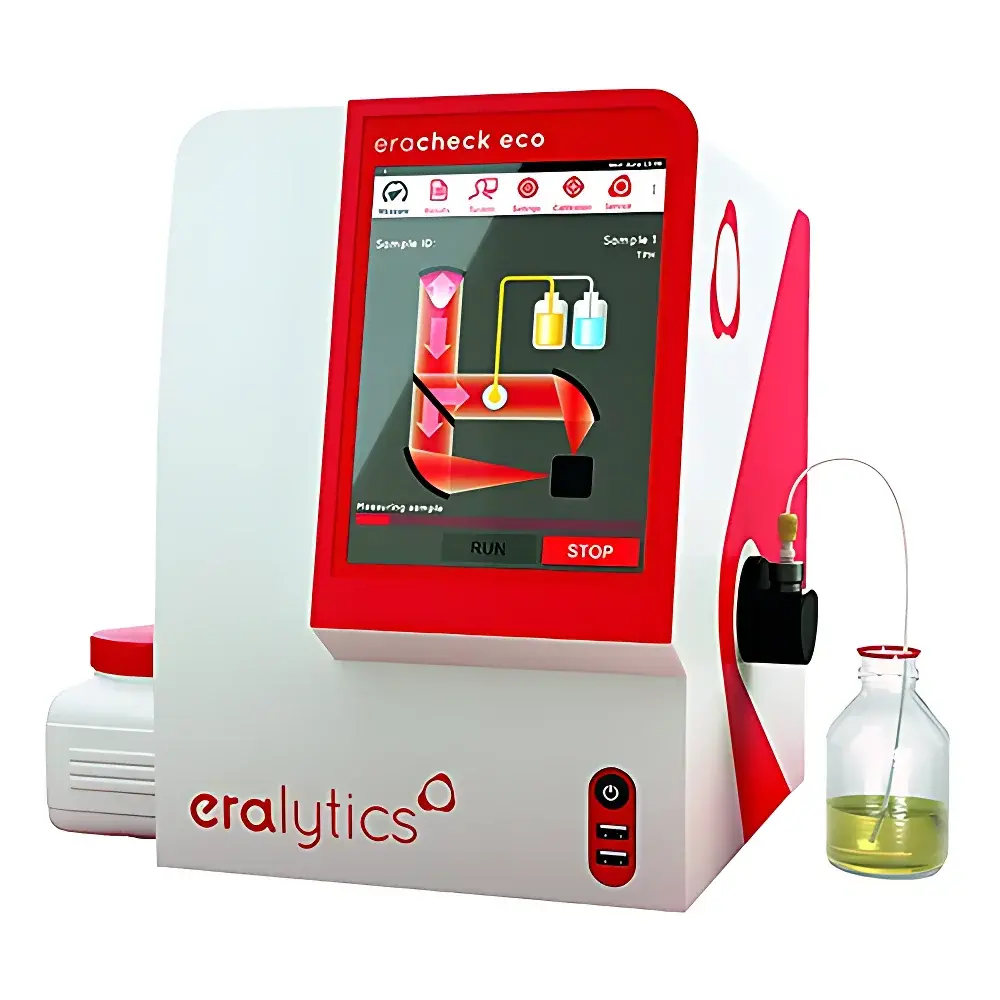
ERACHECK ECO/PRO Total Oil and Grease Analyzer
| Brand | ERALYTICS |
|---|---|
| Origin | Austria |
| Model | ERACHECK ECO/PRO |
| Instrument Type | Portable |
| Measurement Principle | Quantum Cascade Laser Infrared (QCL-IR) Spectrophotometry |
| Measurement Range | Water: 0.1–2000 ppm (PRO), 0.5–1000 ppm (ECO) |
| Soil | 7–72,000 mg/kg (PRO), 18–36,000 mg/kg (ECO) |
| Detection Limit | 0.1 ppm (water), 7 mg/kg (soil) |
| Accuracy | ±0.1% of reading |
| Resolution | 0.01 ppm (water) |
| Repeatability | <0.1 ppm (PRO), <0.5 ppm (ECO) |
| Analysis Time | 2 min (PRO), 5 min (ECO) |
| Extraction Solvent | Cyclohexane |
| Compliance | ASTM D7678, D7066, EPA Method 418.1, DIN 38409-H18, ISO 9377-2, EPA 1664 |
Overview
The ERACHECK ECO/PRO Total Oil and Grease Analyzer is a field-deployable, laboratory-grade instrument engineered for rapid, trace-level quantification of total petroleum hydrocarbons (TPH) and total oil and grease (TOG) in aqueous and solid matrices. It operates on the principle of Quantum Cascade Laser Infrared (QCL-IR) spectroscopy — a highly selective, interference-resistant variant of mid-infrared absorption measurement. Unlike conventional broadband IR systems, QCL-IR employs tunable, narrow-linewidth laser sources centered at key C–H stretching vibrational bands (e.g., ~2920 cm⁻¹ and ~2850 cm⁻¹), enabling discrimination of aliphatic hydrocarbon signatures with minimal matrix-induced spectral overlap. This physical measurement approach eliminates reliance on calibration curves derived from surrogate standards alone, delivering inherently higher specificity for petroleum-derived hydrocarbons versus biogenic or polar organic interferences. Designed for regulatory compliance and operational robustness, the system supports both routine screening and confirmatory analysis in environmental monitoring workflows where speed, safety, and metrological traceability are critical.
Key Features
- QCL-IR optical engine with factory-aligned laser source and thermoelectrically stabilized detector — optimized for long-term signal stability and minimal drift over temperature fluctuations (15–35 °C operating range)
- Integrated cyclohexane-based extraction module compliant with Montreal Protocol requirements — fully replaces ozone-depleting chlorofluorocarbons (CFCs) and hazardous halogenated solvents per EPA 1664 and ISO 9377-2
- Self-contained, portable platform with built-in industrial PC, 8.4-inch color TFT display, and real-time spectral visualization
- Dual-mode operation: direct aqueous analysis (0.1–2000 ppm) and solid-phase extraction for soil/sludge (7–72,000 mg/kg)
- Onboard data integrity safeguards including password-protected user access, audit-trail-enabled measurement logging, and GLP-compliant metadata tagging (operator ID, timestamp, method version, solvent lot)
- Multi-interface connectivity: dual USB ports, RS232 serial, 10/100 Mbps Ethernet, and native LIMS integration via ASTM E1384-compliant messaging protocol
Sample Compatibility & Compliance
The ERACHECK ECO/PRO accommodates diverse sample types including surface water, wastewater effluent, groundwater, sediment pore water, and homogenized soil/sediment composites. Sample preparation follows standardized liquid–liquid extraction (LLE) using cyclohexane (≥99.9% purity), with optional cleanup via Na₂SO₄/silica gel columns to remove polar interferences prior to IR measurement. The methodology meets or exceeds performance criteria outlined in ASTM D7678 (Standard Test Method for Determination of Oil and Grease in Water by Infrared Spectrophotometry), EPA Method 418.1 (for TPH in water), and DIN 38409-H18 (German standard for hydrocarbon determination in water). For soil analysis, it aligns with EPA 1664B and ISO 9377-2, ensuring comparability across international regulatory submissions. All firmware and calibration protocols are documented per ISO/IEC 17025:2017 requirements for testing laboratories.
Software & Data Management
The embedded Windows-based software provides full method development, instrument control, spectral acquisition, and quantitative analysis in a single interface. Each measurement generates a complete digital record containing raw interferograms, processed absorbance spectra, peak integration parameters, and uncertainty estimates based on signal-to-noise ratio and baseline correction algorithms. Data export supports CSV, PDF, and XML formats; audit trails log all user actions (e.g., calibration edits, result overrides) with immutable timestamps. Optional 21 CFR Part 11 compliance package includes electronic signature support, role-based permissions, and encrypted database storage — suitable for GLP and GMP-regulated environments requiring FDA audit readiness.
Applications
- Real-time monitoring of produced water discharge compliance at upstream oil & gas facilities
- Routine TOG verification in municipal and industrial wastewater treatment plants (WWTPs)
- Site characterization and remediation validation for brownfield and refinery-impacted soils
- Regulatory reporting under EU Water Framework Directive (WFD), US Clean Water Act (CWA), and national TPH thresholds
- Field screening during emergency spill response — reducing lab turnaround time from days to minutes
- QA/QC of solvent recovery systems and oily water separator performance
FAQ
Does the ERACHECK ECO/PRO require external calibration standards for daily use?
No — factory-installed reference cells and internal wavelength validation routines enable zero-point and span verification without consumable standards. Certified reference materials (CRMs) are recommended quarterly for traceability to NIST SRM 2781.
Can the system differentiate between diesel-range organics and PAH-rich crude oil fractions?
It quantifies total extractable hydrocarbons within the C₁₀–C₄₀ range but does not speciate individual compounds. For molecular speciation, GC-MS confirmation is advised per EPA 8270D.
Is cyclohexane extraction compatible with high-salinity or surfactant-laden samples?
Yes — the extraction efficiency remains stable up to 35 g/L NaCl and in presence of nonionic surfactants below CMC; emulsion-breaking additives may be introduced pre-extraction if needed.
What is the expected lifetime of the QCL source under continuous field operation?
Rated for ≥20,000 hours of cumulative operation; mean time between failures (MTBF) exceeds 15,000 hours per IEC 61508 reliability modeling.
Does the analyzer support remote diagnostics or firmware updates over network?
Yes — secure SSH-enabled remote access allows OEM-level troubleshooting and over-the-air firmware upgrades with cryptographic signature verification.







