
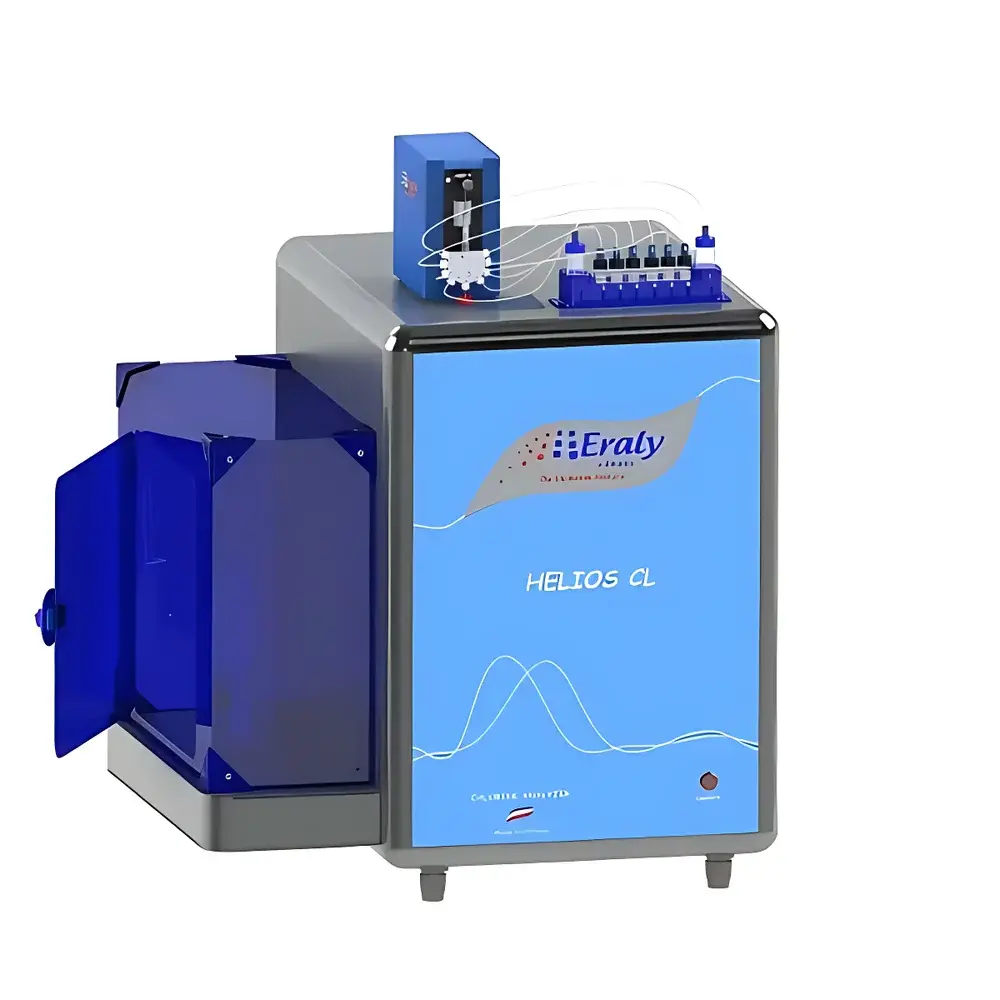
Eraly HELIOS CL Total Chlorine and AOX Analyzer
| Brand | Eraly & Associés |
|---|---|
| Origin | France |
| Manufacturer Type | Authorized Distributor |
| Origin Category | Imported |
| Model | HELIOS CL |
| Price | Upon Request |
| Measurement Principle | Coulometric Titration (Absolute Method) |
| Sample Types | Liquids (including viscous), Gases (incl. LPG), Solids, Slurries, Polymers, Fuels, Environmental Matrices |
| Compliance | ASTM D4929, ASTM D5808, ASTM D5194, ASTM D6721, GB/T 18612, SH/T 1757, GB/T 23971-B, SH/T 0677-A, UOP 779, ISO 9562, NF EN 12260, NF EN 14077 |
| Detection Range | 0.1 ppm to 80 wt% Cl (matrix-dependent, no dilution required) |
| Electrolyte Options | Three grades for low-, medium-, and high-concentration applications |
| Dual-Cell Architecture | Two independent coulometric titration cells |
| Furnace | F2-type high-temperature combustion furnace, max. 1100 °C |
| Carrier Gases | O₂ (99.998%, 3 bar) and Ar (99.995%, 3 bar) |
| Sample Introduction | 20–80 µL liquid |
| Power Supply | 110/230 V, 50/60 Hz, 800 W |
| Dimensions (W×H×D) | 66 × 83 × 56 cm |
| Weight | 32 kg |
| Warranty | 5-year hardware warranty |
| Language Interface | English, French, Spanish, German, Russian, Chinese |
| Safety Features | Automated acid-free dry/wash system, light-shielded semi-pressurized titration cell, integrated gas flow control and pressure monitoring |
Overview
The Eraly HELIOS CL Total Chlorine and Adsorbable Organic Halogens (AOX) Analyzer is a fully automated, high-precision coulometric titration system engineered for absolute quantification of total chlorine—and other halogens (Br, I, F)—in complex and diverse sample matrices. Unlike conventional potentiometric or colorimetric methods, the HELIOS CL implements a fundamental electrochemical principle: controlled pyrolytic combustion followed by coulometric titration of halide ions generated in situ. Samples are introduced into a high-efficiency F2-type furnace operating up to 1100 °C under precisely regulated oxygen/argon atmosphere, ensuring complete oxidative decomposition of organic and inorganic chlorine species into gaseous HCl. The evolved halogen acid is absorbed in an electrolyte solution within a sealed, light-protected, semi-pressurized titration cell, where chloride ions are quantitatively oxidized at a platinum working electrode. The total charge consumed—measured with sub-microcoulomb resolution (down to 0.1 µC)—is directly proportional to the mass of chlorine present, enabling true absolute determination without reliance on calibration curves or reference standards. This traceable, first-principles methodology satisfies metrological requirements for regulatory compliance and laboratory accreditation.
Key Features
- True absolute measurement via coulometric titration—no calibration required; optional verification calibration supported.
- Dual independent titration cell architecture enhances measurement reproducibility, long-term stability, and fault tolerance.
- Automated dry/wash system replaces traditional sulfuric acid absorbers—eliminating operator exposure to concentrated acid and reducing maintenance intervals.
- Three-tier electrolyte formulation strategy enables seamless analysis across an exceptional dynamic range: from sub-ppm (0.1 ppm) to 80 wt% chlorine, without manual dilution or method switching.
- F2 high-temperature furnace with programmable ramp profiles ensures quantitative combustion of refractory matrices including PVC, coal, cement, and heavy tars.
- Integrated gas management module regulates dual carrier gases (O₂ ≥99.998%, Ar ≥99.995%) at stable 3-bar pressure with real-time flow monitoring and leak detection.
- Light-shielded, semi-pressurized titration cells minimize electrolyte evaporation and photolytic side reactions—extending electrolyte service life and improving inter-batch consistency.
- Intuitive multilingual touchscreen interface (English, French, Spanish, German, Russian, Chinese) with context-sensitive help and audit-trail-enabled user authentication.
Sample Compatibility & Compliance
The HELIOS CL is validated for direct analysis of liquids (e.g., crude oil, lubricants, biofuels, solvents, aqueous effluents), gases (including LPG and natural gas condensates), solids (soils, sediments, plastics, paper pulp, coal, biomass), and heterogeneous suspensions. Its robust sample introduction system accommodates viscous oils (up to 500 cSt), particulate-laden slurries, and volatile LPG with minimal preparation. The instrument meets or exceeds performance criteria specified in globally recognized standards: ASTM D4929 (petroleum distillates), ASTM D5808 (AOX in wastewater), ASTM D5194 (chlorine in refinery streams), ASTM D6721 (chlorine in jet fuel), ISO 9562 (AOX in water), NF EN 12260 (AOX in industrial effluents), NF EN 14077 (halogenated organics in waste), UOP 779 (chlorine in hydrocarbons), and multiple Chinese national standards (GB/T 18612, GB/T 23971-B, SH/T 1757, SH/T 0677-A). Data integrity is maintained in accordance with GLP and GMP principles, supporting 21 CFR Part 11-compliant electronic records when paired with validated software configurations.
Software & Data Management
The embedded HELIOS Control Suite provides full method development, sequence programming, real-time electrochemical signal visualization, and automated report generation. All analytical events—including furnace temperature profiles, gas flow logs, titration current integrals, cell status, and user actions—are timestamped and stored with immutable audit trails. Raw coulometric data (Q = ∫I·dt) is retained alongside processed results, enabling retrospective re-evaluation and uncertainty budgeting per ISO/IEC 17025. Export formats include CSV, PDF, and XML for LIMS integration. Software updates are delivered via secure HTTPS channel with version-controlled firmware signing. Optional network-enabled remote diagnostics allow certified service engineers to perform preventive maintenance assessments without onsite visits.
Applications
The HELIOS CL serves as a primary measurement tool across petroleum refining (chlorine speciation in feedstocks and products), environmental monitoring (AOX/EOX/POX in wastewater, leachates, and soil extracts), polymer manufacturing (residual catalyst chlorine in PVC and fluoropolymers), pharmaceutical excipient testing (halogen impurities per ICH Q3D), cement and construction materials (chloride-induced corrosion risk assessment), and academic research in halogen cycling geochemistry. Its ability to quantify chlorine in challenging matrices—such as chlorinated palm oil, bituminous coal, and spent catalysts—without matrix-matched standards makes it indispensable for laboratories requiring method ruggedness and regulatory defensibility.
FAQ
Does the HELIOS CL require daily calibration?
No. As an absolute coulometric method, it does not rely on calibration standards. Routine system suitability checks using certified reference materials (e.g., chlorobenzene) are recommended per ISO/IEC 17025 but are not mandatory for each analysis.
Can the same instrument measure AOX, EOX, and POX?
Yes. When coupled with standardized adsorption (e.g., activated carbon per ISO 9562) and pyrolysis protocols, the HELIOS CL quantifies adsorbable (AOX), extractable (EOX), and purgeable (POX) organic halogens using identical coulometric detection.
What maintenance is required for the dry/wash system?
The automated dry/wash system operates without consumable reagents; only periodic inspection of the desiccant cartridge and condensate trap is needed every 3–6 months depending on usage intensity.
Is the 5-year hardware warranty transferable?
Yes—the warranty is tied to the instrument serial number and remains valid upon documented change of ownership, provided annual preventive maintenance is performed by Eraly-certified personnel.
How is data integrity ensured during power interruption?
The system features uninterruptible power buffering (≥15 sec hold-up time) and automatic recovery mode that resumes analysis from the last stable measurement point without data loss.
Related Products



