
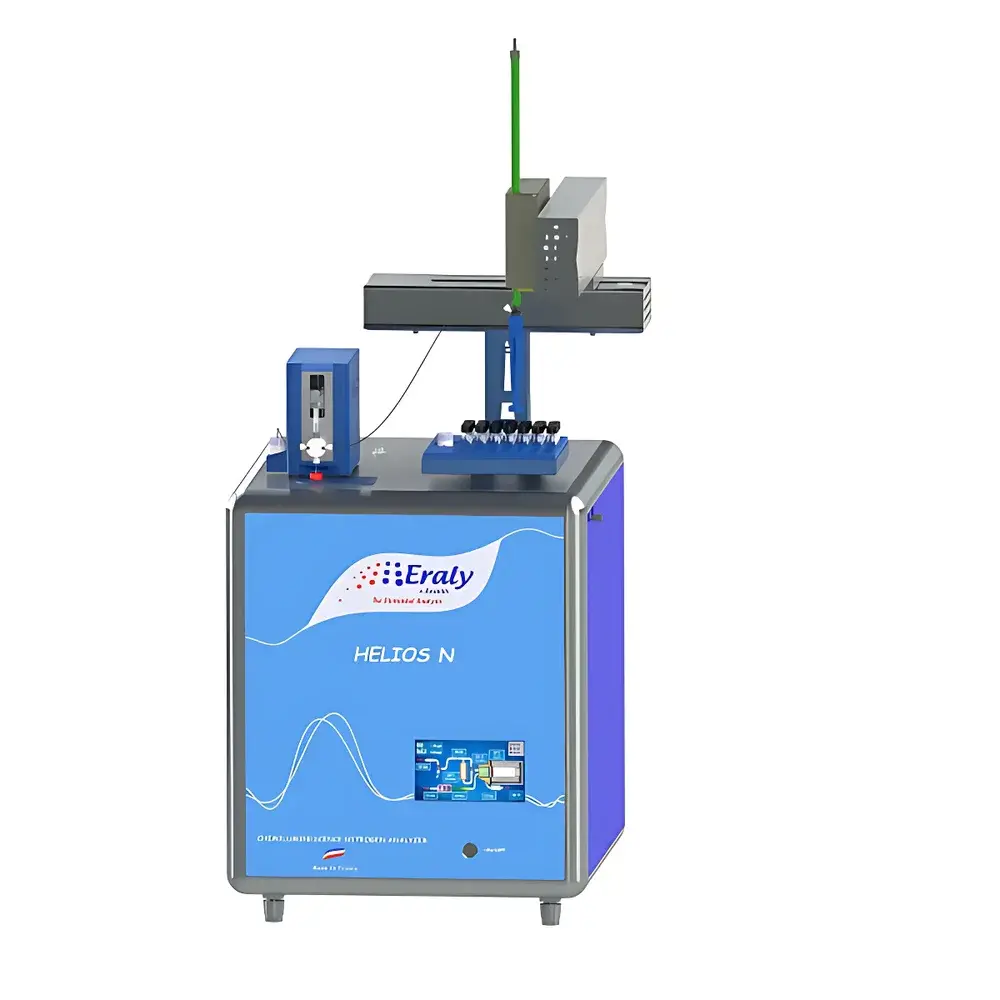
Eraly HELIOS N Total Nitrogen Analyzer
| Brand | Eraly & Associés |
|---|---|
| Origin | France |
| Model | HELIOS N |
| Measurement Element | Nitrogen |
| Measurement Principle | Chemiluminescence Detection |
| Detection Limit | 5 ppb |
| Quantitation Range | 10 ppb – 10 % |
| Furnace Temperature Range | Up to 1100 °C |
| Temperature Control Accuracy | ±1 °C |
| Sample Volume | 20–80 µL (liquid), 10 mL (gas), 20 µL (LPG) |
| Carrier Gases | O₂ (99.998%, 3 bar), Ar (99.995%, 3 bar) |
| Power Supply | 110/230 V, 50/60 Hz, 800 W |
| Dimensions (W×H×D) | 51 × 78 × 56 cm |
| Weight | 32 kg |
Overview
The Eraly HELIOS N Total Nitrogen Analyzer is a high-performance, laboratory-grade elemental analyzer engineered for trace- and macro-level nitrogen quantification in diverse hydrocarbon and non-hydrocarbon matrices. It operates on the well-established chemiluminescence detection principle: nitrogen-containing compounds are combusted at high temperature (up to 1100 °C) in an oxygen-rich environment to form nitric oxide (NO); the NO is then reacted with ozone (O₃) in a dedicated reaction chamber, generating excited-state nitrogen dioxide (NO₂*), which emits photons upon relaxation. This photon emission is detected by a highly stable photomultiplier tube (PMT), enabling linear, wide-dynamic-range quantification from 5 ppb to 10 wt%. Designed specifically for refinery laboratories, independent contract testing facilities, and QC/QA departments, the HELIOS N delivers metrological rigor, operational robustness, and compliance-ready data integrity — all within a single compact benchtop platform.
Key Features
- High-temperature combustion furnace (F2 type) with precise ±1 °C thermal regulation up to 1100 °C, ensuring complete oxidation of refractory nitrogen species including pyrrolic, indolic, and quinoline derivatives.
- Integrated chemiluminescence detector featuring a low-noise, high-gain photomultiplier tube (PMT) with real-time signal monitoring — visualized via 7-inch capacitive touchscreen interface showing PMT voltage, UV lamp intensity, and chamber pressure trends.
- Auto-ranging capability: no manual method selection or range switching required; the system dynamically optimizes gain, integration time, and gas flow rates based on sample response.
- Matrix-independent calibration transfer: correction coefficients derived from one certified reference material (e.g., mineral oil standard) can be applied across heterogeneous sample types — from gasoline and biodiesel to wastewater and solid catalysts — without revalidation.
- Active compensation system for detector stability: real-time adjustment for fluctuations in reaction chamber pressure, sample injection pressure, and internal detector temperature, minimizing baseline drift and improving reproducibility.
- Five-year hardware warranty — among the longest in the elemental analysis instrumentation sector — reflecting Eraly’s confidence in component longevity and thermal/mechanical design integrity.
Sample Compatibility & Compliance
The HELIOS N accommodates liquid (20–80 µL), gaseous (10 mL), and liquefied petroleum gas (LPG, 20 µL) samples without hardware modification. Solid samples require pre-digestion or slurry introduction via optional accessories. Its performance meets or exceeds internationally recognized standards including ASTM D4629 (determination of trace nitrogen in aromatic hydrocarbons), ASTM D5762 (nitrogen in petroleum liquids by Kjeldahl-modified chemiluminescence), ASTM D6069 (jet fuel), ASTM D5176 (diesel), NF EN 12260 (petroleum products), SH/T 0657 (Chinese standard for nitrogen in oil), and GB/T 17674 (crude oil). The system architecture supports GLP/GMP-aligned workflows, with audit-trail-capable software (see below) compliant with FDA 21 CFR Part 11 requirements for electronic records and signatures.
Software & Data Management
Control and data acquisition are managed through Eraly’s proprietary HELIOS Suite — a Windows-based application offering intuitive method setup, real-time chromatogram visualization, peak integration with customizable baselines, and automated calibration curve generation (linear, quadratic, or weighted). All raw signals, processing parameters, user actions, and instrument status logs are timestamped and stored in encrypted binary archives. Audit trails record operator ID, method version, calibration history, and result modifications — fully traceable for regulatory inspections. Export options include CSV, PDF reports (with embedded metadata), and direct LIMS integration via ASTM E1394-compliant ASCII output.
Applications
- Refinery process control: monitoring nitrogen content in feedstocks, naphtha, kerosene, and hydrotreated diesel to optimize catalyst life and prevent downstream poisoning.
- Fuel certification: verification of ultra-low nitrogen specifications (<10 ppm) in aviation turbine fuel (Jet A-1), marine distillate fuels, and renewable diesel per ISO 8217 and ASTM D975.
- Biofuel quality assurance: quantification of protein-derived nitrogen in FAME, HVO, and ethanol blends where nitrogen contributes to NOx emissions and engine deposit formation.
- Environmental analysis: determination of total Kjeldahl nitrogen (TKN)-equivalent values in wastewater, soil extracts, and industrial effluents — validated against EPA Method 351.2 principles.
- R&D laboratories: kinetic studies of denitrogenation reactions, catalyst screening under simulated hydrotreating conditions, and speciation support when coupled with GC or LC separation modules.
FAQ
What carrier gases are required, and what purity levels are mandatory?
High-purity oxygen (≥99.998 %) and argon (≥99.995 %) are required at regulated inlet pressures of 3 bar. Impurities such as moisture, hydrocarbons, or nitrogen oxides must be minimized to avoid background interference and PMT contamination.
Does the HELIOS N require daily recalibration?
No — the system employs a dual-standard calibration protocol with built-in drift correction. Routine verification using a mid-level check standard every 8–12 hours is sufficient for routine QC; full multi-point calibration is recommended weekly or after maintenance.
Can the instrument analyze solid samples directly?
Not natively. Solids must be homogenized and introduced as slurries (e.g., in xylene or chloroform) using the optional solid-sample introduction kit. Alternatively, microwave-assisted acid digestion followed by aqueous injection is supported for inorganic matrices.
Is method validation documentation provided?
Yes — Eraly supplies a comprehensive IQ/OQ/PQ protocol package, including test scripts, acceptance criteria, and blank/precision/recovery data templates aligned with ISO/IEC 17025 and USP <1058> guidelines.
How is data security ensured during remote operation?
All network communication uses TLS 1.2 encryption; local database access requires role-based authentication; and electronic signatures comply with 21 CFR Part 11 Subpart B requirements for closed systems.
Related Products






