
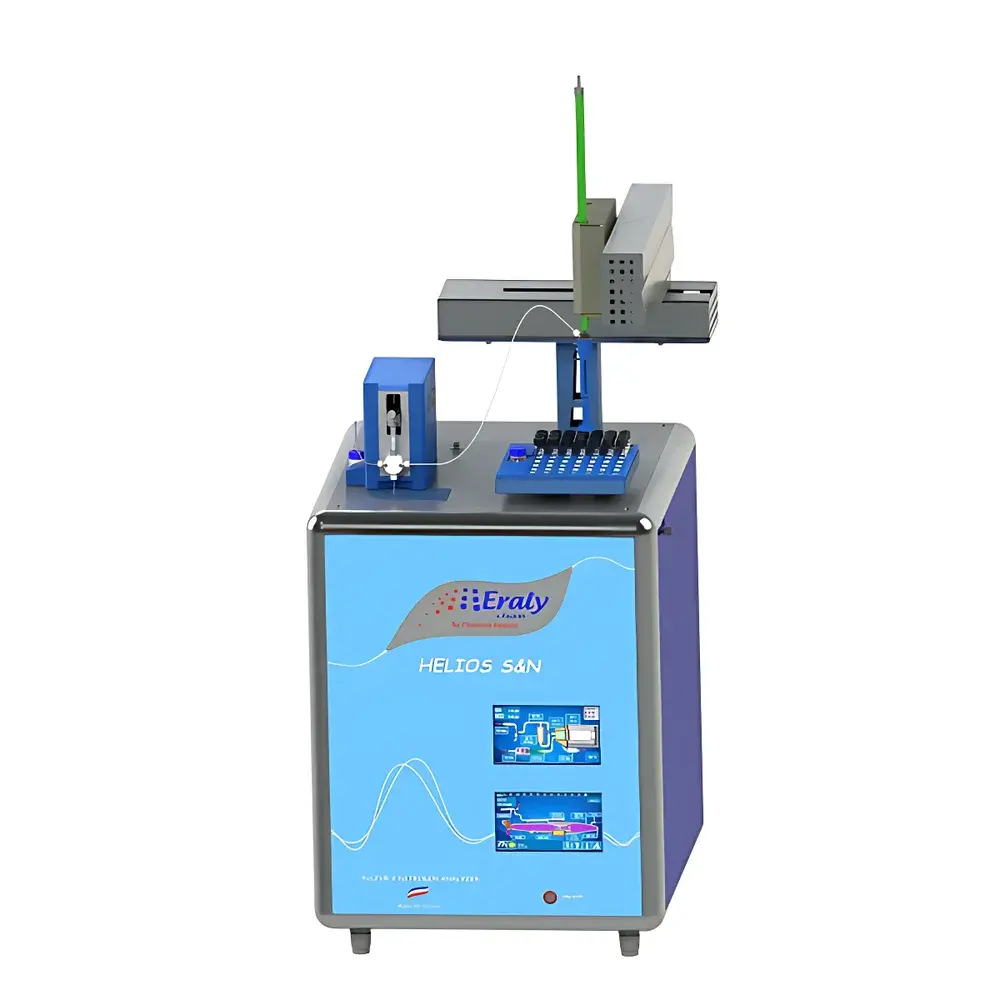
Eraly HELIOS S&N Total Sulfur and Nitrogen Analyzer
| Brand | Eraly & Associés |
|---|---|
| Origin | France |
| Manufacturer Type | Authorized Distributor |
| Origin Category | Imported |
| Model | HELIOS S&N |
| Measurement Elements | Sulfur (S), Nitrogen (N) |
| Measurement Principle | UV Fluorescence (S) / Chemiluminescence (N) |
| Detection Limit | 5 ppb (S), 5 ppb–10% (N) |
| Quantitation Range | 10 ppb–10% (S & N) |
| Furnace Temperature Range | Up to 1100 °C |
| Temperature Control Accuracy | ±1 °C |
| Sample Volume | 20–80 µL (liquid), 10 mL (gas), 20 µL (LPG) |
| Carrier Gases | O₂ (99.998%, 3 bar), Ar (99.995%, 3 bar) |
| Display | 7-inch touchscreen interface |
| Languages | English, French, Spanish, German, Russian, Chinese |
| Compliance | ASTM D5453, D6667, D7183, D7551, D4629, D6069, D5762 |
Overview
The Eraly HELIOS S&N Total Sulfur and Nitrogen Analyzer is a dual-detection, high-sensitivity elemental analyzer engineered for precise quantification of sulfur and nitrogen in complex hydrocarbon matrices. It operates on two orthogonal detection principles: ultraviolet fluorescence (UVF) for sulfur determination and chemiluminescence (CLD) for nitrogen—both implemented in a single, integrated combustion system. Samples are introduced into a high-temperature quartz combustion furnace (up to 1100 °C), where complete oxidative pyrolysis converts all organically bound sulfur and nitrogen species into SO₂ and NO, respectively. The resulting gaseous effluent is swept through proprietary gas conditioning modules—including moisture removal, CO₂ scrubbing, and pressure stabilization—before entering the respective detectors. This architecture ensures stoichiometric conversion across diverse sample types while minimizing interferences from carbonaceous matrix effects or heteroatom cross-talk. Designed for regulatory-compliant operation in refinery laboratories, independent testing facilities, and QC/QA departments, the HELIOS S&N delivers trace-level accuracy without method reconfiguration, supporting seamless transition between ultra-low (ppb) and high-concentration (up to 10 wt%) measurements.
Key Features
- Dual-channel detection architecture with independent UVF (S) and CLD (N) optical paths—no performance trade-off between sulfur and nitrogen analysis
- High-stability combustion furnace with active temperature control (±1 °C) across 100–1100 °C range, enabling reproducible oxidation of refractory compounds including thiophenes and pyridinic nitrogen
- Real-time diagnostic dashboard on 7-inch capacitive touchscreen: monitors UV lamp intensity, PMT gain stability, reaction chamber pressure, internal thermal gradients, and filter saturation status
- Auto-ranging quantification: instrument dynamically selects optimal detector gain, integration time, and baseline correction without user intervention
- Matrix-independent calibration transfer: built-in algorithm applies correction factors derived from reference standards to accommodate varying base oil viscosities, oxygenates, or halogenated solvents
- Integrated pressure-compensated nitrogen detector: measures sample gas pressure, compensation chamber pressure, and internal detector temperature to correct for flow-induced signal drift
- Multi-language firmware (English, French, Spanish, German, Russian, Chinese) with context-sensitive help and animated operational guidance
Sample Compatibility & Compliance
The HELIOS S&N accommodates liquid, gaseous, and solid samples without hardware modification. Validated matrices include gasoline, diesel, jet fuel, biofuels (FAME, HVO), lubricants, crude fractions, aqueous extracts, LPG blends, natural gas condensates, and solid catalysts (via oxygen flask combustion). All measurement protocols conform to internationally recognized standards: ASTM D5453/D6667/D7183/D7551 (S); ASTM D4629/D6069/D5762 (N); ISO 20846; SH/T 0689 and 0657; and NF EN 12260. The system supports full audit trail functionality compliant with GLP and 21 CFR Part 11 requirements when paired with optional secure software licensing. Calibration verification, system suitability testing, and blank monitoring routines are embedded in the workflow to satisfy ISO/IEC 17025 accreditation criteria.
Software & Data Management
The embedded operating system features a deterministic real-time kernel with deterministic data acquisition at 100 Hz sampling rate per detector channel. Raw signals undergo digital filtering (Butterworth 4th-order low-pass), peak deconvolution, and integrated area calculation using adaptive baseline subtraction. All chromatographic and non-chromatographic results are stored in an encrypted SQLite database with immutable timestamps, operator ID, method version, and environmental metadata (furnace temp, gas pressures, lamp hours). Export formats include CSV, XML (ASTM E1382-compliant), and PDF analytical reports with embedded calibration curves and QC charts. Optional network connectivity enables remote monitoring via HTTPS-based REST API and integration with LIMS platforms using ASTM E1482 or HL7 v2.x messaging.
Applications
- Refinery process stream monitoring: real-time sulfur speciation tracking in hydrotreater feed/effluent and FCC gasoline cuts
- Fuel certification: verification of ultra-low-sulfur diesel (ULSD, ≤10 ppm) and marine distillate compliance (IMO 2020)
- Biofuel quality assurance: quantification of residual nitrogen in hydrotreated vegetable oils (HVO) and sulfur in ethanol-blended gasoline
- Lubricant additive R&D: nitrogen content profiling in amine- and imidazole-based anti-wear additives
- Environmental testing labs: sulfur/nitrogen speciation in wastewater extracts and soil leachates following EPA Method 1664B derivatization
- Research applications: kinetic studies of denitrogenation pathways under controlled oxidative conditions
FAQ
What combustion gases are required, and what purity specifications must they meet?
Oxygen (≥99.998% purity, dew point ≤ –70 °C) and argon (≥99.995% purity, hydrocarbon-free) are required at regulated delivery pressure of 3 bar. Gas lines must include particulate filters (0.1 µm), moisture traps, and pressure regulators with dual-stage isolation.
Can the instrument analyze solid samples directly?
Solid samples require pre-treatment via oxygen flask combustion or high-temperature quartz boat insertion. Certified methods for coal, coke, and catalysts are available under ASTM D3176 and ISO 10723 protocols.
Is method validation support provided for regulatory submissions?
Yes—Eraly provides IQ/OQ documentation packages, system suitability test templates, and uncertainty budgeting worksheets aligned with EURACHEM/CITAC Guide CG4 and ISO/IEC 17025:2017 Annex A.3.
How is detector drift compensated during extended unattended operation?
Both detectors perform automatic zero-point correction every 15 minutes using purified carrier gas, and lamp intensity is continuously monitored with closed-loop feedback to maintain photometric linearity over 10,000-hour UV lamp lifetime.
What maintenance intervals are recommended for routine operation?
Quartz combustion tube replacement every 6 months (or after 1,500 injections), desiccant cartridge exchange every 3 months, and PMT voltage recalibration annually—automatically logged and scheduled within the instrument’s preventive maintenance module.





