
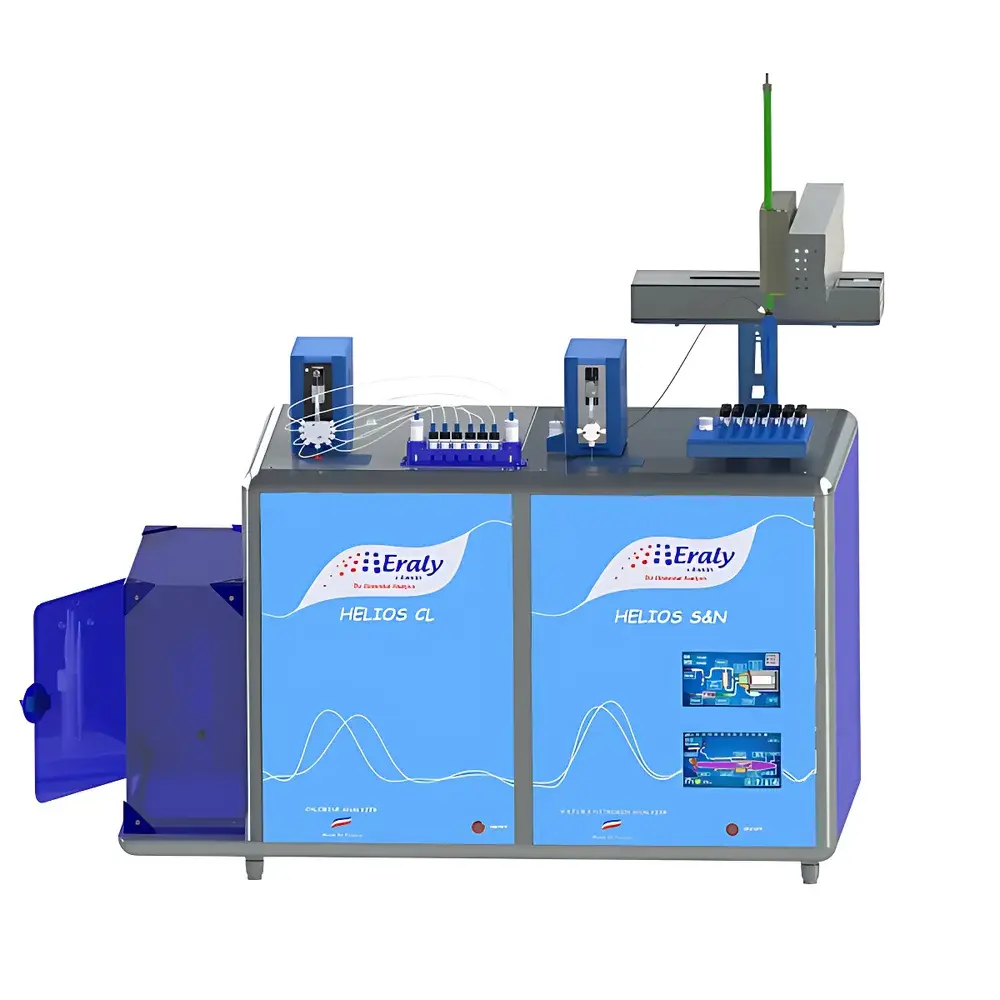
Eraly HELIOS SN&CL Total Sulfur, Nitrogen and Chlorine Elemental Analyzer
| Brand | Eraly & Associés |
|---|---|
| Origin | France |
| Model | HELIOS SN&CL |
| Measurement Elements | Sulfur (S), Nitrogen (N), Chlorine (Cl) |
| Measurement Principles | UV Fluorescence (S), Chemiluminescence (N), Coulometric Titration (Cl) |
| Detection Limits | 5 ppb (S), 5 ppb–10% (N), 50 ppb–80+% (Cl) |
| Quantitation Ranges | 10 ppb–100 ppm (S), 10 ppb N–10% (N), <0.1 ppm–80+% (Cl) |
| Combustion Furnace Temperature | Up to 1100 °C |
| Temperature Control Accuracy | ±1 °C |
| Sample Volume | 20–80 µL (liquid), 10 mL (gas), 20 µL (LPG) |
| Carrier Gases | O₂ (99.998%, 3 bar), Ar (99.995%, 3 bar) |
| Built-in Languages | English, French, Spanish, German, Russian, Chinese |
Overview
The Eraly HELIOS SN&CL is a high-performance, multi-element combustion analyzer engineered for the simultaneous, automated quantification of total sulfur, nitrogen, and chlorine in petroleum-based liquid, gaseous, and liquefied petroleum gas (LPG) samples. It employs three orthogonal detection technologies within a single integrated platform: ultraviolet fluorescence (UVF) for sulfur, chemiluminescence (CLD) for nitrogen, and coulometric titration for chlorine—each operating under optimized, independent combustion conditions. The system features two physically separated quartz combustion tubes: one dedicated to sulfur/nitrogen oxidation at 1100 °C, and another exclusively for chlorine analysis using low-temperature pyrolysis and electrochemical detection. This dual-furnace architecture eliminates cross-contamination between analytes, eliminates the need for post-run tube purging or reconditioning cycles, and ensures measurement integrity across ultra-trace (ppb-level) to high-percentage (up to 80 wt%) concentration ranges. Designed for routine compliance testing in refinery QC labs, independent testing laboratories, and regulatory reference facilities, the HELIOS SN&CL delivers traceable, reproducible results aligned with globally recognized standard methods.
Key Features
- Dual independent combustion zones: One high-temperature (up to 1100 °C) quartz tube for S/N oxidation; one dedicated low-temperature zone for Cl-specific pyrolysis and coulometric detection—eliminating inter-analyte carryover and enabling true concurrent S+N+Cl analysis.
- Auto-ranging detection: No manual method selection or range switching required; the instrument dynamically configures detector gain, integration time, and gas flow based on real-time signal amplitude.
- True absolute coulometric quantification for chlorine: Eliminates calibration dependency for Cl by directly measuring charge consumption during electrolytic titration—no reference standards or drift correction needed.
- Integrated pre-combustion gas conditioning: Oxygen and argon supply lines include pressure regulation, filtration, and flow stabilization; furnace heating occurs under inert atmosphere prior to ignition—ensuring consistent oxidative conditions and eliminating flame instability during cold-start sequences.
- Self-diagnostic service architecture: Real-time monitoring of detector baseline stability, combustion gas pressure differentials, furnace thermocouple response, and electrolyte saturation status enables predictive maintenance alerts and early fault isolation.
- Automated post-analysis purge and dry cycle: Replaces traditional sulfuric acid scrubbers with a dry-gas purge sequence—removing residual moisture and acidic condensates without operator intervention or hazardous chemical handling.
Sample Compatibility & Compliance
The HELIOS SN&CL supports direct injection of liquid hydrocarbons (e.g., gasoline, diesel, jet fuel, lubricants), compressed gases (e.g., natural gas, refinery off-gas), and LPG matrices. Sample introduction is compatible with standard liquid autosamplers (20–80 µL), gas-tight syringes (10 mL), or pressurized LPG loops (20 µL). All measurement protocols comply with major international regulatory and industry standards, including ASTM D5453, D6667, D7183, D7551 (S); ASTM D4629, D7184, D5762 (N); and ASTM D4929, D5808, D5194, D6721, UOP 779 (Cl). It also meets ISO 20846, ISO 9562, EN 12260, EN 1407, SH/T 0689, SH/T 0657, GB/T 17674, GB/T 18612, and GB/T 23971-B. System validation supports GLP and GMP environments, with full audit trail capability for instrument parameters, calibration events, and user actions—fully compliant with FDA 21 CFR Part 11 requirements when configured with optional electronic signature modules.
Software & Data Management
The embedded firmware provides a multilingual (English, French, Spanish, German, Russian, Chinese) graphical interface with intuitive workflow navigation and context-sensitive help. All acquisition, processing, and reporting functions are managed via the Eraly Analytical Suite v4.x software suite, which includes peak integration algorithms optimized for transient CLD and UVF signals, automatic baseline correction, and dynamic retention time alignment. Data files are stored in vendor-neutral .csv and .xml formats with embedded metadata (sample ID, operator, date/time, method version, instrument serial number). Audit trails record all parameter changes, calibration updates, and report generation events with timestamped user attribution. Optional network connectivity enables remote diagnostics, centralized data archiving via LIMS integration (ASTM E1467, ASTM E1578), and scheduled backup to secure NAS or cloud repositories.
Applications
The HELIOS SN&CL serves as a primary analytical tool for sulfur, nitrogen, and chlorine speciation in upstream, midstream, and downstream petroleum operations. Typical use cases include monitoring ultra-low-sulfur diesel (ULSD) compliance (<10 ppm S), evaluating nitrogen-induced catalyst poisoning in hydrotreating units, verifying chlorine content in feedstocks to prevent corrosion in FCC and hydrocracker reactors, and certifying marine fuels against IMO 2020 sulfur cap regulations. It is also deployed in petrochemical QA/QC for naphtha, BTX streams, and polymer-grade monomers where trace heteroatoms impact downstream polymerization kinetics and product color stability. In research settings, it supports kinetic studies of heteroatom removal mechanisms and validation of novel desulfurization/denitrogenation catalysts.
FAQ
Does the HELIOS SN&CL require separate calibrations for sulfur, nitrogen, and chlorine?
No. Sulfur and nitrogen are calibrated using certified liquid standards traceable to NIST SRM 2724c and SRM 2725c; chlorine uses certified gas-phase standards or solid NaCl reference materials. However, coulometric Cl quantification is absolute and does not rely on calibration curves.
Can the instrument analyze solid or viscous samples?
Not directly. Solids must be dissolved in suitable solvents (e.g., xylene, chloroform) prior to injection; highly viscous fuels (e.g., bunker C) require pre-heating and dilution to ensure homogeneous aspiration and complete combustion.
What maintenance intervals are recommended for routine operation?
Quartz combustion tubes should be inspected every 200 injections; detector windows cleaned weekly; electrolyte replenished monthly for high-throughput Cl analysis; and gas filters replaced quarterly. Full system performance verification is recommended every six months per ASTM D7039.
Is method transfer supported from legacy Eraly instruments?
Yes. Method files from previous Eraly models (e.g., ANTEO, AURORA) can be imported and automatically converted to HELIOS-compatible syntax, preserving integration parameters, calibration coefficients, and report templates.
How is instrument qualification documented for regulated environments?
The system includes IQ/OQ/PQ protocol templates compliant with ASTM D7039 Annex A1, along with electronic records of as-delivered verification, installation checks, operational range testing, and precision/recovery studies—all exportable in PDF/A-1b format for regulatory submission.




