
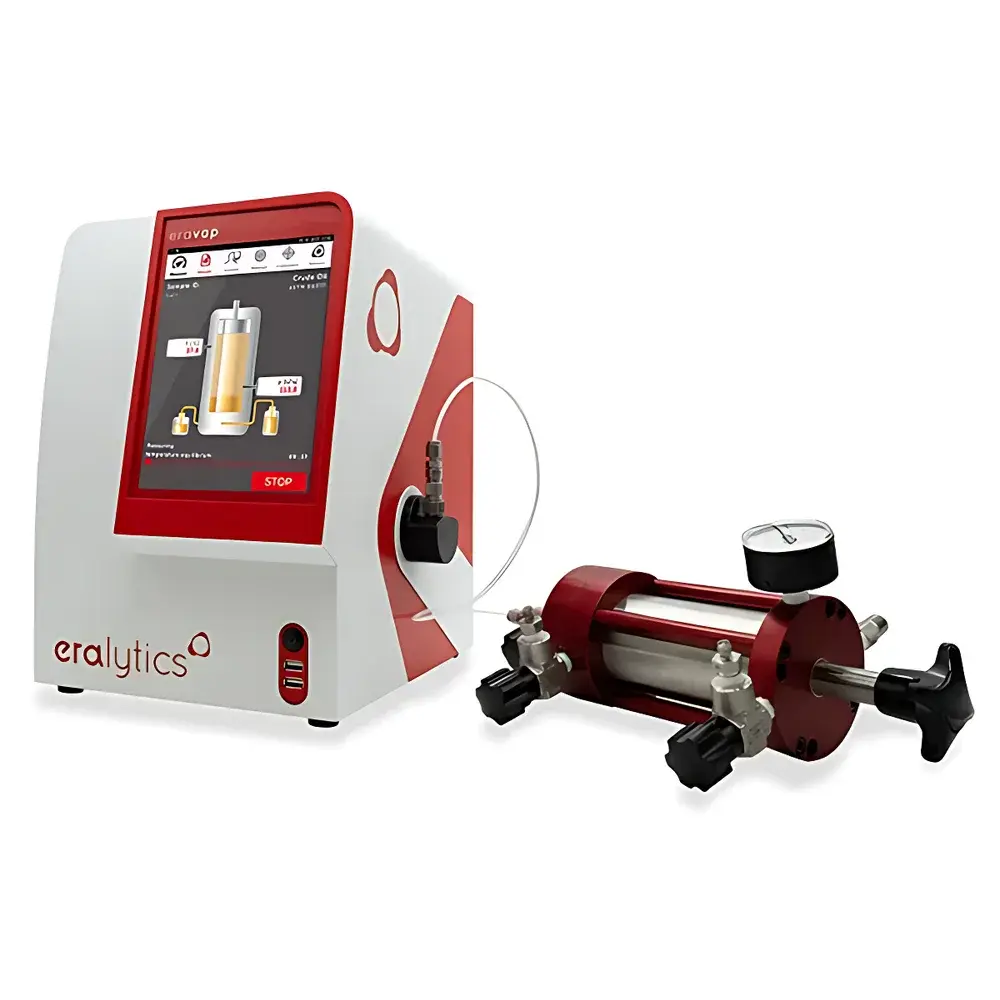
ERALYTICS CRUDE Microscale Crude Oil Vapor Pressure Analyzer
| Brand | ERALYTICS |
|---|---|
| Origin | Austria |
| Model | CRUDE |
| Analysis Method | Three-Stage Expansion Method |
| Pressure Range | 0–2000 kPa |
| Temperature Range | −20 to 120 °C |
| Compliance | ASTM D6377, D6378, D5191, D5188, D6897, GB/T 11059, SH/T 0769, SH/T 0794, SN/T 2932, EN 13016 |
| Sample Handling | Heated high-viscosity module, integrated oscillator, pure-sampling valve, automatic liquid/gas purge |
Overview
The ERALYTICS CRUDE Microscale Crude Oil Vapor Pressure Analyzer is a fully automated, benchtop instrument engineered for precise determination of true vapor pressure (TVP), Reid vapor pressure (RVP)-equivalent values, and bubble point pressure of crude oils and unstable petroleum liquids. It operates on the internationally validated three-stage expansion method—defined in ASTM D6377 and ISO 13702—where a known volume of sample is expanded stepwise into evacuated chambers under controlled temperature, enabling thermodynamic equilibrium assessment without phase separation artifacts. Unlike traditional piston-based or mini-method RVP testers, the CRUDE system maintains full thermal management across the entire fluid path—including syringe, transfer lines, and expansion chamber—to prevent wax precipitation, asphaltene flocculation, or light-end loss during analysis. Its design specifically addresses the compositional volatility heterogeneity and high viscosity typical of unrefined crudes, making it the reference instrument endorsed by the Canadian Crude Quality Technical Association (CCQTA) for custody transfer, pipeline specification compliance, and refinery feedstock characterization.
Key Features
- Integrated heated high-viscosity module: Maintains uniform temperature (−20 to 120 °C) across syringe, tubing, and discharge path to ensure representative sampling of waxy, heavy, or sour crudes.
- Three-stage expansion architecture: Enables accurate TVP calculation per ASTM D6377 Annex A1 and supports extended low-volatility range measurement down to sub-kPa partial pressures.
- Pure Sampling Valve (PSV) technology: A proprietary isolation valve system minimizing carryover between runs; validated for ≤0.05% residual contamination in sequential high-sulfur crude analyses.
- Onboard mechanical oscillator: Applies controlled agitation during equilibration to accelerate vapor–liquid mass transfer—critical for viscous or emulsified crudes where static settling yields non-representative headspace composition.
- Automated liquid and vapor purge cycle: Eliminates manual solvent rinsing; gas-phase purge uses inert nitrogen or argon, while liquid-phase flush employs calibrated micro-volume displacement.
- Full touchscreen HMI with multilingual UI (English default): Supports audit-trail-enabled operation compliant with GLP and 21 CFR Part 11 when paired with optional software licensing.
- Compact monolithic chassis: Dimensions of 320 × 380 × 290 mm enable deployment in mobile labs, offshore containerized units, or constrained refinery QC spaces.
Sample Compatibility & Compliance
The CRUDE analyzer accommodates undiluted crude oils ranging from light condensates (API > 50°) to heavy bitumens (API < 10°), including emulsified, foaming, or hydrogen-sulfide–rich streams. It meets regulatory and contractual testing requirements specified in ASTM D6377 (standard test method for vapor pressure of crude oil), ASTM D6378 (for volatile crude oils), ASTM D5191 (mini-method RVP), and Chinese national standards GB/T 11059 and SH/T 0769. All firmware and calibration protocols are traceable to NIST-certified pressure transducers and PT100 temperature sensors. The system supports full compliance documentation packages—including IQ/OQ protocols, uncertainty budgets per GUM (JCGM 100), and raw data export in .csv and .xlsx formats—for internal validation and external regulatory audits (e.g., API RP 2553, ISO/IEC 17025 accredited labs).
Software & Data Management
ERALYTICS’ VAPORLINK™ v4.2 software provides real-time visualization of expansion curves, pressure decay profiles, and temperature-stabilization diagnostics. Each analysis generates a timestamped report containing measured TVP, calculated RVP-equivalent, bubble point, and statistical confidence intervals derived from triplicate expansion cycles. Data integrity safeguards include electronic signatures, role-based access control, and immutable audit trails recording user actions, parameter changes, and calibration events. Optional 21 CFR Part 11 Module enables full electronic record compliance—including biometric login, digital certificate signing, and secure long-term archiving—with encrypted database storage and configurable retention policies. Export options support LIMS integration via ASTM E1394-compliant ASCII output or direct OPC UA server connectivity.
Applications
- Custody transfer verification at wellhead, tank farm, or pipeline inlet/outlet stations
- Refinery crude assay preparation—ensuring accurate distillation curve initialization
- Blending optimization for diluent injection or synthetic crude formulation
- Regulatory reporting for EPA Method IP-480, Transport Canada TDG Class 3 hazard classification
- Research into vapor–liquid equilibrium (VLE) behavior of unconventional resources (e.g., tight oil, shale condensate)
- Monitoring of crude stability during storage—detecting early signs of flashing or vapor lock formation
FAQ
Does the CRUDE analyzer require sample preheating or filtration prior to analysis?
No. The integrated heated fluid path and Pure Sampling Valve eliminate the need for off-instrument conditioning; samples are loaded directly from pressurized containers or field samplers.
Can the instrument measure vapor pressure of crude oils containing suspended solids or water droplets?
Yes—provided the solids content remains below 0.5 wt% and free water is less than 1 vol%; the oscillator and heated manifold prevent sedimentation and coalescence during equilibration.
How is calibration verified and maintained?
Calibration is performed using certified reference materials (CRMs) traceable to NIST SRM 2721 (crude oil vapor pressure standard); annual verification includes pressure transducer linearity checks and thermal uniformity mapping per ASTM E74.
Is remote diagnostics and firmware update supported?
Yes—via secure HTTPS-based portal with TLS 1.3 encryption; updates are digitally signed and require dual-authorization before installation.
What safety certifications does the CRUDE system hold?
CE marking per EU Directive 2014/30/EU (EMC) and 2014/35/EU (LVD); ATEX Category 2G IIA T4 certification for use in Zone 1 hazardous areas (optional configuration).




